
No longer ‘Judenfrei,’ Estonia boasts future-focused model developing Jewish youth
Estonia possesses fewer than 3,000 Jews. Through continuous informal Jewish education, and robust communal programming, local leaders ensure there's a promising tomorrow for Jewish Estonians and 'all of us'
Pittsburgh Jewish Chronicle Senior Staff Writer Adam Reinherz accompanied educators and lay leaders on a two-week trip to northern Europe. Traveling through Lithuania, Latvia, Estonia and Finland, Reinherz reported on modern Jewish life, vanished communities and the quest to create a new European Jewish story. Coverage relied on dozens of site visits and more than 75 interviews. This is the fourth article of a five-part series.
TALLINN, Estonia — Even when preserving the past, there’s a singular mindset in Estonia’s largest Jewish community: Fixate on the future.
Speaking with members of a Classrooms Without Borders delegation (including this reporter) last month, Estonian lay leaders, Jewish professionals and residents said the quest to grow Tallinn’s Jewish community necessitates investment in the young.
The forward-focused approach, explained guide David Shlick, 48, follows a “painful” history.
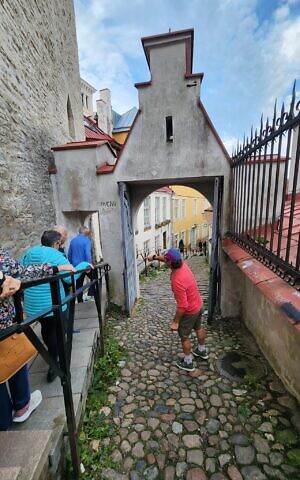
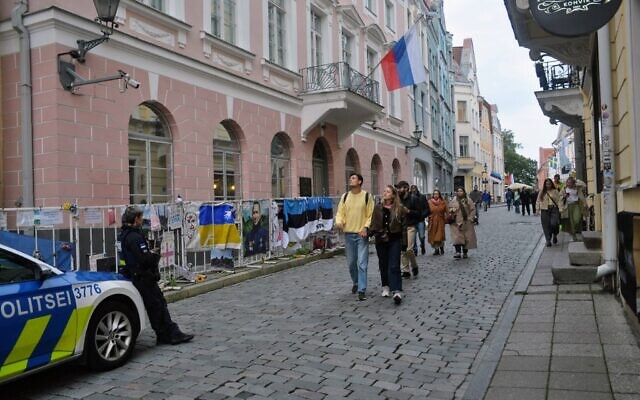
While walking Tallinn’s cobblestone streets and pointing to preserved medieval buildings, the fourth-generation Estonian delivered insights to travelers.
“I’m not teaching,” he said. “I’m just sharing what I have.”
Following freedom
Initial traces of Estonian Jewry date to the 14th century; however, Tallinn’s Jewish community mostly began 500 years later when Jewish men, plucked from their homes as children by the czarist army, relocated to the area. Referred to as cantonists, these military men could leave the Pale of Settlement and venture beyond the primary region of Jewish residence after conscription — around ages 12-13 — and successfully complete 25 years of service to the Russian empire.
Near the end of the 19th century, Tallinn’s tiny Jewish community grew. In 1883, a synagogue was built. Cultural and religious amenities, including the creation of a mikvah and schools, followed. By the eve of World War I, more than 1,000 Jews called the picturesque city home.
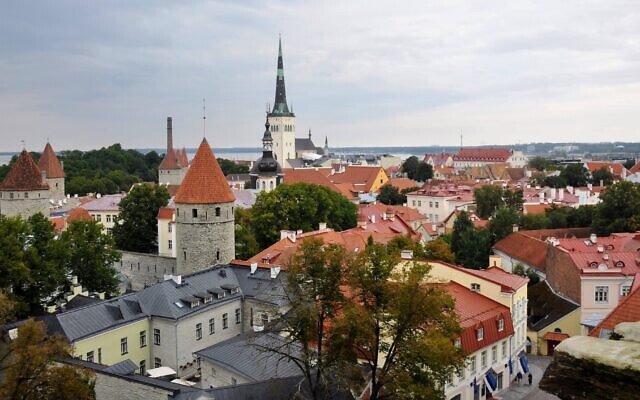
After declaring independence in 1918, and battles with German and Soviet forces, Estonia was autonomous from 1920-1940.
Still, Shlick said, Estonians, whose population approached 1 million, were “mostly never in control of their own lives.”
In June 1940, Soviets occupied Estonia. Jewish institutions were disbanded. At least half the country’s 4,500 Jews fled, according to the U.S. Holocaust Memorial Museum. Those who remained were terrorized. Between June 13 to 30, 1941, 400 Jews (almost 10% of Estonia’s Jewish population) were deported. The group was among 10,000 Estonians — nearly a quarter of whom were under 16 years old — sent to Siberian prisons and other Soviet sites.
Weeks later, Germany invaded Estonia. Jews were subjected to injustices, including confiscation of property, requisite donning of yellow stars and murder.
The totality of crime was confirmed in a beautiful Berlin suburb on Jan. 20, 1942, when high ranking Nazis and members of the Wannsee Conference declared Estonia Judenfrei (free of Jews).
After German occupation ended in the fall of 1944, Jewish members of the Soviet Army and other returnees to Estonia encountered an area of “total annihilation,” according to author Josef Katz. Gone were synagogues and earlier signs of Jewish life. Despite destruction, a demographic “oddity” arose: Estonia was the only European country whose post-war Jewish population surpassed pre-war totals. By 1959, 5,400 Jews called Estonia home.
Residence during post-war Soviet occupation afforded some aspects of survival. Jews could live relatively safely, but virtually all religious and cultural Jewish practices were forbidden.
We are the children
Standing inside the capital city’s Estonian Jewish Museum, a small third-floor space inside the Jewish Community Center, Aleksandr Zdankevitš, 40, chair of the Council of the Jewish Community of Estonia, recalled dichotomous childhood experiences.
“During the Soviet Union, we had no Jewish life here,” he said.
But in 1992, nearly a year after Estonia declared independence again and shortly after the Tallinn Jewish School reopened — founded in 1924, the institution shuttered during the Holocaust and post-war period — Zdankevitš enrolled.
Growing up in an environment with a functioning school and “established Jewish community” impacted him and his classmates, he continued. The directors and board members now driving Tallinn’s Jewish future represent a “generation who were born here” and experienced active Jewish engagement as “chanichim (students), madrichim (youth leaders) and youth directors.”
Echoing Zdankevitš sentiment, JCC director Irina Shlick said, “Me and my team, we all grew up in a Jewish environment.” Exposure to education, camping and community reaffirmed the need to further the model. “Passing the tradition through to the next generation is what’s important.”
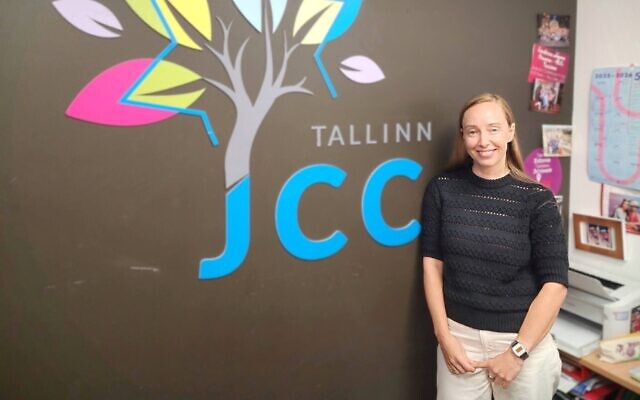
Shlick, 40, has worked in the Jewish world for 20 years. During that span she’s determined a recipe for sustainable community: continuous informal Jewish education.
With engagement rates “higher than anywhere else in the Baltic states,” the Jewish professional has data to back her beliefs. Estonia’s Jewish community has 2,134 members. Nearly 250 events are annually held. More than 1,000 adults participate. Within the JCC’s Youth Centre, weekly activities and camps welcome approximately 360 kids and teenagers. The nearby Tallinn Jewish School boasts 365 students, while Aviv, a private Jewish kindergarten, has 45 pupils.
Casual, constant, committed
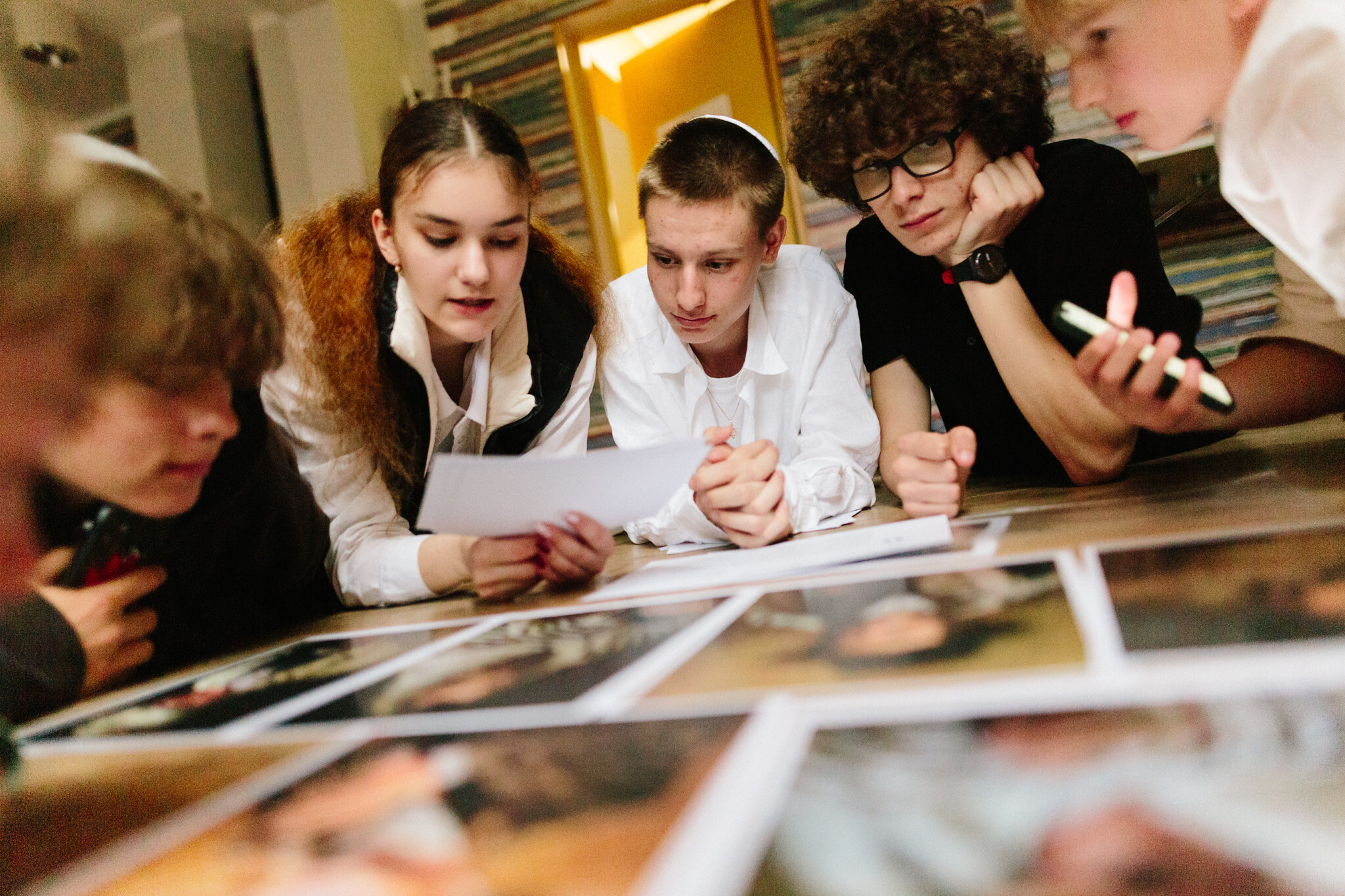
Unlike the rigidity of school, with its subject-based goals, or camp’s intermittent exposures, the JCC promotes yearlong “informal education” by cultivating layered Jewish involvement among Estonia’s youth.
With groups mostly bifurcated between children 7 to 12 and teens 13 to 18, there’s a predictable pathway for learning and leading.
Some of the youngest learners spend three hours each Sunday experiencing the Jewish calendar through cooking, Hebrew, arts, and play therapy with a psychologist, Shlick said.
These students represent the first stage in a stratified approach, explained youth director Mark Dorfman, 26. As children age, different opportunities exist. A new program for 10- to 13-year-olds pairs informal Jewish education with life skills. For older teens, several hours of weekly offerings probe Jewish topics and daily life.
Conversation, such as what to make of Yom Ha’Atzmaut amid the Israel-Hamas war, prompts questioning and growth, Dorfman explained.
Within the Centre, students are expected to support others. Older teens are tasked with disseminating knowledge to younger learners. But conveying information requires verbal competencies. Programming is largely delivered in Russian, with some reliance on Estonian and English.
Linguistic fluidity marks a push between past and present, Shlick said. The Estonian Jewish community was essentially “destroyed during World War II.” People who returned and tried to rebuild largely came from Belarus, Russia and Ukraine. Russian was their primary language. Today, most students use Estonian in school. Among JCC youth, about 80% speak Russian and Estonian.
While a polyglot society offers many benefits, difficulties emerge when children are unable to articulate their thoughts. In discussions conducted in Russian, for instance, a limited vocabulary can lead to communication barriers, Shlick continued.
Politics adds another dimension. Given Estonia’s proximity to Russia, many adults receive their news from Russian media; dialogue at home and at the JCC is consequently impacted.
“It’s complicated,” Shlick said. Recently, the JCC has welcomed “neutral specialists,” including journalists, who can “give a fair overview” of events. Other experts invited include mental health professionals.
So close and shofar
Each year, the JCC operates multiple weeklong camps. Largely led by teens, experiences require months of preparation. Post-pandemic, JCC staff (which totals four) noticed several difficulties.
“We had a huge amount of kids who just couldn’t communicate between themselves,” Shlick said.
Whether it was an inability to make eye contact or respond to social cues, interactions were amiss. Heading into camp, JCC staff asked a mental health professional to facilitate conversation.
That decision, Shlick said, proved doubly beneficial. Not only did the expert run ice breakers and youth programs, but she also held “private sessions if somebody just wanted to talk.”
At the time, much was on teens’ minds — camp began shortly after Russia invaded Ukraine.
In Estonia, some teens have Russian heritage; others come from families who’ve fled Ukraine. “There were conflicts from time to time. Kids would say hard stuff to each other,” Shlick said. Having a professional on site “helped us to work through that” and other challenges.
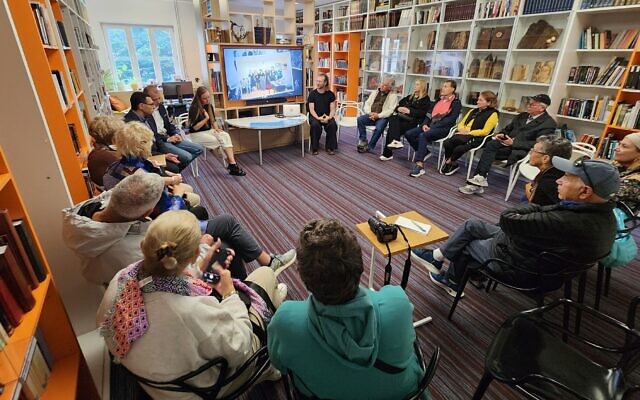
Shlick said the JCC strives to create a “safe” environment for children and parents. And though routine programming is focused on the young, ample opportunities for parent enrichment exists. Through its Jewish Parents Academy, Shabbat and holiday-related gatherings, the JCC provides multiple venues to discuss child-raising, educational concerns or meaningful ways to celebrate Judaism.
Longtime educator and CWB founder and executive director Tsipy Gur applauded the Estonians’ efforts. Along with commending staffers and lay leaders for rearing another generation of Jews, she praised Rabbi Efraim Shmuel Kot and “Beit Bella,” a modern synagogue, with 150 members, adjacent to the JCC.
Speaking with CWB travelers, Kot likened Estonia’s Jewish community to the shape of a shofar: “It started out narrow, but step-by-step it’s growing.”
Authoring our story
With an inability to gather and operate routine programming during the pandemic, Shlick and colleagues recommitted to reaching the young. JCC professionals created pamphlets, papers, even coloring books, containing infographics about Jewish practices.
“We’re design freaks,” Shlick said with a laugh.
The purpose was to help users understand holidays, traditions and prayers through accessible materials. “They would be interesting for kids, because they’re colorful, and fast and easy for parents, because you don’t need to think that much.”
Initial copies were printed in Russian. Estonian versions followed.
Another booklet, which Shlick shared before CWB travelers departed, was titled “Jewish Tallinn.”
Complete with photos, the text tells Estonia’s Jewish story. Starting with the cantonists’ arrival in the mid-19th century, journalists’ reports describe buildings and streets erected, traversed and celebrated by Tallinn’s Jews.
On the booklet’s last page is an image of an unassuming home. Beside the picture is written, “Nothing is Jewish about the past of this building … It is the present that counts. In 2013, kindergarten ‘Aviv’ of the Jewish Community of Estonia opened.”
After noting the school’s location, the text concludes: “This means there will be a Jewish future for this modest building and for all of us.” PJC
Adam Reinherz can be reached at areinherz@pittsburghjewishchronicle.org.
comments