
On the ground with the Daughters of Israel
A notice for the Daughters of Israel Cemetery Association prompts an expedition to the First Podolier Independent Society.
On a clear, humid day this summer, I visited the First Podolier Independent Society cemetery in Reserve Township, hoping to find traces of a short-lived and long-forgotten group called the Daughters of Israel Cemetery Association. According to several sources, the Daughters of Israel held permanent rights to a 16-by-100-foot section of the cemetery. The section had 25 plots with four burials between 1922 and 1931.
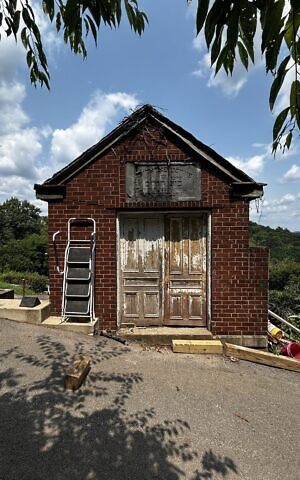
A private road passes in front of the cemetery for a few hundred feet. A caretaker’s house stands at the start of the road, followed by an unused “ohel” from the First Podolier Independent Society cemetery. A stone marker above the door honors the donors who underwrote construction of this small cemetery chapel in 1923.
I descended down some old concrete steps. Sunbaked moss crunched under my shoes, and mosquitos buzzed in my ears. I was looking for any small section set apart from the others, but every promising candidate had some disqualifying detail. Either the dates were wrong, or the names didn’t match, or there were too many graves, or too few.
I continued toward a clearing. It took me a moment to realize I had crossed into a different parcel of land. It turns out I had been wandering around the wrong cemetery.
* * *
Kether Torah Congregation started in 1907 as “Anshe Volynia,” a landsmanshaft for immigrants from the Volynia province of Ukraine. The group lifted its regional requirement around 1914 and renamed itself Kaiser Torah, meaning “Crown of Torah.”
A few years later, in May 1916, Kaiser Torah acquired 2.756 acres in Reserve Township from August Hoffman for $3,200. At the time, the land already had at least eight Jewish burials at its eastern edge. All eight were children under the age of 6. This is not uncommon at local Jewish cemeteries and might indicate some sort of private deal made between families of the recently deceased and an accommodating landowner.
In the summer of 1917, Kaiser Torah sold 0.6295 acres to the Daughters of Israel Cemetery Association for $900. Today, a line of trees separates the two cemeteries.
By the summer of 1917, the large Romanian Jewish population of the Hill District was divided between Oir Chudesh and Cneses Yisroel. Each had a synagogue and cemetery property. If the Daughters of Israel wanted to provide burials for the Romanian community, why not just use one of these existing burial grounds? If it wanted to provide burial for any Jew regardless of national origins, why not use the Chesed Shel Emes cemetery, which was created explicitly for families who could not afford burial costs?
Even odder, the Daughters of Israel did not bury anyone in its first four years owning the cemetery, at least not according to the dates on the legible graves. And the first burials were members of a different group, the First Podolier Independent Society.
* * *
Once I was properly oriented, I resumed my investigation. The First Podolier Independent Society cemetery sits on a hillside. I marched up and down its steps looking for some small, set-apart section of graves. My thighs ached, and my shirt grew damp.
I sat down on the steps to rest. On my phone, I pulled up the 1932 agreement between the First Podolier Independent Society and the Daughters of Israel Cemetery Association. It described a “piece of ground being 16 feet in width by 100 feet in length and containing 25 burial lots, of which four burial lots have already been occupied.”
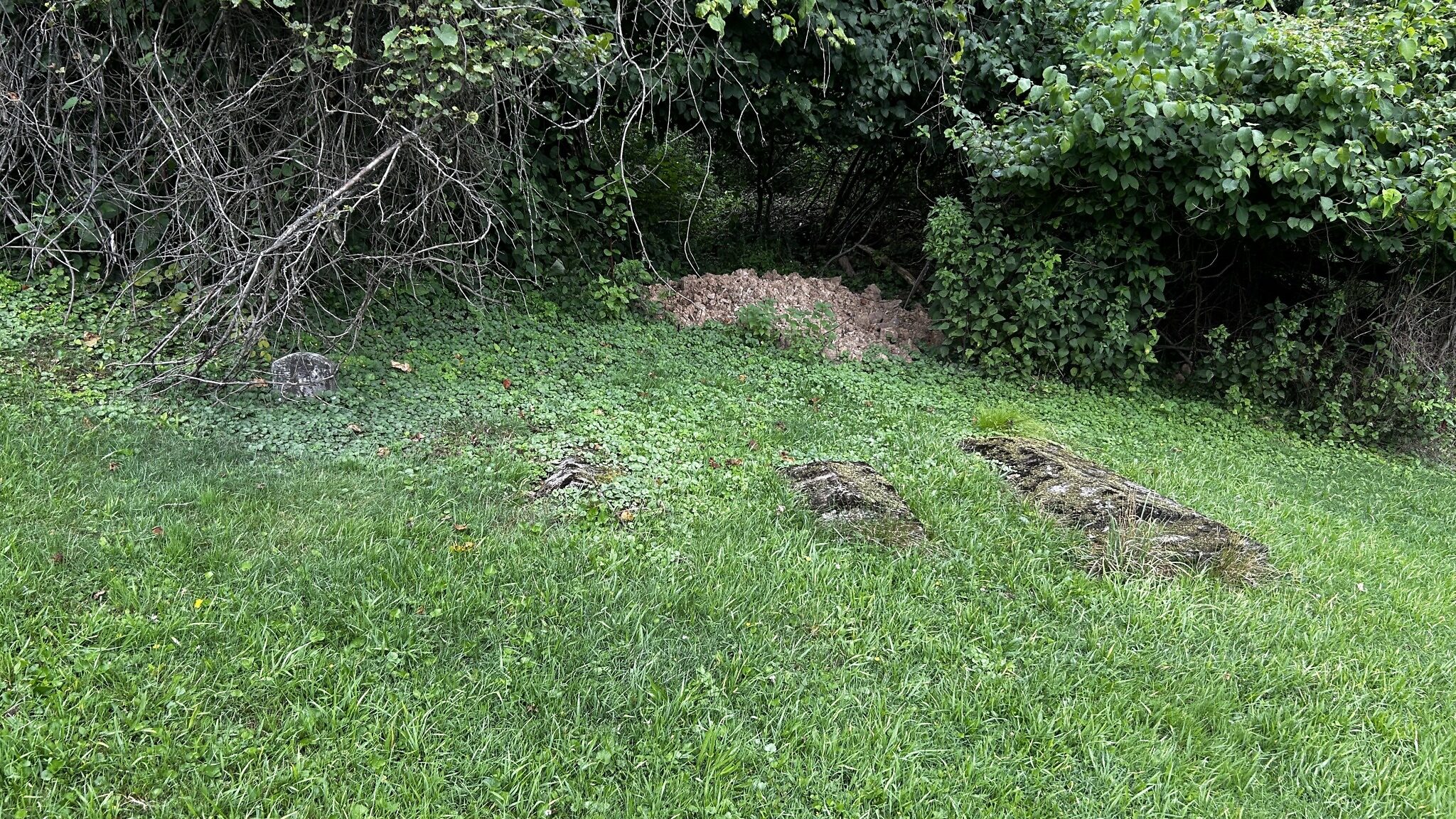
I was about to leave when something caught my eye. Toward the bottom of the hill, a few mounds of dirt hugged the edge of a clearing. I wandered over. They weren’t mounds. They were graves, covered in the same sunbaked moss covering the steps.
Standing at the edge of the cemetery, before the four unmarked graves, I felt certain I had found the remains of the Daughters of Israel cemetery. There was even a line of three stone markers separating these graves from all the others. I rushed back to my car for a tape measure. Standing at one end of the four graves, I lay the tape measure on the ground. It measured exactly 16 feet. The entire cemetery is 100 feet wide.
* * *
All the details matched, and yet, I was wrong.
Charles and Ethel Finesman oversaw the First Podolier Independent Society cemetery for years and were buried there. Then it passed to their daughter and son-in-law Evelyn and Macy Levine, who were also buried there. Responsibility went to their son Paul. Since 2023, the Jewish Cemetery and Burial Association has managed the grounds.
When I was sharing all my research with Paul Levine the other day, he remembered that he still had an old map of the cemetery. It was created in 1934, a few years after the First Podolier Independent Society resolved its issues with the Daughters of Israel. The map marked 12 sections, each filled with rows of roughly uniform plots.
The map showed the unmarked graves I had found. And then, on the other side of the cemetery, along the boundary with the old Kether Torah cemetery, was a strip labeled “Daughters of Israel.” Instead of 25 plots with four burials, it listed 52 plots with three burials — a husband, his wife and his sister-in-law, buried between 1927 and 1930.
* * *
In talking with Paul Levine, he presented a new mystery. According to family lore, he said, the First Podolier Independent Society had to acquire its cemetery through a judge because the original landowner refused to sell the property to Jews. This didn’t make sense, since the organization had purchased the property directly from fellow Jews.
And so, hoping to make sense of it all, I trekked back downtown to the County Records Office to try and get a better understanding the history of the property.
NOTE: This is the second of a three-part series. In the final part, we unravel the complex sequence of events leading to the creation of the Podolier cemetery. PJC
Eric Lidji is the director of the Rauh Jewish Archives at the Heinz History Center and can be reached at rjarchives@heinzhistorycenter.org or 412-454-6406.
comments