
University of Pittsburgh, Working Group on Antisemitism push back on criticism
The university called it categorically false “that Jewish members of our Pitt community — and especially Jewish students — did not have their perspectives included."
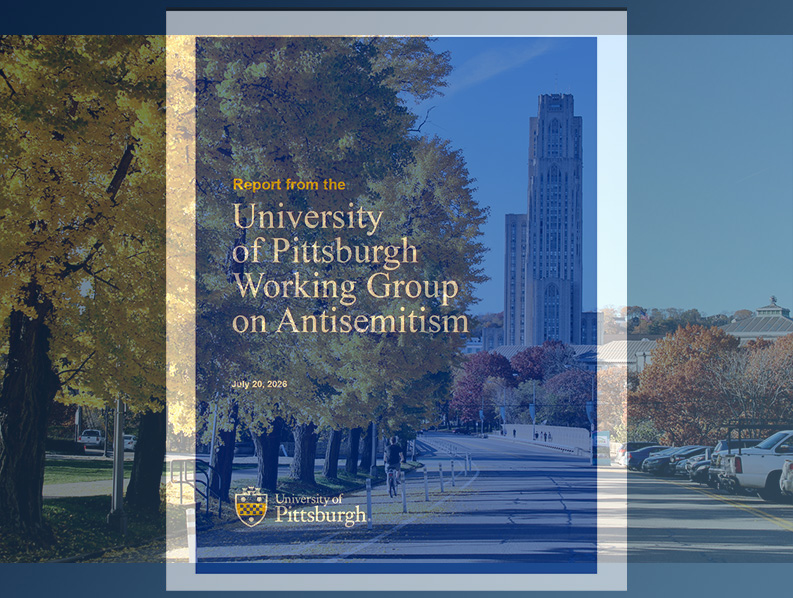
The University of Pittsburgh and members of its Working Group on Antisemitism have pushed back on allegations — published in a Jewish Telegraphic Agency story earlier this month — that the group didn’t speak with Jewish students before issuing its final report in late July.
“We certainly spoke to Jewish members of the Pitt campus community, including Jewish students,” Kathleen Blee, chair of the university’s Working Group on Antisemitism told the Chronicle. “Additionally, almost all members of Working Group, which had Pitt students, faculty, and staff from Pitt, were Jewish.”
Working group member Jennifer Murtazashvili agreed.
“I was put on the committee because of my knowledge and work with Pitt’s Jewish students,” Murtazashvili said. “I had been interviewing Jewish students for a year-and-a-half.”
In fact, Murtazashvili’s conversations date back to a time before Pitt’s Chancellor Joan Gabel created the working group.
In November 2024, the university’s Faculty Assembly voted to create its own ad hoc committee, co-chaired by Murtazashvili, tasked with examining antisemitism on campus.
Murtazashvili, director of the university’s Center for Governance and Markets, began the committee’s work, talking directly to stakeholders — included Jewish students, faculty and staff.
A month later, Gabel created the working group that would be chaired by Blee, a distinguished professor of sociology at the university.
The report produced by the group contains a list of recommendations for the university. What it didn’t include was a list of individuals or groups with whom group members spoke.
Blee said the group agreed to keep its workings confidential.
Part of the reason for not releasing data produced by the group was to keep the focus on antisemitism that occurred on the campus and how that was experienced by the students, faculty and staff, Murtazashvili said.
She noted that the group looked at other universities’ working groups and spoke with numerous organizations, including the American Jewish Committee, which provided guidance to the group and suggested it focus on the experience of students on campus.
Three Jewish Pitt students were attacked in 2024 in two separate incidents, each attack containing elements of antisemitism, and the university has been a hotbed of anti-Israel activity, including an encampment that lasted several days that led to the arrest of several participants, some of whom were not affiliated with the university.
Rather than focus on Israel or the political headwinds blowing, the Working Group said in its report that it covered, “procedures, programs, and support systems related to combating antisemitism and … options for improving their development, implementation, or enforcement, if necessary.”
The recommendations fell into five broad categories: institutional capacity to respond to antisemitism; institutional policies; training, education and contextual understanding; incident response and enforcement mechanisms; and external events and off-campus influences.
More than a month after the release of the report some Pitt faculty members criticized it, citing worries over shared governance and academic freedom as their primary concerns.
Blee said she doesn’t share those concerns. She noted that academic freedom is addressed four times in the report, including adopting language for “all relevant faculty modeled after the University of Pittsburgh’s Faculty Collective Bargaining Agreement,” that states, “Faculty members are entitled to speak and write as private citizens, free from institutional censorship or discipline, but as scholars and educators they should at all times be accurate, exercise appropriate restraint, and show respect for the opinions of others … ”
In a video released on social media, Chadad House on Campus at Pitt Director Rabbi Shmuel Rothstein took issue with the JTA story.
Rothstein said he is in contact with almost all Working Group members and noted that both he and his board of Jewish students took umbrage with the story.
The rabbi went bemoaned the fact that the JTA story was shared by other news sources.
His recommendation was simple: “Do better,” he said.
The university also has taken issue with the JTA story, calling it “categorically false” to assert “that Jewish members of our Pitt community — and especially Jewish students — did not have their perspectives included as part of the Working Group on Antisemitism’s process and final report.”
“To the contrary, the Working Group worked to ensure that a wide spectrum of voices, perspectives, and lived experiences, including those of undergraduate, graduate, and professional students on campus, were represented in the recommendations of the final report. We firmly stand by the report’s recommendations and the Working Group’s process, and we are disappointed by any reports or assertions that misrepresent the group’s hard work,” Pitt spokesperson Jared Stonesifer told the Chronicle in an email.
Several days after the initial story, JTA published a follow-up article, writing that, “A spokesman for the University of Pittsburgh now says the school’s campus antisemitism working group did speak to at least some Jewish students and community members beyond those in the group itself before issuing its recommendations.”
In fact, Stonesifer told the JTA that “the working group included two Jewish students. One of those students, however, graduated prior to the report’s release, and their name does not appear on the finished report.”
Pitt’s Working Group on Antisemitism’s final report can be read at Here. PJC
David Rullo can be reached at drullo@pittsburghjewishchronicle.org.
comments