
Experts unpack Israeli elections at JCC program
“Dialogue is the opportunity to get dangerously involved with one another.”
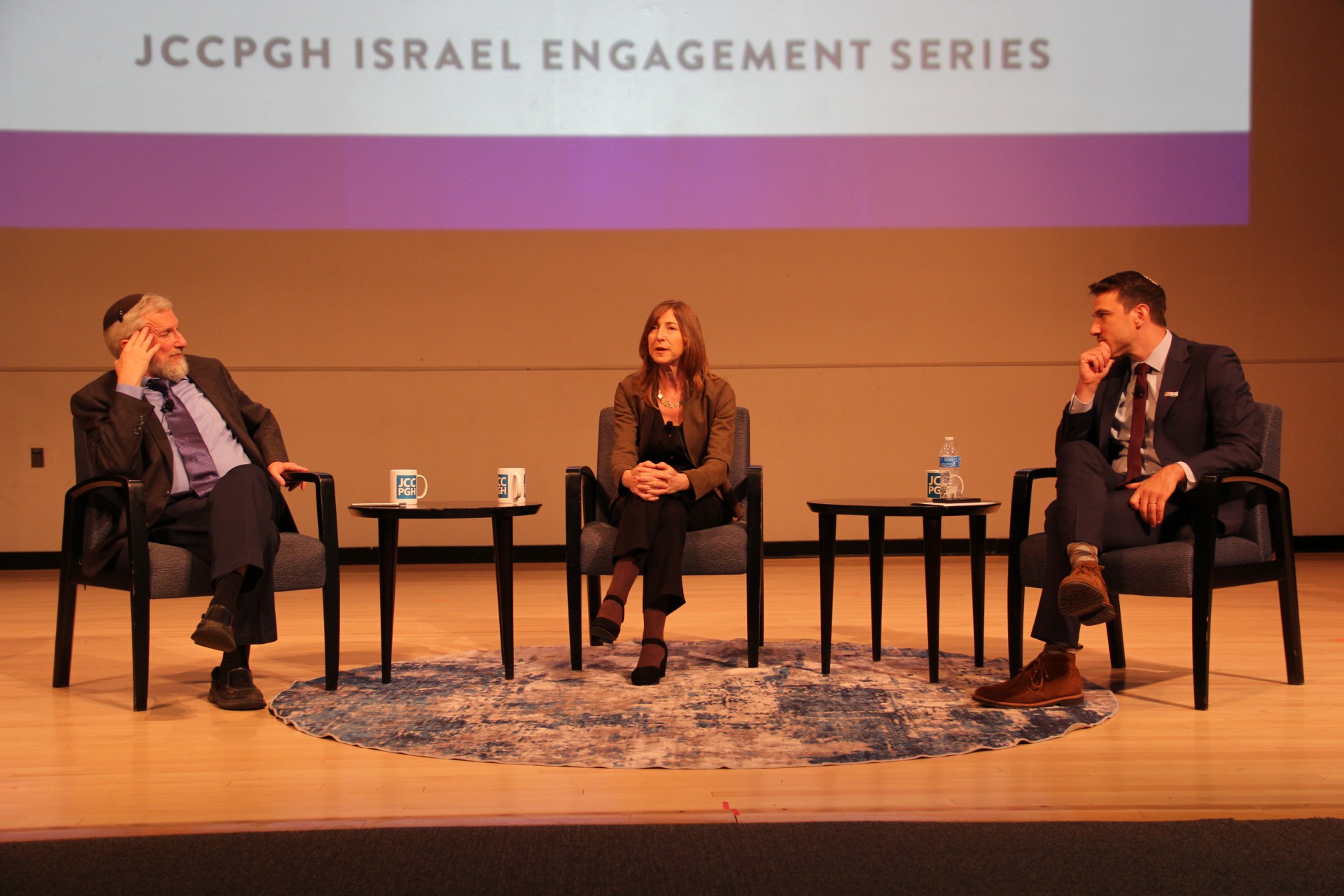
The Jewish Community Center of Greater Pittsburgh’s “Come Curious. Leave Wiser” series continued on Nov. 2 with a conversation between Moshe Koppel and Dahlia Scheindlin, drawing more than 200 attendees.
Moderated by Yisrael Klitsner, Koppel and Scheindlin debated the Oct. 27 Israeli elections, and the political, social and ideological currents shaping the Jewish state’s future.
Jason Kunzman, president and CEO of the JCC, opened the evening by recalling the words of Rabbi Abraham Joshua Heschel: “Dialogue is the opportunity to get dangerously involved with one another.”
The conversation, Kunzman said, should not be interpreted as the JCC endorsing any political candidate, policy or viewpoint; rather, it was a search for “points of commonality and to engage in meaningful conversation.”
Before Koppel and Scheindlin addressed the audience, Klitsner said that many had described the recent Israeli elections as “the most historic” since the founding of the state in 1948. He noted these were the first elections held since Hamas’ terrorist attack on Oct. 7, 2023.
“Israelis leaned in en masse,” Klitsner said. “To me, that signaled that there is real buy-in to trying to shape Israel in a way that individuals see, be that on the left or the right.”
Scheindlin is a political strategist and public opinion researcher whose writings often appear in the left-leaning Haaretz. Typically, she said, anytime Israel is attacked, the Jewish Israeli electorate moves to the right. Approximately 60% of Jewish Israelis defined themselves as right-wing before Oct. 7; she had expected that number to rise to 70-80% in the most recent election.
The numbers shifted, she said, but by a smaller percentage than she predicted.
And while Israeli Prime Minister Benjamin Netanyahu lost numbers in the Knesset — he had about 64 seats in the 120-seat parliament in the last election; this time he has 53 — she said most of that drop occurred at the end of December 2022, when the government announced a package of judicial reforms that triggered demonstrations against them.
“Whatever people thought of the government’s failure to detect, prevent and respond to Oct. 7, or whether they were critical of how Israel waged war since then, and for anything else the government has done — whether that is the Qatar scandal, or how much the prime minister knew about the warnings, or how long it took him to get to a ceasefire agreement to release the hostages — all of those things filtered through what they already thought,” she said.
Koppel, founder of the Kohelet Policy Forum and one of the chief architects of the judicial reforms to which Scheindlin referred, explained the differences between the Israeli and the U.S. political systems.
In the U.S., Democrats and Republicans spend much of an election cycle focused on getting the moderate, centrist vote; and the party that receives the most votes in any race wins, he said.
In Israel, a party is required to receive more than 3% of the vote to get a seat in the Knesset.
“If a particular party gets 10% of the vote, they get 10% of the seats,” he said.
The result: Political parties in Israel aren’t interested in capturing votes from differing viewpoints, but instead simply volley for the most votes in their political ideological spectrum.
“This creates a particularly different dynamic,” he said. “The result is that you get parties all over the spectrum, and now you need to somehow make a coalition.”
The pair discussed the immediate impact of Netanyahu’s policies and his messaging during the election, before the conversation shifted to discussing the 2023 judicial reforms that kicked off widespread protests — both in Israel and the United States.
Koppel explained why he felt reforms were needed, including reining in an “unfettered” judicial branch that was able to not simply make rulings on law but create them, as well.
Scheindlin disagreed, noting that in many parts of Israeli society, there is a belief that the executive branch of the government already has too much power.
The evening concluded with a question-and-answer period.
While the crowd inside the JCC was eager to engage with the speakers, fewer than two dozen protesters gathered at the corner of Forbes and Murray avenues shortly before the program began, objecting to the event and to the participation of Klitsner, who has served in the Israel Defense Forces and worked with the pro-Israel lobby AIPAC.
The protestors, saying that they were “fighting for freedom,” shouted lies about Israel, including that the Jewish state makes a habit of kidnapping Palestinian children in their pajamas, whisking them away from their parents in the dead of night.
For Kunzman, the protests are anathema to the purpose of the JCC’s “Come Curious. Leave Wiser” series.
“I think it would behoove not only those who gathered to protest but anyone else to come inside and listen, and be exposed to something other than just the headlines or a scroll in a social media feed,” he said.
The series, Kunzman said, is an opportunity for people to challenge long-held assumptions and beliefs because, he said, “it’s an ever-changing world.”
And that is the point of the series, he stressed: creating “brave spaces” for challenging conversations.
“We have lost our ability to sit in a room and respectfully disagree,” Kunzman said. “Instead, we dig in our heels and insist that we are right. We don’t practice resilient listening, which is, ‘I don’t like what I’m hearing, but I’m going to keep listening so I can better understand what is being said, and can respond in a well-informed manner.’”
He hopes the series can use Israel as a “learning laboratory to rebuild the communal muscle of civil discourse.”
The next conversation in the “Come Curious. Leave Wiser” series takes place Dec. 2 and will include Oded Revivi, former mayor of Efrat and international spokesperson for the YESHA Council, and Yariv Oppenheimer, former director of Peace Now, discussing “The West Bank Settlements — Is There a Path?” PJC
David Rullo can be reached at drullo@pittsburghjewishchronicle.org.
comments