
Dutch mayor intervenes over canceled synagogue exhibit
Amersfoort's Jewish community is optimistic the exhibition will go ahead but rejects any compromise that moves it outside the city-funded museum.
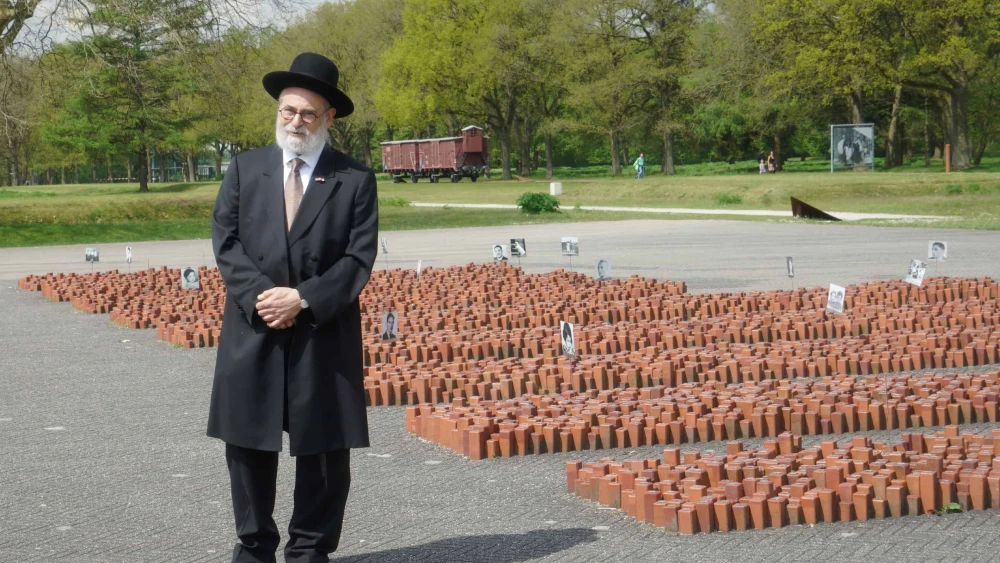
A Dutch mayor has intervened against a museum’s cancellation of an exhibition about a synagogue in Amersfoort, prompting local Jews to express cautious optimism that the event would be held as planned.
“I expect that in a few weeks, after we’ve had these discussions, I’ll be able to bring positive news that the exhibition will take place at Museum Amersfoort after all,” Alexander van Dijkhuizen, chairman of the Jewish Community of Amersfoort, told JNS on Tuesday, days after Mayor Lucas Bolsius vowed to try to reverse the cancellation. Dutch Chief Rabbi Binyomin Jacobs, who lives in Amersfoort, said the outcome of talks was unclear but added he was “optimistic.”
The controversy began earlier this month in Amersfoort, a city of some 160,000 residents east of Amsterdam. The local historical museum, which the city funds, announced it was canceling the exhibition, titled “300 Years Amersfoort Shul,” which was scheduled to open ahead of the synagogue’s 300th anniversary in February.
Museum Director Paul Baltus told the Dutch newspaper AD that the institution had canceled the exhibition because of “tensions following Oct. 7, 2023,” referring to the Hamas-led attack on Israel and the subsequent war in Gaza. “As a small, vulnerable organization, I do not want to subject my people to that,” Baltus said, referring to possible hostile reactions toward museum volunteers.
“Of course, you can deploy security guards or install cameras, but the fact remains that our volunteers have to deal with all kinds of possible reactions,” he added.
According to van Dijkhuizen, Mayor Bolsius told council members he disagreed with the cancellation and would approach museum officials to ensure the exhibition could proceed.
The mayor met with museum representatives the following day, Nov. 5, and agreed to arrange talks involving the museum, the Jewish community and the municipality.
“The mayor intervened because the museum no longer wanted to speak with us. They said, ‘We’re not going to do it. Period,’” van Dijkhuizen said.
The municipality has since appointed someone to coordinate the discussions, although no date has been set for the meeting.
The local Jewish community, to which Jacobs, the rabbi and his wife, Blume Jacobs, have belonged to for many years, will insist that the exhibition be held in the museum and not at any alternative location, the rabbi and van Dijkhuizen both told JNS.
“If the solution is to move the exhibition, that’s no solution at all,” Jacobs told JNS. “That’s tantamount to saying Jews are allowed to be in some places and not in others.”
“The only solution is for the exhibition to take place in the museum,” van Dijkhuizen said.
The decision to cancel drew criticism from Jewish leaders, who accused the museum of excluding Jewish history because of political tensions surrounding Israel.
Ronny Naftaniel, a former leader of the Netherlands’ Central Jewish Board, described the decision as “cowardly.” A Dutch organization combating antisemitism, STITS, also filed a complaint against the museum with the Ethics Commission for Museums.
Van Dijkhuizen said the dispute reflected a broader pattern in which Jewish events and institutions were increasingly being pushed out of public spaces because of hostility toward Israel.
“Where we initially faced the cancellation of everything connected to Israel, we are now reaching the point where everything connected to Jews is being canceled,” he said.
“That is why I will never agree to holding the exhibition outside the museum. I will not allow our Jewish community to be marginalized.”
He also criticized Dutch authorities for failing to enforce public-order regulations at demonstrations, despite repeated appeals from Jewish community representatives.
“Politicians say a lot but do little,” he said. “You can make as many laws as you want and say as many things as you want, but ultimately you have to enforce them. Otherwise, they’re meaningless.”
Van Dijkhuizen said the Jewish community had received numerous expressions of support from individuals and organizations following publicity surrounding the cancellation.
The controversy follows several disputes involving Jewish and Israeli cultural events in the Netherlands.
In May, administrators of a prestigious Dutch retirement home canceled a concert by Lenny Kuhr, a Jewish singer-songwriter who won the 1969 Eurovision Song Contest, after anti-Israel activists protested at one of her previous performances.
Last year, Amsterdam’s Royal Concert Hall announced the cancellation of a Chanukah concert because one of the performers was an Israeli military reservist. The institution reversed the decision following a threat of legal action.
Earlier, Dutch singer Bob Douwe withdrew from a Jewish event, citing what he described as “expressions of Zionism.” PJC
comments