
Eisenkot exerts control over the Knesset, seeks to undo Netanyahu’s judicial reform
Change bloc sees legislative blitz as essential to Israeli democracy, while PM’s ally calls it a political power grab.
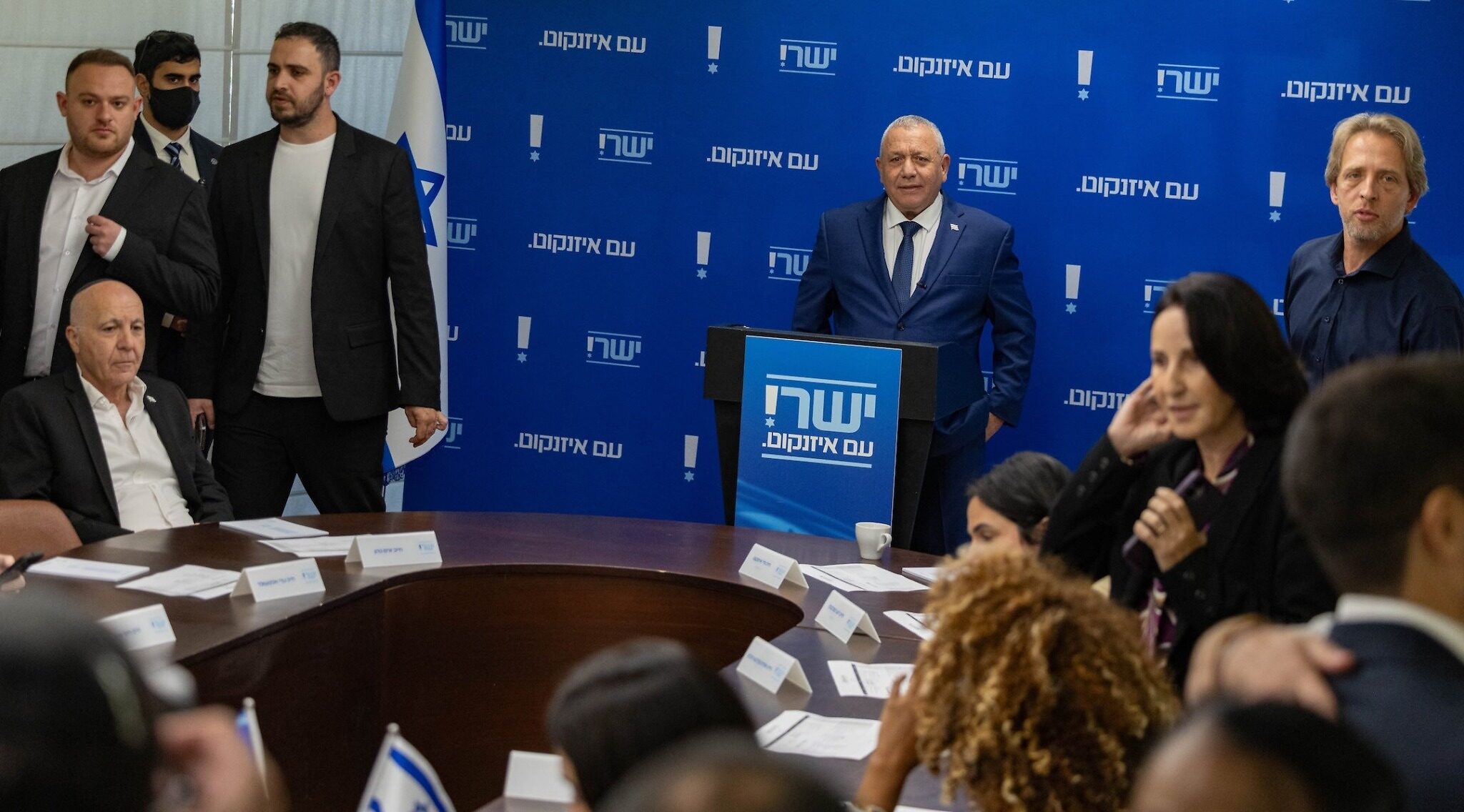
(JTA) — Yashar leader Gadi Eisenkot is not yet prime minister, but he is already using his power as the favored candidate of the majority of Knesset members to tackle a topic that preoccupies Israelis and American Jews: the state of Israeli democracy.
Eisenkot, who has at least until Dec. 6 under his initial mandate to form a government in the aftermath of Israel’s Oct. 27 election, has yet to clear a path to replacing Prime Minister Benjamin Netanyahu. Should he fail, Netanyahu would likely be given the option to form a government.
But during this period, there is an unusual balance of political forces in Israel. Netanyahu remains prime minister with a lame duck government, while Eisenkot informally controls a bloc of 67 legislators out of the 120-member Knesset, a situation that places him in an unusually powerful position.
That gives Eisenkot a chance to act on one of his bloc’s campaign promises before a government is formed by moving to undo Netanyahu’s judicial reform program, which was controversial both in Israel and in the Diaspora. Its proponents saw it as an essential plan to preserve Israeli democracy, while its opponents believed it would transform Israeli democracy into an autocracy.
To push the issue forward, the opposition “change” bloc named lawmaker Gilad Kariv of the left-wing Democrats Party to chair a special Knesset committee charged with repealing the judicial overhaul legislation.
“For four years, we fought in the Constitution Committee, in the Knesset and above all in the streets, against a series of laws that threatened to destroy Israeli democracy,” Kariv said in an interview with the Jewish Telegraphic Agency on Sunday, alluding to the weekly Saturday night mass protests that drew hundreds of thousands into the streets and attracted the support of many American Jews, including major mainstream groups.
“Repealing those laws is one of our most important commitments to voters, and one of my most important personal commitments. I am determined to see it through,” he added.
Dr. Guy Lurie, a research fellow at the Israel Democracy Institute, described the decision to move quickly to repeal legislation as soon as the Knesset convened, even before a government had been formed, as an “unusual act” on the part of Eisenkot and his political allies, known as the “change bloc.”
They view Netanyahu’s judicial reform plan as “catastrophic for the future of Israeli democracy. And so they want to prevent this catastrophe from happening,” he told JTA.
In a statement earlier this month, Yashar identified six laws it intends to repeal, only some of which fall within the scope of Kariv’s committee. All six were passed by the previous Netanyahu-controlled Knesset as part of the judicial overhaul.
The judicial reform legislation included laws weakening the authority of the attorney general, changing the process of appointing judges, transforming the regulation of media organizations in ways critics said would weaken a free press and overhauling the operations of the Police Internal Investigations Department.
Kariv told JTA that the change bloc’s top legislative priorities include repealing the laws that sought to overhaul the judicial selection process, weaken the institution of the attorney general and place the Police Internal Investigations Department under political control.
Simcha Rothman of the Religious Zionist Party, one of the architects of the judicial overhaul program, criticized the change bloc’s attempt to rush through the repeal of the laws before a new government has been formed.
He said the “speed and urgency” with which the bloc was moving to repeal the legislation, before a government had been sworn in and the Knesset’s permanent committees had been established, showed that “they are not acting with sound judgment — they are acting out of hysteria, frenzy and in a legislative blitz.”
The speed of the process showed that it was a “political power grab for election purposes,” said Rothman, who is aligned with Netanyahu’s bloc. “They accused us of doing things quickly and in a power grab, but we passed the laws over the course of a year, while they are doing it in a week or two. By any standard, they are not doing things right,” Rothman said.
Kariv explained the urgency, saying that the judicial reform laws he is prioritizing reviewing “are set to take practical effect within the coming weeks, making it imperative to repeal them now to prevent legal and operational instability in Israel’s judicial and law enforcement systems.”
Lurie said the laws targeted by the change bloc that are set to take effect very soon include those weakening the attorney general’s powers, changing the operations of the Police Internal Investigations Department and altering the process for appointing judges.
Rothman warned that the speed of the changes could set a damaging precedent for the Knesset. “Once you have a temporary majority in the Knesset, you push through a blitz of legislation repealing the previous government’s laws. That will become the norm in the Knesset. It will turn the Knesset into a farce. This is not serious lawmaking, and it will further undermine the standing of the Knesset and its laws,” he said.
On the substance of the legislation, he added: “If they pass laws that return the judicial system to its dark days of backroom deals with the Israel Bar Association and a system of personal connections, they will do great damage to the State of Israel.” The bar had a determinative say in naming judges; Rothman sought to increase the involvement of political parties in the appointments.
Lurie said the change bloc believes these laws “will be very harmful for the checks and balances of the Israeli regime.” He described the legislation targeted by the bloc as the most important institutional changes enacted as part of the judicial overhaul.
“The assumption is that they can undo these changes right now in a quick fashion, in a matter of a few weeks, simply because it should just return to the status quo,” Lurie said.
Other laws passed as part of the overhaul, however, are not currently among the bloc’s immediate priorities, Lurie noted. These include legislation allowing gender segregation in Israeli academia and a law expanding the authority of rabbinical courts, both of which critics say undermine individual rights.
Kariv said that “There are many other laws that do not carry the same immediate urgency in terms of timing, and we will repeal them after a new government is formed. These include laws expanding the powers of the rabbinical courts, among others.”
If a new government ultimately fails to materialize, it will become much harder for the change bloc to use its parliamentary majority to reverse the legislation, Lurie said. Changing laws in the wake of the failure to form a government would break with parliamentary convention and would lack the same public mandate during an election period.
Beyond repealing the judicial overhaul legislation, the change bloc has also pledged to advance two other campaign promises: establishing a state commission of inquiry into the Oct. 7, 2023, Hamas attacks and imposing a term limit on the prime minister.
The latter is unlikely to affect Netanyahu in the immediate term, as any legislation seeking to apply the limit to him retroactively is expected to face significant legal challenges. Netanyahu has already served 19 years as prime minister in his political career.
Eisenkot can move forward on the legislation in part because parliamentarians from the change bloc voted in a Knesset speaker from the Yashar party, Matan Kahana, replacing Amir Ohana of Netanyahu’s Likud party. It’s a move that will make it easier for the change bloc to pass and advance legislation.
But moving forward with the bills will require the bloc to make political choices that could come at a significant cost.
The four Zionist parties in the change bloc hold 48 seats in the 120-member Knesset. The Arab parties, which also oppose Netanyahu and could support repealing the legislation, hold another 19 seats. Netanyahu’s coalition has 53 seats, including seven held by the ultra-Orthodox United Torah Judaism party, which has signaled a willingness to switch sides and cooperate with the change bloc instead of the Likud.
To pass the legislation, Eisenkot will need to secure the support of either the ultra-Orthodox lawmakers or the Arab parties, a decision that could carry a heavy political price with those who oppose Yashar aligning with either group. If Eisenkot succeeds, it would represent a major political victory for the change bloc — and an encouraging sign of the possibility of forming a new government in Israel.
Rothman, for his part, vowed that the opposition would not make it easy for the change bloc to advance its legislation. “We won’t make their lives easy. We won’t let them run wild,” he said. PJC
comments