
State trooper visits CDS to discuss Roblox and online safety for children
'I wish many parents knew about this — that we understood what our kids were engaging with and the potential harm that they might experience'
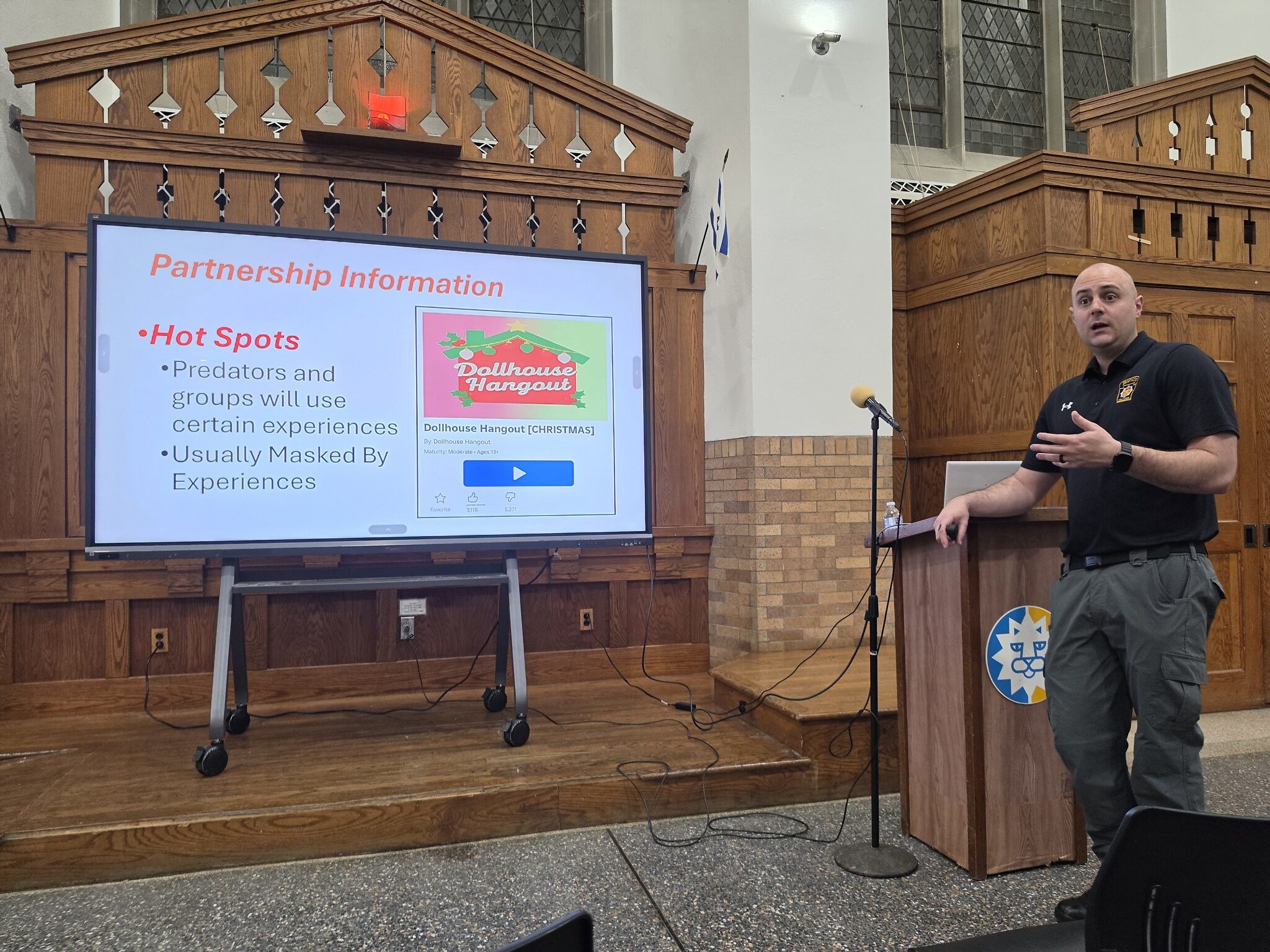
One day after a congressional subcommittee explored safety risks associated with Roblox, an online gaming platform often used by young children and teenagers, a Pennsylvania State Trooper articulated similar concerns during a Nov. 18 program at Community Day School.
Trooper Rocco Gagliardi told attendees he’s spent nearly two years researching the platform and that he was greatly interested in the Nov. 17 senate meeting concerning bipartisan legislation introduced by Republican senator Josh Hawley and Democratic senator Dick Durbin.
The No Forced Arbitration for Child Sexual Exploitation and Cyber Injuries Act, if passed, would allow families of victims to sue Roblox directly; currently, the platform’s terms of service require parties to settle claims privately in arbitration.
While legislation could change user-experience outcomes, parents simply need to know more about their children’s actions online, Gagliardi said.
For nearly an hour, the state trooper highlighted various scenarios children encounter on Roblox, a platform registering more than 135 million daily users.
Whether it’s sexually explicit avatars or games encouraging users to become active-shooters, the platform possesses elements parents must be aware of, Gagliardi said. Also of note, he continued, is that although many Roblox users purport to be children that’s not always the case.
The reason why predators enjoy the platform is because “they get gifted the catfishing ability to look like everyone else,” Gagliardi said “I remember law enforcement buddies for years kept saying, ‘Why are you dealing with this kids’ game?’ I said, ‘Well, because it’s not a kids’ game. It’s much more than that.’”
Even despite the platform’s repeated use of colorful cartoonish imagery, parents and community leaders need to take a closer look, he said.
In an effort to demonstrate how bad actors manipulate the platform, Gagliardi pointed to Robux, the virtual currency used to personalize avatars and unlock extra features within Roblox. Although parents are theoretically providing money for children to purchase Robux, “one of the best predator attacks is gifting or exchanging photos for the in-game currency.”
Gagliardi said it’s essential for parents to monitor children’s digital wallets. If a child’s currency holdings have suddenly increased, “You can really start to play detective and say, ‘Where’d you get all this Robux from?’
Another thing to look for, he said, are the letters RP. “Parents don’t even know what RP stands for, but for everyone else and the predators, that stands for ‘role play.’ They want to role play with your children. They want to bond with your children, and they want to get them out [of the platform] and start doing other things that can be considered role play, but to the predator’s benefit.”
Gagliardi described incidents in which predators met children on the platform and moved discussions to other digital fora, including Snapchat, TikTok and Discord by promising children “free codes for free stuff.”
These predators, he said, “want to actually talk to your child, and or they want to see your child. They want video, photo, video calls with your children.”
The ultimate goal for predators, he continued, is to encourage children to send compromising images and or to have children inflict harm on themselves and others.
“It’s no longer the creepy guy in the van trying to lure you with candy. It’s these people sitting behind computers, and they’ve been untouched for years, untouched, [and] they’re going to keep attacking before something happens,” Gagliardi said.
Wednesday’s talk was the 99th presentation Gagliardi has given since March, he said.
The discussions are part of a statewide program to “educate families about emerging technology, the risks of online gaming and the critical precautions to take to ensure their children can enjoy the internet safely,” according to Pennsylvania State Police.
At the end of each discussion, Gagliardi said he reiterates that he can’t tell parents to “go home and delete the game. We can’t do that. But what we want to say is whether you want more of the game or less of the game. Hopefully, we’ve shown you enough tonight to make the appropriate decisions on how to protect your child.”
Squirrel Hill resident and parent Lilith Bailey-Kroll praised the program for identifying numerous risks children and families unknowingly face.
“I wish many parents knew about this — that we understood what our kids were engaging with and the potential harm that they might experience,” she said.
Vicky Butch, chief of security at Community Day School agreed and said, “I just wish more parents knew what was out there.”
Even given more than 30 years of experience working in the City of Pittsburgh, whether as law enforcement or in other capacities, “this is eye-opening for me,” she said. “The amount of work that Trooper Gagliardi did to bring this to light is fantastic, and I hope more people join in as he goes along in his fight.”
Despite having delivered 99 presentations on the topic, Gagliardi said the work is nowhere near complete.
What’s important for parents and community leaders to know, is “you’re the next step in this program, he said. Reach out to legislators and demand action: “If you want to help me in my journey to help protect children, you guys are the next vocal step on that.” PJC
Adam Reinherz can be reached at areinherz@pittsburghjewishchronicle.org.
comments