
A wartime hack becomes an educational tool: Meet Yuvi
Created by an army reservist, YuviLab has grown into a platform reaching tens of thousands of children and bringing personalized AI learning into Israeli classrooms.
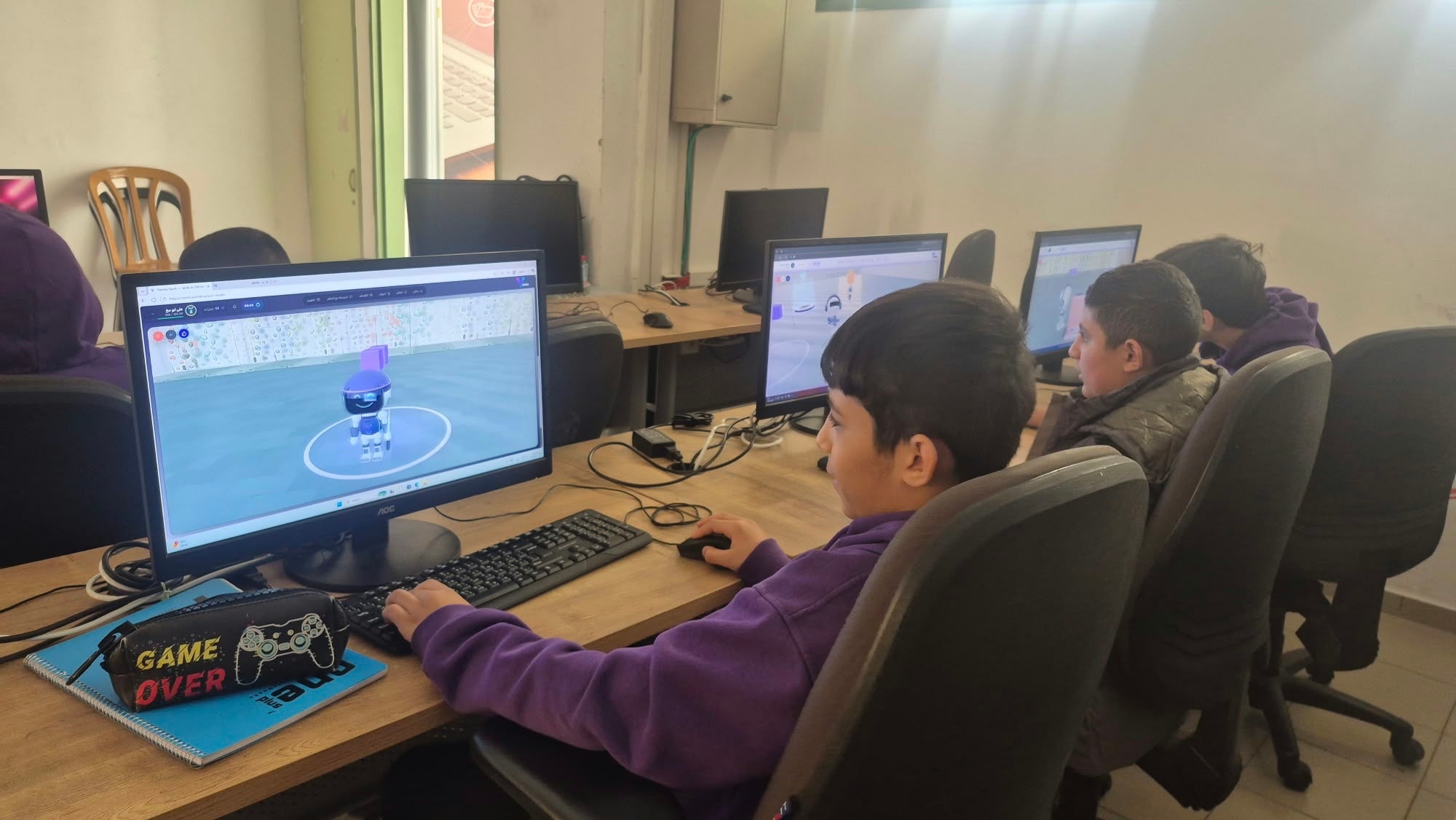
(JTA) — Moti Malka was away on reserve duty when his wife hit the very ordinary wartime wall of trying to help their 10-year-old study for an English test while schools were shut and screens had become the fallback.
Malka, a father of four who jokes that he has spent more time in uniform than at his day job as an AI architect at a high-tech firm, used AI to build a game in which his son had to form English sentences correctly to advance in a race.
“It took me two minutes to build and my son was captivated, both by the game and how it was made,” he told the Jewish Telegraphic Agency.
That experiment turned into YuviLab, an educational AI platform Malka launched in March to encourage children toward a different kind of screen use, one based on “building, experimenting, and thinking creatively,” he said.
Earlier this month, YuviLab announced that the Education Ministry had selected Spark, its AI-powered personalized learning platform, for the English-language component of Project 720, a government-led initiative to bring personalized learning into Israeli schools.
He worked on the first version whenever the war left him time, during downtime as a commander in a Home Front Command search-and-rescue unit focused on evacuating people from missile impact sites, and while sheltering with his own family and their newborn.
Moti Malka, founder of Israeli AI education startup YuviLab, during his IDF reserve service in 2024. (Courtesy Moti Malka)
With the war forcing parents back into remote-learning routines they had hoped had ended with the pandemic, Malka wanted to offer an alternative to Zoom classes where “no child I know learned anything” and days of “far too many hours spent playing Roblox,” watching television or scrolling.
Even before the Israel-Hamas war, Israeli children were already spending long hours online. A 2022 Israel Internet Association survey found that about a quarter of Israeli youth spent six to eight hours a day on screens, while 11% spent more than eight hours.
The war made those habits harder to contain. A study by Israel’s National Institute for Health Policy Research found that nearly half of parents reported an increase in young children’s screen time, with families of reservists and evacuees reporting bigger increases. Nearly a quarter said ordinary screen-use rules were “infeasible” under wartime conditions.
A study by Sharon Cayzer-Haller, a Hebrew University researcher studying screen time in war, followed 318 Israeli adolescents during the first months after the deadly Oct. 7, 2023, Hamas attack that launched the war, and found that the impact of screens depended heavily on how they were used.
“Not all screen time is the same,” Cayzer-Haller told JTA. “The key question is not how many hours adolescents spend online, but how they use digital media.”
Nearly half of the adolescents – 46% – in the study belonged to what Cayzer-Haller called the balanced-user group, combining communication, learning and social interaction rather than passive scrolling and content consumption. That group reported the highest levels of well-being during the war, while adolescents whose use was mostly passive were more exposed to harmful online content and reported lower well-being. Greater parental involvement and clearer boundaries around screen use were also associated with healthier digital habits.
Malka’s initial goal was to move children from consuming content to creating it. Yuvi’s launch coincided with the rise of vibe coding, shorthand for using plain-language AI prompts to build games, apps and other digital tools. Malka, a software developer who admitted he hasn’t written “a single line of code” in nearly two years, said children quickly learn to work with the platform by describing what they want, testing the result and refining the prompt.
Yuvi was developed with support from Microsoft and is hosted on Microsoft Azure, where AI-generated content is filtered and personally identifiable information is not stored. In its latest education report in 2025, Microsoft said that 86% of global education organizations are now using generative AI. While Spark is a paid platform for schools, Yuvi’s student-facing platform is free, and lets children build games, apps and learning projects, with tools for parents and teachers to connect that work to school material and track progress.
Available in Hebrew, English, Russian and Arabic, the game-building platform is straightforward. A child enters the platform and chooses whether to create a game, a lesson or another project. One student asked Yuvi to build an escape room for learning English, in which the player can leave the room only by solving language questions. In another, more germane example, a student modeled his game on the Iron Dome air defense system, with the player intercepting incoming missiles by answering arithmetic questions correctly. Others have built projects inspired by Minecraft or Roblox, adopting the kind of gaming language they already know for school.
As children build games through prompts, Yuvi displays the code being generated in real time. Malka said the feature was encouraged by Microsoft education specialists, who argued that children are naturally curious about how things work and should be able to look under the hood rather than interact only with the finished product.
Yuvi has since expanded beyond its original focus on gamifying learning, with the company now concentrating on personalized learning in schools. Its platforms reach tens of thousands of children and are used by thousands of teachers, according to Malka.
It uses several AI models rather than a single chatbot, so a coding request, a math explanation and a creative prompt are not all handled the same way. The platform routes each task to the model that designers have determined is best suited for it, while also adapting to the child’s language and level.
Malka described Yuvi as “a way for kids to enter STEM,” shorthand for science, technology, engineering and math, fields where Israel has been struggling. The latest results from PISA, an international assessment of 15-year-olds released in September, showed Israeli students scoring well below the Organization for Economic Co-operation and Development (OECD) average in mathematics, science and reading, with scores in all three subjects falling to an all-time low. Last year, the Education Ministry announced a national plan to bring AI into classrooms from fourth through 12th grade, with teacher training, new curricula and tools developed with major technology companies including Google, Microsoft, Apple, and Nvidia.
Spark is already in use in Israeli schools through Project 720’s mathematics and science pilot, with Yuvi working across dozens of local authorities, including Jerusalem, Rishon LeZion, and Netanya. The expansion into English follows an announcement by Prime Minister Benjamin Netanyahu and Education Minister Yoav Kisch of plans to expand AI-assisted English instruction, after just 22% of Israeli ninth-graders met national English curriculum requirements last year. Spark allows students to practice spoken English through conversations with AI at their own level.
At an education conference in Jerusalem last week, Israeli-Arab content creator Nuseir Yassin, known as Nas Daily, mused that if he ran the Education Ministry, he would teach only English during the first two years of school. Yassin also predicted that within five years, classrooms of 40 students could have five AI agents providing personalized instruction, with teachers acting as supervisors rather than delivering every lesson themselves. A survey presented at the same conference found that 87% of Israeli teenagers felt schools were failing to prepare them for the future. Nearly 80% expected AI to replace much of teachers’ work, while only 50% of teachers agreed with that assessment.
In its education report, Microsoft said AI training has not kept pace with adoption, with 45% of educators globally and 52% of U.S. students saying they had received no AI training. An Israeli survey of more than 27,000 teachers, published in November by the Education Ministry, found that while 76% had received AI training, only about half felt equipped to help students use it.
But not everyone is convinced that teaching children to use AI should become a classroom priority. A report by the Brookings Institution released earlier this year, drawing on more than 400 studies and consultations across 50 countries, concluded that the risks of generative AI in children’s education currently outweigh its benefits, particularly because of its potential to undermine foundational learning.
Lea Shahar, who left her job as a programmer in high tech as generative AI took off and now teaches coding to high-school students, has a more basic objection. She sees the rush into AI as a poor use of limited school time. The tools are changing too quickly to build a curriculum around them, Shahar said, and part of the appeal of AI is that it is meant to be intuitive. Schools would do better, she argued, to spend more time on skills children are less likely to develop alone on a screen, including interpersonal communication and languages.
“Nobody has stopped to ask if we need to embrace AI blindly in schools,” she said. “We’re thinking about the future through our own brains and not through our children’s brains.”

Malka said he agrees with part of that critique. Schools should focus on the principles behind AI, he said, not the tools that are constantly evolving. Yuvi’s early users also showed him that fluency does not come automatically. Children were building games and learning modules, but some treated the process as “magic,” he said, giving vague instructions and accepting outputs that looked complete even when they did not match what they had asked for. That prompted the launch of Yuvi Academy earlier this year, a training program meant to teach children how to work with AI before they start building with it. About 1,000 students have since participated in the company’s AI learning activities, including games and hands-on projects, Malka said.
“We don’t teach a specific platform,” Malka said. “We teach the principles. How models think, how to ask the right questions, how to build a work process with AI, how to identify mistakes, how to critique answers and how to work with AI agents and complex tasks.”
The educator-facing side of Yuvi is meant less as another subject to teach than as a “co-pilot for teachers,” he said, reducing the administrative work around teaching. Teachers can use it to create assignments, presentations, tests and interactive learning units, send them to students and identify where each child struggled. Parents can also follow a child’s progress through their own dashboard. The platform can then generate a personalized exercise for the same student, instead of forcing the teacher to manually build different tasks for every child.
“What we’re actually doing is taking the weight off the teacher and giving them more time to be actually teaching and less with the operational side of things,” Malka said.
Yuvi also tries to curb one of the main risks of using AI in schools: hallucination. “AI models do not really ‘know’ facts, they only predict what word is most likely to come next,” he said, often producing answers that sound convincing but are wrong. Yuvi’s teacher-facing platform is designed to operate in a closed loop, working from Education Ministry textbooks and other approved classroom materials already uploaded to the system, so its learning units are generated from defined sources rather than the open-ended knowledge of a general chatbot. The system “doesn’t invent beyond the material it was trained on,” Malka said, and teachers can still edit and approve the material before sending it to students.
Used properly, Malka said, AI should make users more discerning, not less. “Literacy and critical thinking around artificial intelligence is no longer a ‘nice to have,’” he said, “but a fundamental skill that every child will need in the world we are entering.” PJC
comments