
Anti-Jewish boycott backfires, as 10 times as many show up to support targeted Philly eateries
"This was more than solidarity. It was a refusal to let history repeat itself," Jayne Zirkle of End Jew-Hatred told JNS.
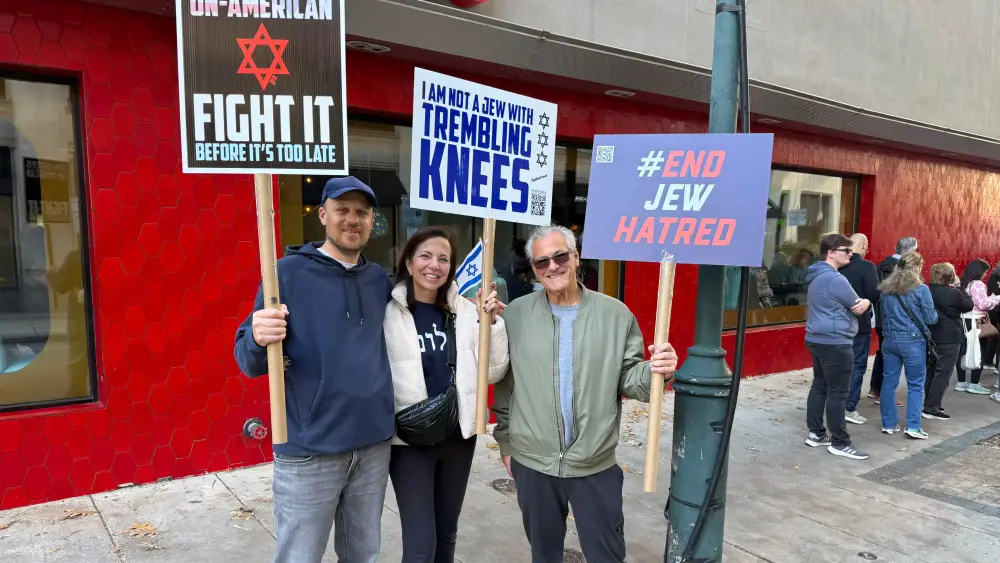
More than 2,000 people supported Jewish-owned businesses in Philadelphia targeted by a “boycott ride” on Sunday, after lawmakers, including Pennsylvania Gov. Josh Shapiro, said the ride was antisemitic.
“Philadelphia sent a powerful message,” Jayne Zirkle, communications director for End Jew-Hatred, told JNS.
“Supporters flooded the streets to stand with the Jewish community, carrying signs that read ‘End Jew-Hatred’ and ‘I am not a Jew with trembling knees,'” Zirkle said. “These are the voices of a community that refuses to be intimidated.”
Organized by the anti-Israel group Philly On Your Left, the boycott targeted Huda, K’Far Café, Mac Mart, Dizengoff, Goldie and Schlesinger’s, each of which is Jewish- or Israeli-owned. (Goldie, a falafel restaurant, is kosher.)
Organizers of the protest said it was “anti-Zionist.” They said that the American-Israeli celebrity chef who owns three of the targeted businesses held a fundraiser for Friends of United Hatzalah, an Israeli emergency medical service.
Jewish leaders and legislators noted that the boycott was scheduled for the eve of the anniversary of Kristallnacht, the 1938 Nazi-led pogrom targeting Jews in Germany, and that only Jewish-owned restaurants were targeted in the Philadelphia boycott.
Community members organized a food crawl, slated for the same time and place as the boycott, to support the restaurants.
On Sunday morning, Marti Lieberman, owner of Mac Mart, said her kiosk was “stacked with security” and with macaroni and cheese.
“Let’s show them that love always wins,” she said, after spending the weekend preparing for expected crowds.
The Jewish Federation of Greater Philadelphia told supporters not to engage with protesters, and city leaders told the Philadelphia Police Department to maintain safety.
Boycott organizers said that they were protesting “pogroms” against Palestinians.
Mark Goldfeder, CEO of the National Jewish Advocacy Center, which sent attorneys to observe the boycott and document any crimes, said that the lawyers saw a “massive police presence” and a “strong Jewish counter-protest.”
“Philadelphia showed what happens when government takes antisemitism seriously before it becomes a crisis,” Goldfeder told JNS.
“The governor spoke clearly,” he said. “The attorney general spoke clearly, and the police showed up in force to protect the businesses, their customers and everyone’s right to peaceful expression.”
“That is what responsible government looks like,” Goldfeder told JNS. “We called for preparation, coordination and enforcement before the weekend, and Philadelphia delivered. The law did its job, and that made it possible for the community to do something extraordinary.”
Boycott organizers hoped for “empty Jewish restaurants,” according to Goldfeder.
“Philadelphia gave them lines around the block,” he said. “Jews and non-Jews, families and neighbors showed up not with threats or bullhorns but with their appetites and their wallets.”
Supporters “didn’t just defend the right of Jewish businesses to exist,” he said. “They made sure those businesses thrived.”
“That is Jewish pride, American decency and a very effective way to defeat a boycott,” he told JNS.
The Philadelphia Police Department told JNS that “three individuals were arrested, including an adult female for assault, an adult male for disorderly conduct and a 17-year-old male for assault on police.”
“Two officers sustained minor injuries while assisting with an apprehension,” the police department told JNS.
“Neither required medical treatment,” it said. “Additionally, a female counter-protester reported being assaulted by an unknown individual.”
Shapiro, the governor, thanked the police department for maintaining safety “in the midst of blatant antisemitic targeting of Jewish-owned restaurants on the anniversary of Kristallnacht.”
“The City of Brotherly Love showed up to support our neighborhood businesses and prove once again that hate has no place in our commonwealth,” he said.
‘A fight for America’
Noa Peri-Jensch, chief communities officer at the Israeli-American Council, said that more than 2,000 people showed up to support the restaurants.
Peri-Jensch, who lives in New York and Las Vegas, took a train from New York to Philadelphia.
“My grandparents lived through Nazi Germany,” she said. “So when that bold and unashamed group advertised they’re going to go on bikes to boycott Israeli and Jewish restaurants, it was the memory of my ancestors in my body.”
“I decided literally this morning, even though I have many other things I’m supposed to do, I’m going to go,” she said. “It was one of the most energetic, exciting, inspiring experiences I’ve ever had.”
Peri-Jensch said that she stood on line at Huda, a burger restaurant owned by Yehuda Sichel, with hundreds of others.
“Even after the bikers left, there were still people standing in long lines,” she said. “Not just Jews. Non-Jews, Christians. People came right after church. Some took the train, drove down, drove hours, to make a point.”
“The lines were long, but people didn’t mind,” Peri-Jensch told JNS. “They stood and talked and chatted and became friends. It was very social, people talking to strangers and making new friends.”
She told JNS she had to leave early to catch a train back to New York and didn’t get a chance to eat at Huda, but the council plans to buy gift cards to support the businesses.
The anti-Israel protest ended up better than prior ones for the Jewish community, because “people are fed up.”
She said that she talked to people who didn’t care about Israeli politics but did care about “innocent business owners in America.”
“It was a fight for America,” she said. “That’s how it felt to me.”
According to the police department, some 200 boycott participants rode bicycles.
Footage that circulated online appeared to depict keffiyeh- and mask-clad cyclists waving Palestinian flags under police protection. Counter-protesters lined the streets shouting “shame,” “Jew-haters” and “show your faces.”
A sign in a nearby bar, The Goat, read “no public restroom” and featured a drawing of a Palestinian flag. Footage on social media seemed to show pro-Israel protesters yelling at bar staff about the sign.
Later on Sunday, The Goat stated that the sign “was put up without management approval and was removed quickly.”
“We are ashamed of this incident and want to make it clear that our restaurant is a welcoming space for everyone,” it stated. “The employee responsible was terminated on site.”
The bar got several one-star reviews on Google on Sunday afternoon, but some social media users praised it for acting quickly.
“We will not stand by and allow another Kristallnacht to happen in America,” Zirkle told JNS. “We will not allow Jewish businesses to be targeted.”
“‘Never again’ cannot simply be something we say when remembering history,” she said. “It must be something we are willing to defend today.”
Unlike on Kristallnacht and at other protests targeting Jews since Oct. 7, the community “responded by showing up,” according to Zirkle.
“Neighbors stood in line, bought Jewish food, supported Jewish business owners and made it clear that hatred would not have the final word,” she said.
“This was more than solidarity,” she said. “It was a refusal to let history repeat itself.”
“On the eve of Kristallnacht, Philadelphia wrote a different ending,” Zirkle told JNS. PJC
comments