
Mosaic exhibition honors Pittsburgh shooting victims and brings message of hope
Exhibit on display at Congregation Beth Shalom
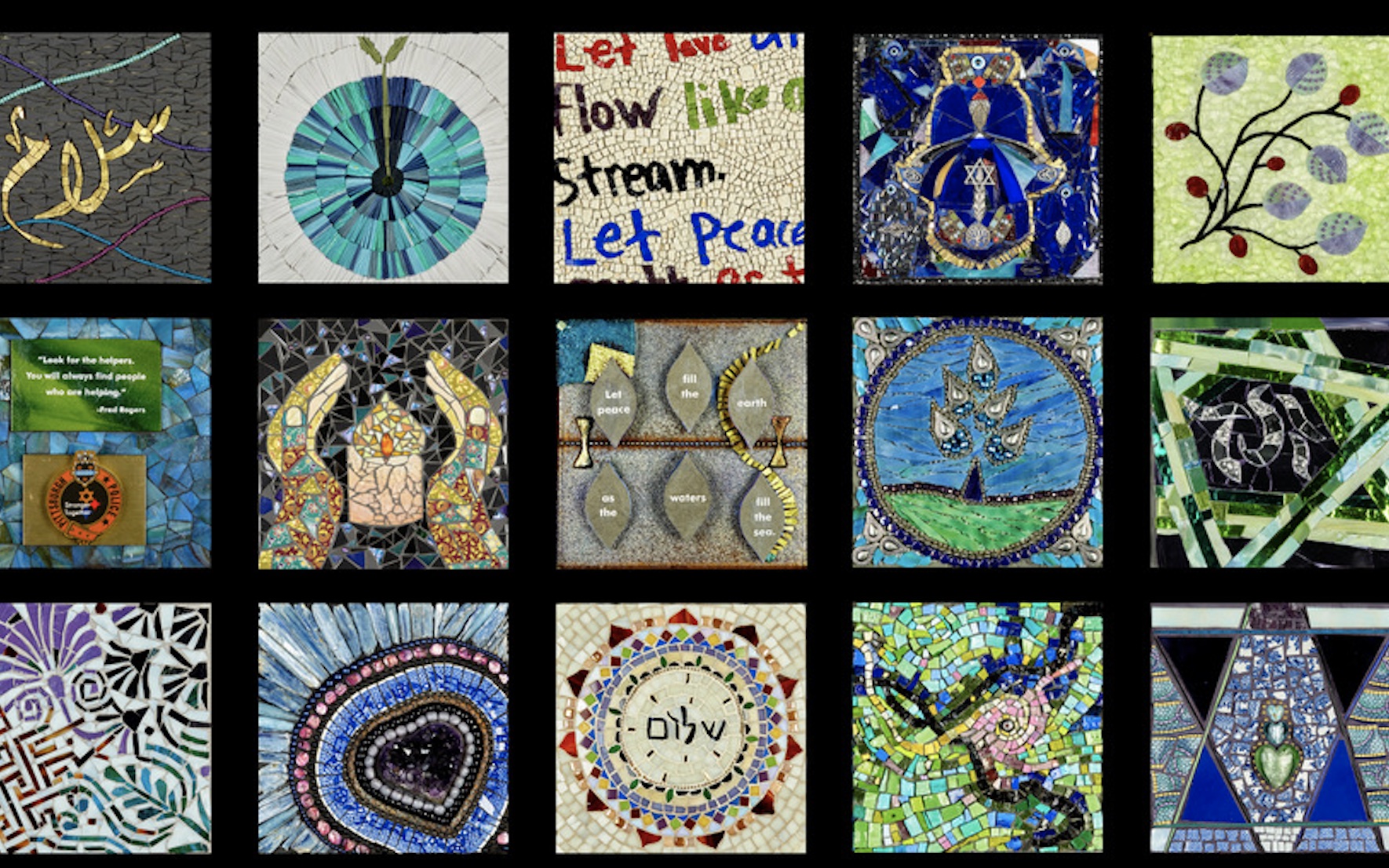
An art exhibition honoring the victims of the Pittsburgh synagogue shooting — and decrying hate — is now at Congregation Beth Shalom in Squirrel Hill, its latest stop on a national tour.
“From Darkness to Light: Expressing Hope through Mosaic Art” includes 36 tiles by artists from around the world, each created in response to the 2018 shooting that claimed 11 lives.
The museum-style display has traveled to nearly a dozen venues since its genesis in 2020 by Susan Ribnick, a prominent mosaic artist in Austin, Texas, and other artists she engaged in the project.
“When I saw the level of workmanship and craftsmanship and creativity, I knew something special was brewing,” said Ribnick, who vetted every piece. “When people feel strongly about an issue, they dig deep and do great work.”
Pittsburgh-based Stevo Sadvary contributed “Coming Together in Peace,” a stained glass mosaic that merges several distinct patterns into a harmonious whole.
“I’m always working with patterns, sometimes flowing patterns that meet in the middle,” said Sadvary, whose portfolio includes several public mosaic installations. “For this tile, the patterns represent different communities and how they should come together to get along.”
Using a frame sent to him from Ribnick, Sadvary leaned on his recollection of the morning of the shootings, which occurred so close to home.
“I was teaching a mosaic workshop in Mt. Lebanon, and my phone started lighting up,” he said. “People were calling me and texting me because my studio is a mile from the synagogue.”
Contributing to the project, he said, provided an opportunity to show the power of art to confront religious persecution. “If the pieces spark thought and emotion, that is always a positive.”
The collection’s dedication panel, created by Ribnick and members of the Austin Mosaic Guild, features glass leaves etched with the names of the 11 victims on a gradient green background. Other pieces use symbols, such as the Star of David, or more abstract designs to inspire optimism in challenging times.
While the project originated from the Pittsburgh synagogue shooting, it speaks to bigotry of all kinds, and to gun violence, Ribnick said, noting that a mosaic by Rachel Davies also memorializes 16 school children and a teacher killed in a shooting in 1996 in Dunblane, Scotland, where Davies works.
Her mosaic depicts snowdrops, which were in bloom when the massacre occurred and became a symbol of the will to triumph over tragedy.
Artists worked with a variety of materials, from ceramic and glass to beads, stones, and folded paper, and included written messages with their work.
“Each tile tells a story,” said Shari Woldenberg, Beth Shalom’s Derekh (pathways) program coordinator. “There are so many layers besides the visual impact of the tiles.”
She noted that because the exhibition is coming to Beth Shalom “during a very, very polarizing time,” she hopes it can encourage “strength and hopefulness.”
Robin Friedman, president of Tree of Life Congregation, notes the significance of artists with no connection to Pittsburgh and who aren’t necessarily Jewish uniting to deliver a message “that we have to stand against antisemitism and hate and that we can do it without being harsh.”
David Kalla, a member of Tree of Life Congregation, is the keeper of the exhibition, volunteering his time to coordinate its journey, and providing support through the Barb and Dave Kalla Charitable Trust.
“I was very moved that people so far away, in Texas, were thinking of us and organizing to do something,” he recalled, noting that he wanted to help ensure the mosaics would remain in the public eye.
He and Ribnick worked with Abby Schwartz, then-director of the Cincinnati Skirball Museum on the mosaics’ first institutional showing, Kalla said.
“The project started at the grassroots and Abby turned it into a polished exhibition.”
Since then, it has traveled to venues ranging from Michigan’s Art Center of Battle Creek to Penn State University to Montclair State University in New Jersey. Local places have included the Seton Hill University Arts Center, Southern Alleghenies Museum of Art, and Duquesne University.
While Kalla is working to schedule more stops, he is encountering reluctance from some prospective hosts, despite the collection’s deep social value and uplifting message.
“We’re reached out to a lot of people, but some campuses are very unsure of how to promote this, to advertise something Jewish,” he said. “It’s a shame.”
He also is seeking a permanent home for the collection and believes the new Tree of Life Center for Humanity, now under construction, is an ideal candidate.
“This was a beautiful gift to our congregation,” he said. “My hope is that, along with the many other beautiful gifts we received, at least some of the tiles can be viewed on the outside walls of the sanctuary.”
From “Darkness to Light: Expressing Hope through Mosaic Art” runs until May 5, 2027. Admission is free and by appointment through Shari Woldenberg at swoldenberg@bethshalom.org. PJC
Deborah Weisberg is a freelance writer living in Pittsburgh.
comments