
Tomashpilers and Podoliers
Did the First Podolier Independent Society have to use a legal maneuver to sidestep an antisemitic property owner?
According to community lore, the First Podolier Independent Society had to acquire its cemetery in Reserve Township through a judge because the original landowner refused to sell to Jews. In an attempt to prove or disprove this story, I spent a few hours sorting through property records in the County Records Office downtown.
I found a plat map created after 1956. It listed the First Podolier Independent Society cemetery as two parcels — the caretaker building with a burial ground behind it.
The Daughters of Israel Cemetery Association was chartered in 1917 with the purpose of starting a cemetery. It purchased the back plot from Kaiser Torah in June 1917 for $900. At the time, a German immigrant named Joseph Wuesner owned the house.
In early September 1919, Wuesner sold the house to Samuel Katz, Harry Frank and Ben Frank, serving as trustees for the First Tomashpiler Independent Society.
During the worst days of the Russian Civil War, the shtetl of Tomashpil in the Podolia province of Ukraine suffered greatly at the hands of the Volunteer Army.
As described at the time in a book-length report by Yiddish writer Nokhem Shtif, “In September 1919 Tomashpil was overrun by the Second Kuban Labinsk Cavalry Regiment, which launched a pogrom lasting five days straight. A delegation of two Christians traveled to Vafniarka, which was the nearest train station, and complained to General Rozenshild von Paulin. The general sent a field court to Tomashpil. When they arrived, the commander of the Labinsk Regiment summoned some Jews, and ordered them to write a letter attesting that his regiment had done no wrong to the Jews.”
A few months before this humiliation, some Tomashpilers found each other in Pittsburgh. They formed a landsmanshaft and applied for a charter in early June 1919 as the First Tomashpiler Independent Society. They finalized the incorporation in late September, about three weeks after buying the house. These dates suggest that they purchased the house through trustees because they were not yet a legal corporate entity.
* * *
As the Tomashpilers were pursuing incorporation and purchasing property in the summer of 1919, two members of Daughters of Israel formed a new group called Zionim Lamass. For years, I have seen the name Zionim Lamass in various notices. I always assumed it was a Zionist group, that “Lamass” was some Yiddish word for society.
The local Yiddish newspaper Der Volksfreund published a notice in June 1919, announcing the formation of Zionim Lamass. It described the organization as a group of Jewish women dedicated to the great mitzvah of caring for abandoned dead. They met at the Cneseth Israel synagogue. Zionim Lamass obtained a charter in October 1920 with the mission “to erect tombstones or other demarcations for indigent Jewish decedents.”
One day, flipping through Holladay’s “A Concise Hebrew and Aramaic Lexicon of the Old Testment,” I found reference to a verse in Ezekiel where “tzion” means “gravestone.” Zionim Lamass (L’meit) is Hebrew for “Gravestones for the Dead.”
Zionim Lamass started strong. By November 1919, it had set headstones on 18 unmarked plots at Beth Abraham, Chesed Shel Emes and “the Romanian cemetery,” likely New Light. And then, nothing. Within the next few years, the Daughters of Israel sold its cemetery, and the Zionim Lamass faded considerably from the local press.
* * *
Whatever it was these groups were planning came to pass on March 18, 1922.
There were two transactions that day. Katz, Frank and Frank sold the house to the First Tomashpiler Independent Society for $1. The Daughters of Israel sold its burial plot to the First Tomashpiler Independent Society for $1,000 but held rights to a 16-by-100-foot section. Now the First Tomashpiler Independent Society owned the entire property.
As pogroms spread beyond Tomashpil throughout the entire province of Podolia, more Jewish refugees arrived in Pittsburgh. The First Podolier Independent Society began sometime in the late teens or early 1920s and made its first burial at the First Tomashpiler Independent Society cemetery in May 1921, when founding member Katy Kurland died. The Podoliers made another burial that October and two more in June 1923. They staked a stronger claim to the cemetery in 1923, when they dedicated a chapel on the property.
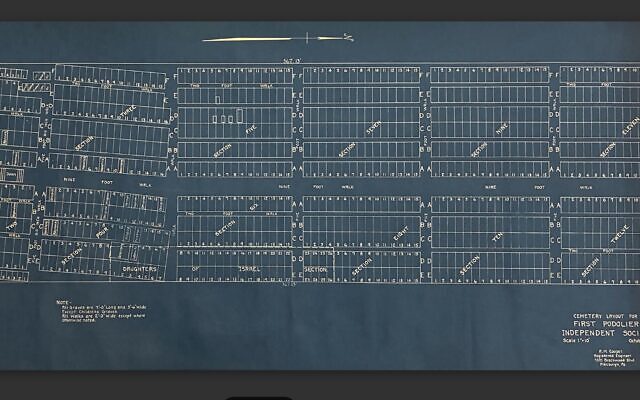
A map of the First Podolier Independent Society confirmed the existence of an independent section held by the Daughters of Israel Cemetery Association. (Image courtesy of the Rauh Jewish Archives)
The First Podolier Independent Society officially applied for a charter from the state in April 1924, using the services of a young Jewish lawyer named Benjamin Lenchner. A few weeks later, the First Tomashpiler Independent Society sold the house and the cemetery to the same Benjamin Lenchner for $1. In early January 1925, Lenchner sold the house and the cemetery to the First Podolier Independent Society, noting that the Daughters of Israel retained an interest in the 16-by-100-foot section of the property.
About eight years later, in 1933, Lenchner was appointed to the Allegheny County Court of Common Pleas. So there was a future judge involved in the series of transactions but seemingly not to get around the prejudice of a local landowner.
Over the next century, the First Podolier Independent Society buried around 80 people in its cemetery. The grounds still have room for several hundred more.
* * *
After the sale, the Daughters of Israel slid into a slow dormancy. It was revived at 8 p.m. on Sept. 16, 1931, when it held a special meeting at Tillie Ellovich’s home on Centre Avenue. The purpose was to settle a $500 mortgage with the First Tomashpiler Independent Society, money still owed from the sale of the cemetery in 1922.
According to the minutes of that meeting, the Daughters of Israel forgave the remaining debt. Going forward, it agreed to pay the First Tomashpiler Independent Society $5 for each future burial and to “cover the grave within a reasonable time with a tomb stone.” They must have talked about a lot else. The meeting didn’t end until 10:30.
The Daughters of Israel formalized this arrangement in late March 1932 with the First Podolier Independent Society, which now described itself as a successor to the First Tomashpiler Independent Society. The Daughters of Israel never used any of the remaining plots. All its members were buried in other cemeteries throughout the region.
A month later, in April 1932, the Daughters of Israel donated $100 to the Jewish National Fund. This was its last documented act. A newspaper notice from July 1943 announced that the Daughters of Israel had unclaimed funds in a local bank totaling $53.34. After all this, I have no sense whether it succeeded or failed in its intentions. PJC
Eric Lidji is the director of the Rauh Jewish Archives at the Heinz History Center and can be reached at rjarchives@heinzhistorycenter.org or 412-454-6406.
comments