
Beneath Latvia’s soil, stories speak
The quest to clarify and correct Riga's Jewish story began decades ago.
Pittsburgh Jewish Chronicle Senior Staff Writer Adam Reinherz accompanied educators and lay leaders on a two-week trip to northern Europe. Traveling through Lithuania, Latvia, Estonia and Finland, Reinherz reported on modern Jewish life, vanished communities and the quest to create a new European Jewish story. Coverage relied on dozens of site visits and more than 75 interviews. This is the third article of a five-part series.
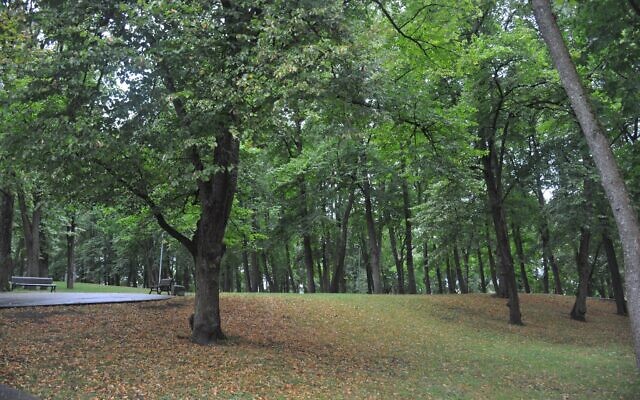
RIGA, Latvia — The quiet confines of a tranquil Latvian field and lush forest scream stories worth remembering. Inside the former, a nearly 6.5 acre stretch of manicured grass and paved pathways called the “Old Jewish Cemetery,” few markers remain.
It wasn’t always this way, guide Lena Spungina, 66, told nearly a dozen seminar participants from Classrooms Without Borders, a Pittsburgh-based organization offering educators professional development. For nearly 200 years — beginning in 1725 — this was a traditional Jewish cemetery: Bodies were buried, headstones were erected. In the mid-1920s, however, once capacity was reached, another cemetery was secured.
Located 5 miles northeast, the new site offered space for the deceased and recognition of past deeds. In May 1934, according to cemetery records, a monument to 37 Jewish soldiers and officers who died fighting for the independence of Latvia in 1918-1920 was erected.
Despite the arrival of new plots, old responsibilities remained. The community, Spungina said, upheld its duties and continued caring for the former grounds and buildings: a small chapel for services and a work area for members of the chevra kadisha (Jewish burial society).
Like the number of its plots, Riga’s Jewish community kept increasing. Before World War I, the Jewish population totaled 33,000. According to Ilya Lensky, director of the Riga-based Jews in Latvia museum, the community grew to 43,000 by 1935.
Flattening, however, soon followed.
On July 4, 1941, Nazis torched Riga’s synagogues. Jews, who had sheltered inside Riga’s Great Choral Synagogue, were burnt alive, according to the Museum of the Occupation of Latvia.
Within a month, a ghetto was created. Encircling the “poorest part of the city,” Spungina said, “all known Jews” were resettled there.
A space that previously held 13,000 teemed with 30,000. Estimates suggest that, due to overcrowding, each person had only about 4 to 6 square meters of space.
Other than the ghetto, the only option for Riga’s Jews, Spungina said, was the forest. Different “rumors” existed about what waited in the woods. By the time ghetto residents arrived “they could hear the shooting.”
The terror of ordered chaos
For Riga’s Jews, final moments in the ghetto blended chaos and order. Holocaust survivor and former Riga resident Steven Springfield told the U.S. Holocaust Memorial Museum he remembered thousands of Latvian and German police entering the ghetto and chasing prisoners out.
“Whoever couldn’t walk was shot on the spot: children, women, elderly men, on the street,” he said.
Jews were directed toward the forest where Russian prisoners of war had prepared mass graves. Ghetto residents were instructed to disrobe and approach the pits. Nearly 25,000 Jews were murdered in mass shootings on Nov. 30 and Dec. 8, 1941.
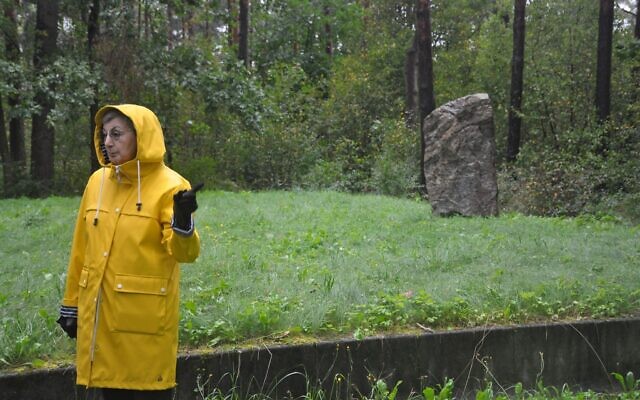
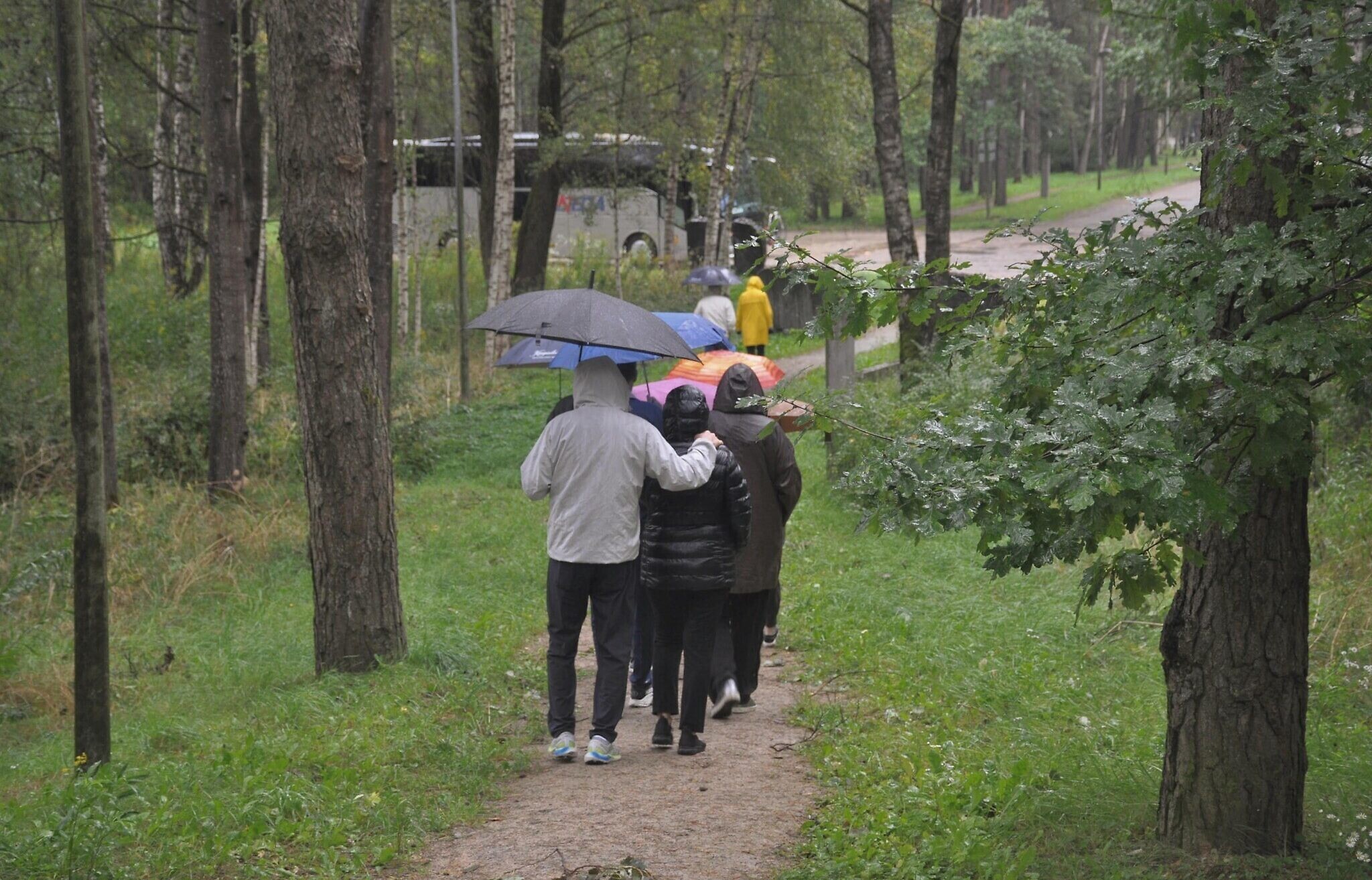
Standing inside the forest last month, seminar participants spoke little. Tsipy Gur, founder and executive director of Classrooms Without Borders, distributed sheets with Hebrew and English memorial prayers. Texts were read. A candle was lit. Rain fell. After traversing soaked grass, seminar participants returned to the bus.
Classrooms Without Borders board member Naomi Weisberg Siegel said that visiting a site like Rumbula prompts a haunting realization that it’s “not only where people were killed, but where other people killed.”
Lest any doubt such horror could happen again, “all you have to do is look at the world today,” she continued. “I think our only hope against that is remembering the past, talking about it and trying to teach understanding.”
Shifting landscape
For days, Spungina detailed Riga’s Jewish history. Having guided since 1985, she routinely interspersed facts and memories.
Years after the Holocaust, she said, transformations occurred at the Old Jewish Cemetery and Rumbula forest. Post-war Soviet occupation enabled the cemetery’s erasure. After falling into disrepair, its headstones were cleared and the area was razed. Former markers became building materials.
Referred to as “The Park of the Communist Brigades,” the cleared site bore no mention of its prior use.
Spungina recalled ambling the area decades before its paths were asphalted. She said on several occasions she noticed odd-shaped stones along the rolling gravel walkways. Apart from being different sizes and colors than nearby pebbles, the small pieces had remnants of Hebrew writing. The fragments, Spungina continued, were shards of Jewish headstones.
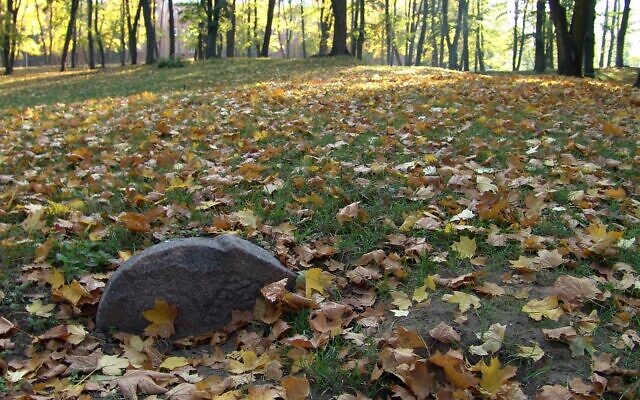
After several years, the municipality asphalted the gravel path. Grounds were manicured. Memorial markers indicating the Jewish space’s former presence were installed; but they weren’t the only signs pointing to the past, Spungina said. Somehow, despite the cemetery’s demolishment, the corner of a Jewish gravestone remained rooted in the ground. To observers, the marker, which contained letters spelling the start of a Hebrew word — likely “isha” (woman) — appeared to “pop out” of the earth.
“Other fragments” are now visible, Lensky said. They, too, appear to have risen from the former cemetery’s ground.
History tells its story
Lensky, speaking from within the museum, told seminar participants that the museum is tasked with educating thousands.
People must understand that Latvia’s Jewish past is “not only about tragedy and suffering,” he said. “It’s about more than that.”
Lensky isn’t alone. The quest to clarify and correct the local Jewish story began decades ago, Spungina explained.
After the Soviet Union fell in 1991, the Park of the Communist Brigades in Riga was renamed the Old Jewish Cemetery. A Star of David monument was placed near the cemetery’s entrance. Twenty years later, another marker — shaped like an unrolled Torah scroll with etched details recounting the area’s Jewish history — was installed.
Walking the grounds and reading these monuments offers insight into what happened at the cemetery, Gur said. But visiting Rumbula is the only way to “understand the murders.”
Speak soil
After the war, former Riga resident Samuel Zeitlin traveled to the Rumbula forest. He and his wife, Spungina said, heard Riga’s 25,000 Jewish ghetto residents were killed in the woods. Zeitlin and a small group entered the area, but all they found was “a forest.” Zeitlin and company returned again. This time, Spungina continued, they brought an agronomist, who noticed flowers growing in “organic soil.”
The team tore open the ground. Beneath the soil were burnt bones and other remains. The Nazis, in an effort to destroy evidence, had instructed prisoners to ignite proof of murdered Jews. After the incineration was complete, the prisoners were also killed, Spungina said. For weeks, in an effort to preserve the past, Zeitlin, and his small group, returned to the Rumbula site. Opening the earth, time and again, they discovered remains belonging to thousands.
A protracted memorialization process began. In 1963, despite pushback from Soviet authorities, Zeitlin and the team arranged for a Yiddish plaque to be placed on a nearby pine. Additionally, on the side of the Rumbula railway, according to the University of Latvia, a poster by artist Joseph Kuzkovsky was placed; it depicted a man, “rising from the grave, with his fist clenched, symbolizing a protest against these crimes.” By 1964, however, both the plaque and poster were removed.
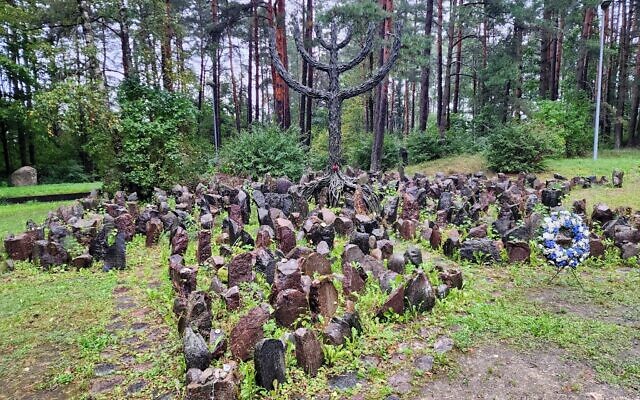
Zeitlin and others refused to accept a negation of remembrance, Spungina said. Eventually, permission was granted to install a stone, with the words “To the Victims of Fascism” written in Latvian, Russian and Yiddish. A later plaque indicates the monument was “erected by activists of Riga’s Jewish community” and that it was the “only Jewish memorial to victims of Nazi terror in the territory of the USSR.” Finally, after the Soviet Union’s demise, a large Jewish memorial was erected at Rumbula.
With rain still falling, seminar participants approached the memorial. At its center was a seven-branched menorah. The structure’s base resembled roots pushing forth from the ground. Surrounding the candelabra were six sections of stones collectively forming a Star of David. Written on several stones were names of former Riga Jewish residents who were murdered in the forest.
One stone deserves special attention, Spungina said. Unlike those used to record the names of Jews murdered in 1941, this stone bears the name of a survivor. Pointing to a rock reading Samuel Zeitlin, the guide instructed visitors to pause and consider a Riga resident who unearthed his landsmen and laid them to rest so the ground could tell their story. PJC
Adam Reinherz can be reached at areinherz@pittsburghjewishchronicle.org.
comments