
White supremacist claims ‘Jews didn’t like what was on the flyer’
Ohio man pled guilty to littering in case related to antisemitic literature distributed in Pittsburgh
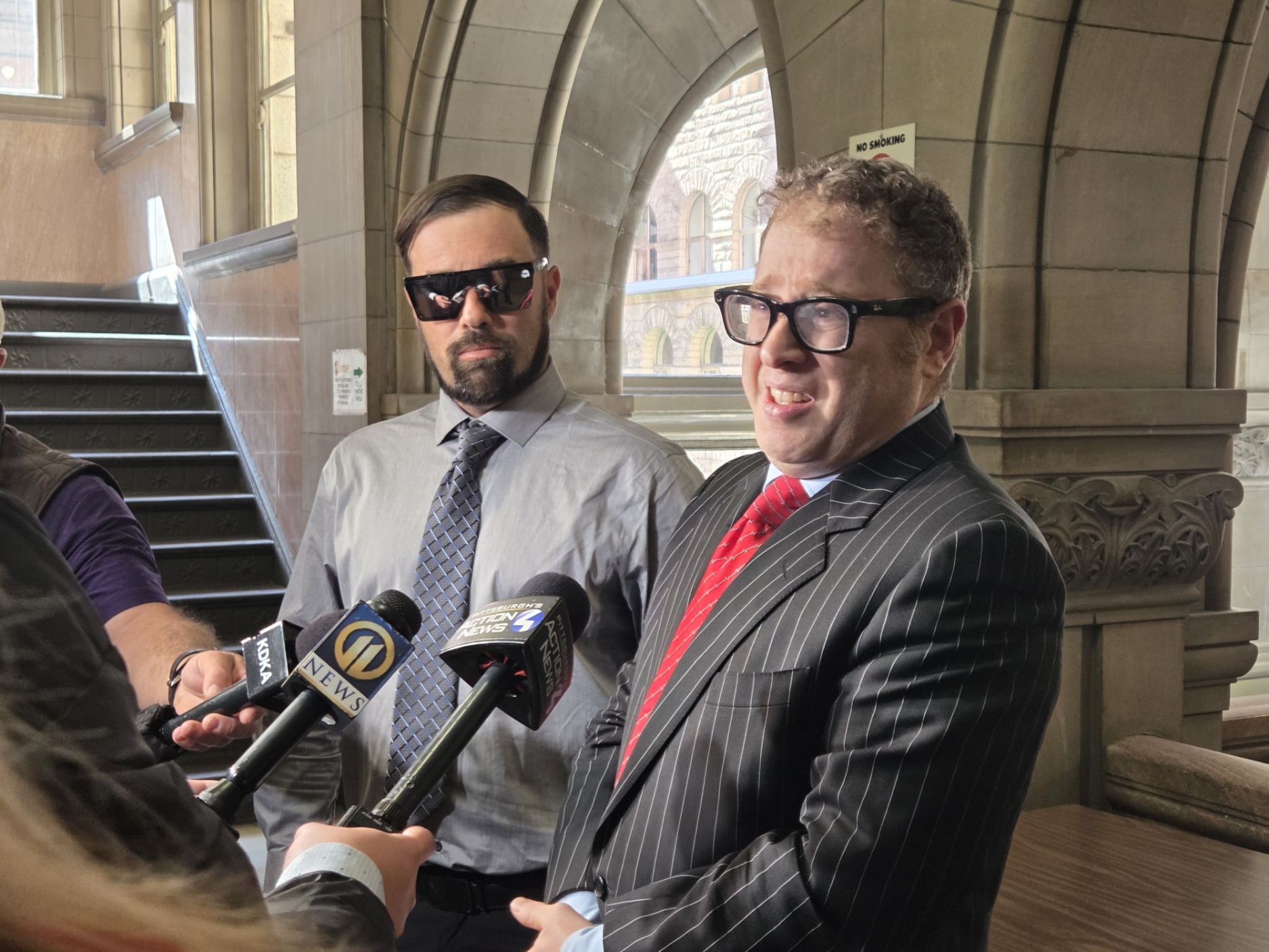
At a June 3 hearing in the Allegheny County Court of Common Pleas, Jeremy Brokaw pled guilty to five counts of littering for distributing antisemitic flyers last May in Squirrel Hill and Shadyside. He was fined a total of $1,500 plus court costs.
The sentence was agreed upon following the appeal of his conviction last September, when he was found guilty of 160 counts of littering and fined more than $50,000.
The appeal hearing was originally scheduled for May 6, 2026, but neither Brokaw nor his attorney, Joshua Smith, made an appearance. Smith claimed they were not notified of the court date. After initially ruling against the defendant, Judge Thomas E. Flaherty rescheduled the hearing.
Brokaw’s new sentence equates to a $300 fine for each of the five streets where antisemitic literature — placed in a baggie with corn seeds to keep them from blowing away — was thrown from a Dodge Durango owned by Brokaw.
Calling the case “unusual,” Flaherty asked Assistant District Attorney Michael Siegert if the fines were the maximum allowed. Siegert said they were and, pivoting from the antisemitic nature of the flyers, said the charges against Brokaw were strictly for littering. Brokaw appeared to smile during the exchange between Siegert and the judge.
Flaherty seemed to reluctantly accept the plea after indicating he would have preferred community service to be part of the deal. But the defendant lives in Zanesville, Ohio, and his attorney assured the judge that Brokaw wouldn’t be back to Pittsburgh, saying he had “learned his lesson.”
In a post-hearing press gaggle, Smith said the plea deal was “a reasonable offer.”
He called Brokaw’s actions a “misguided attempt at advocacy,” saying it was akin to behavior practiced in the 1960s or 1970s, before the advent of the internet.
Asked by the Chronicle if Brokaw’s behavior wasn’t more in line with lighting a cross in an African American neighborhood in the 1960s, Smith responded: “Now you’re talking about viewpoint discrimination, and you can’t do that.”
Asked what viewpoint Brokaw was advocating, Smith replied “pro-white advocacy.”
Speaking to the gathered reporters, Brokaw said that everything on the flyers “was facts. You can fact check everything on the flyers distributed without malicious intent.”
The literature thrown from Brokaw’s vehicles was filled with conspiracy theories, antisemitic tropes and falsehoods, including “Every single aspect of the Jewish Talmud is Satanic,” and references to the “Protocols of the Learned Elders of Zion” and “The Jew’s Plan for World Domination.”
Brokaw speculated that if the content on his flyers had been different, he wouldn’t have been arrested and found guilty.
“Jews didn’t like what was on the flyer,” he said.
Asked why he didn’t advocate for white supremacy in his hometown rather than in Pittsburgh, Smith replied, “He probably hasn’t advocated for his position in Zanesville,” before Brokaw said that he had “advocated for it all over the country.”
Brokaw went on to claim that he wasn’t aware Squirrel Hill was a large Jewish neighborhood.
David Heyman, associate vice president of the Jewish Federation of Greater Pittsburgh, finds that hard to believe.
“There’s no accident that Mr. Brokaw drove from Zanesville, Ohio, to Squirrel Hill, the site of the worst antisemitic attack in U.S. history,” Heyman said, referring to the Pittsburgh synagogue shooting.
Heyman said that coming into the hearing, he believed the judge was likely to reduce the original fines.
Like the judge, he said, the Federation, reluctantly accepted the guilty plea.
Brokaw had the right to express his point of view, Heyman said, but called his actions “targeted harassment.” Heyman noted the need for stronger legislation in Pennsylvania to address that type of behavior.
Eric Kroll, the Federation’s deputy security director agreed, noting that legislation addressing actions that are hateful and targeted at a particular individual or group — rather than advancing a political opinion — has stood up in court in other circumstances.
Kroll and Heyman both thanked the district attorney, law enforcement and the community, whom they said helped to quickly identify Brokaw.
“The community spoke up,” Heyman said. “The community reported the incident. The community provided video of the car. The Pittsburgh Bureau of Police took this seriously. The prosecution took this seriously.” PJC
David Rullo can be reached at drullo@pittsburghjewishchronicle.org.
comments