
Pennsylvania Supreme Court Justice speaks on the importance of women’s leadership at JWF event
"Leadership, perseverance, and commitment"
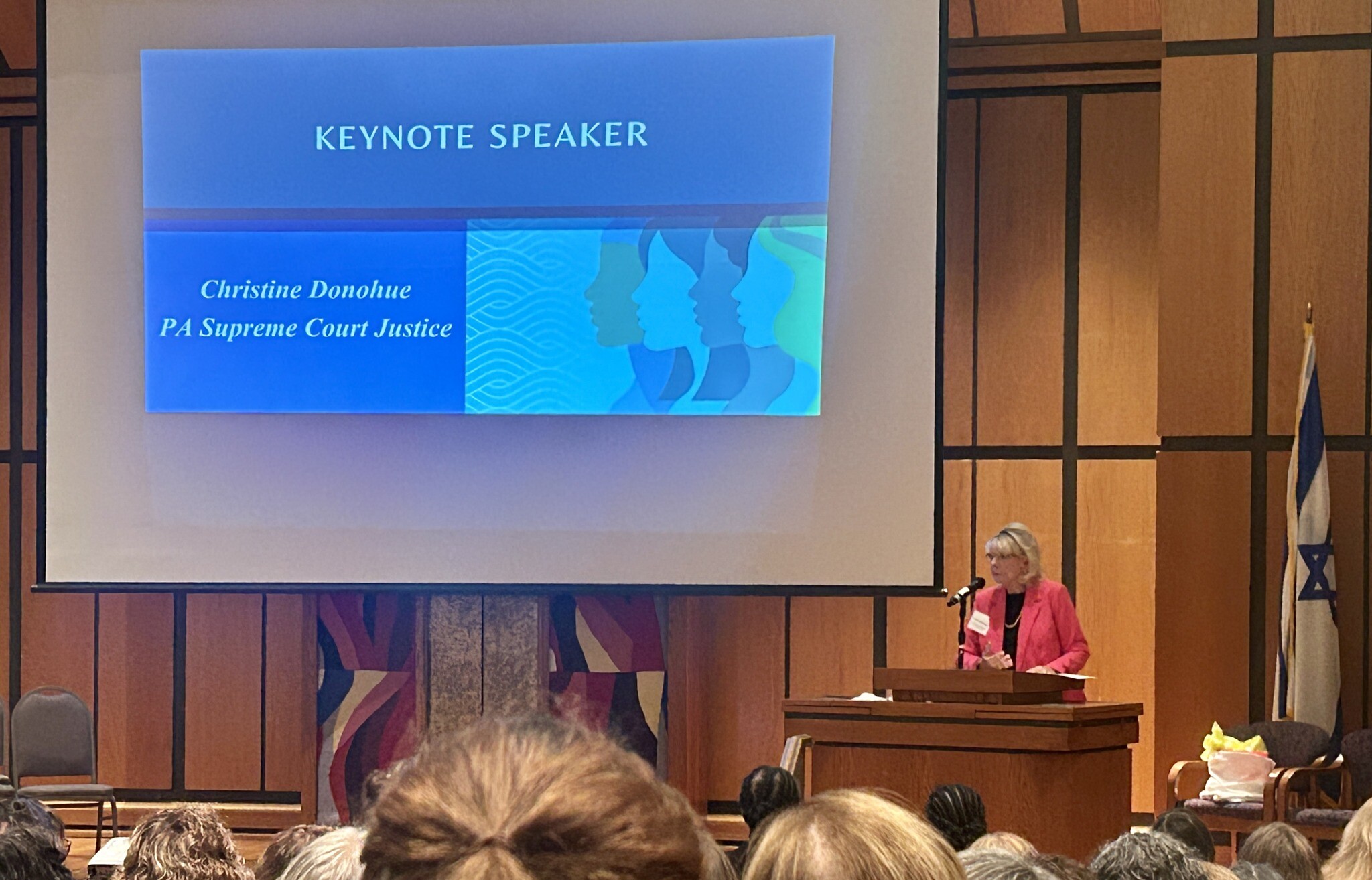
Before she became a justice on Pennsylvania’s highest court, Christine Donohue was the daughter of a disabled coal miner and a seamstress who worked six days a week to keep her family afloat.
Donohue’s perspective — forged far from polished courtroom walls — grounded her understanding of the world around her and the legal scaffolding that underlies it.
At the Jewish Women’s Foundation annual meeting on June 3 at Beit Kulanu, Donohue, the event’s keynote speaker, emphasized the importance of diverse perspectives — particularly those of women — in creating a more just society.
“What’s critical to remember for all of us who are concerned with women’s rights is that it’s important to have a woman’s perspective on [the court’s] work,” Donohue said. “Women who are active parts of the community make the community better — we want to have women serving in their ranks. The jurisprudence is better.”
Before her Supreme Court appointment in 2016, Donohue spent 27 years working as a civil trial lawyer. She has been recognized as a trailblazer who has paved the way for the next generation of women in her profession, receiving Duquesne University’s Woman of the Year Award in 2023 and the Pennsylvania Bar Association’s Anne X Alpha Award in 2025.
“As a woman who has reached the highest levels of her profession while helping to create opportunities for those who follow, Justice Donohue embodies the leadership, perseverance, and commitment to advancing women that we celebrate through the work of the Jewish Women’s Foundation,” JWF trustee Carol Sikov Gross said.
Donohue grew up in a working class family in Lansford, Pennsylvania — a small borough in Carbon County. By the time she had reached grade school, her father was left disabled by black lung disease. As a result, her mother — a seamstress — took on the responsibility of supporting her family.
“She worked six days a week, and somehow she always had the time to make certain that she could sew me a new dress to wear to a dance when I was in high school, or a Halloween costume when I was a little kid,” Donohue recounted. “I’ve never known anyone who’s worked as hard as my mom worked.”
The first in her family to attend college, Donohue studied political science at East Stroudsburg University, before later earning her Juris Doctor at Duquesne University School of Law, now the Thomas R. Kline School of Law of Duquesne University.
Donohue focused on the contentious legalities surrounding women’s reproductive rights across the country. She walked the audience through a brief history of abortion rights, emphasizing the nuances that define the tumultuous post-Roe legal landscape in Pennsylvania.
While Donohue noted that individuals are endowed with the constitutional right to reproductive autonomy under the Pennsylvania Constitution, she emphasized that litigation on the issue is still ongoing, and a decision will likely be made within a year to 18 months.
“We follow the law. We interpret the law based upon the language and precedents, but perspective matters,” she said. “Now the Superior Court of Pennsylvania has 15 judges, and three of them are men. The Commonwealth Court of Pennsylvania has nine members, and two are men. The Pennsylvania Supreme Court — on which I sit — there are seven of us, and three of us are women.”
The notion of women so well represented on the most powerful courts in the state was met with thunderous applause.
She concluded that the work the JWF accomplishes in empowering women is “seminal” in the local community. In the past year alone, the JWF has awarded $183,700 in grants to local organizations, and has welcomed 19 new trustees after instating an annual donation model.
Four grantees — Casa San Jose, Community Day School, H.O.P.E for Tomorrow, Inc. and Yeshiva Girls School — were featured for the remarkable work they accomplished with the philanthropic support of JWF.
The JWF also presented the inaugural Judith R. Roscow Young Women’s Legacy Awards. Named in honor of the organization’s cofounder who died last year, the $5,000 honor recognizes young women who are devoted to “leadership, education, community engagement and a commitment to making the world a better place.”
LeAnn Reynolds, a rising senior at Pittsburgh Creative and Performing Arts, was recognized for her dedication to “education, leadership, and entrepreneurship.” Outside the classroom, Reynolds dances at the Hill Dance Academy Theater while simultaneously managing a bustling crochet business. Between dance classes, Reynolds also teaches younger students to crochet.
Lily Sassani, a graduating senior at Burrell High School, was awarded for her unwavering commitment to “education and community leadership.” She is a member of the National Honor Society and serves as an ambassador for the Girl Scouts. In an effort to “empower kids into finding solidarity and taking action during strife,” Sassani partnered with the Holocaust Center of Pittsburgh to create the Holocaust Education Patch. She will be pursuing a Bachelor’s of Art in Visual Communication and Design at Kent State this coming fall.
To further honor Roscow’s legacy, JWF Executive Director Judy Cohen announced that the City of Pittsburgh issued a proclamation declaring June 3 to be Judith R. Roscow Day. PJC
Octavia Liku can be reached at oliku@pittsburghjewishchronicle.org.
comments