
Germany trip offers Squirrel Hill resident insights on past and future
'True reconciliation can only happen if we acknowledge what has happened in the past and we do everything we can to make sure that it doesn't happen again'
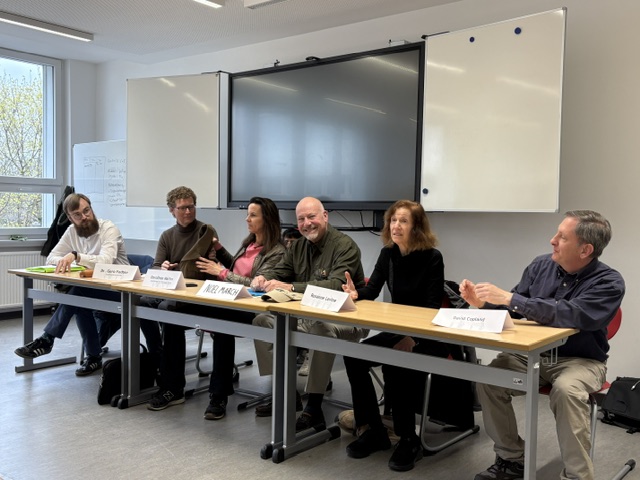
Just as Passover ended, Pittsburgher Rosanne Levine hurriedly left her Squirrel Hill home to visit Germany. The trip’s purpose, Levine said, was to speak about her late father’s experiences liberating the Langenstein-Zwieberge concentration camp and to create new connections through participation in Days of Encounter, a commemorative event organized by the Langenstein-Zwieberge Memorial.
Now back in Pittsburgh, Levine said her April 10-12 trip offered new insights on the past.
Growing up, she knew that her father, Herbert Mandel, was a member of the 8th Armored Division 399th Armored Field Artillery Battalion – Battery C; even so, Levine didn’t know much else about his activities abroad. In her 40s, she discovered her father’s historic contributions.
Langenstein — at the time of its April 12, 1945, liberation — had 1,100 male prisoners, each weighing about 60 pounds. On a daily basis, 25-30 people died, dysentery was rampant, barracks were lice-infested and most prisoners were “stretcher cases,” according to military records.
Two years before his 2023 death, Mandel told the Chronicle about liberating Langenstein. Along with speaking with this reporter, Mandel connected with a fellow liberator’s son, Noel March, and a survivor’s son, Stuart Lesorgen. Mandel used the virtual meetup to share stories about horror, heroism and retribution.
The Days of Encounter program offered students a chance to speak with descendants of liberators and former prisoners.
Levine said she’d long followed reports about “new Germany” and was deeply interested in the ways Germans are “grappling with their history.” So, hours after Passover’s conclusion, the Squirrel Hill resident boarded a plane and headed overseas.
During her brief stay in Germany, Levine traveled to Langenstein, met with families of survivors, and victims and liberators of the camp, and joined a panel during which German students viewed a video of her father describing the liberation, which was created by the Holocaust Center of Pittsburgh.
She said that while speaking to German students, she and the other family members were asked serious and deep questions about the experiences of their parents and grandparents.
Conversations with German students, participation in their efforts to clean mass graves at the site, and observation of student-created performance art made clear “they feel like they have the responsibility to carry this knowledge forward,” she added.
The students, Levine noted, were participants in NESHAMA – Network for European Youth for Holocaust Remembrance — a yearlong project funded by the European Commission under the EU Strategy on Combating Antisemitism and Fostering Jewish Life (2021-2030).
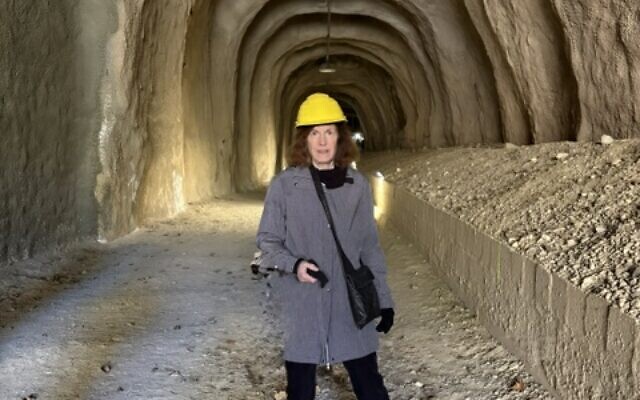
Along with participating on the panel, and spending time with German residents and dignitaries, Levine visited a nearby memorial telling the story of enslaved individuals from 23 countries.
The prisoners, Levine explained, were required to work on a 13-kilometer-long tunnel system.
Located in the Thekenberge hills near Halberstadt, the tunnel was intended to be an “underground aircraft factory.”
Between April 1944 and April 1945, more than 1,700 of the camp’s more than 7,000 prisoners died “as a result of the physical strain and inadequate nutrition” excavating the tunnel, according to museum records.
Entering the tunnel and imagining those enslaved there was an emotional experience, Levine said. “The Nazis were working people to death. It was extermination through labor.”
Levine credited The Saxony-Anhalt Memorial Foundation with “preserving the site, the memorials, the mass grave and the history.”
Those interested in preserving the past should also consider the tunnel’s future, she said. A series of 2024 articles describes how a private developer is considering transforming the tunnel into “luxury bunkers.”
Protests have occurred, including one observed by Levine that was organized by the International Second Generation Group, comprised of people whose parents were prisoners at the camp.
Levine said she knew about the tunnel system from conversations with her father, but it wasn’t until she traveled to Germany that she heard about the area’s potential transformation.
Since returning to Pittsburgh, Levine said she put away her Passover dishes and has continued following updates about the German site.
There’s a thematic relationship, she explained, as the story of Passover recalls the enslavement of Israelites and “first incident of antisemitism.”
“Remembrance and reconciliation go hand in hand,” she said. “We must all acknowledge what has happened in the past and we do everything we can to make sure that it doesn’t happen again.” PJC
Adam Reinherz can be reached at areinherz@pittsburghjewishchronicle.org.
comments