
Community marks Yom HaShoah with testimony, music and remembrance
'With the passage of time, those of us who are children and grandchildren of survivors now have the responsibility of helping to ensure that the survivors’ stories continue to be heard'
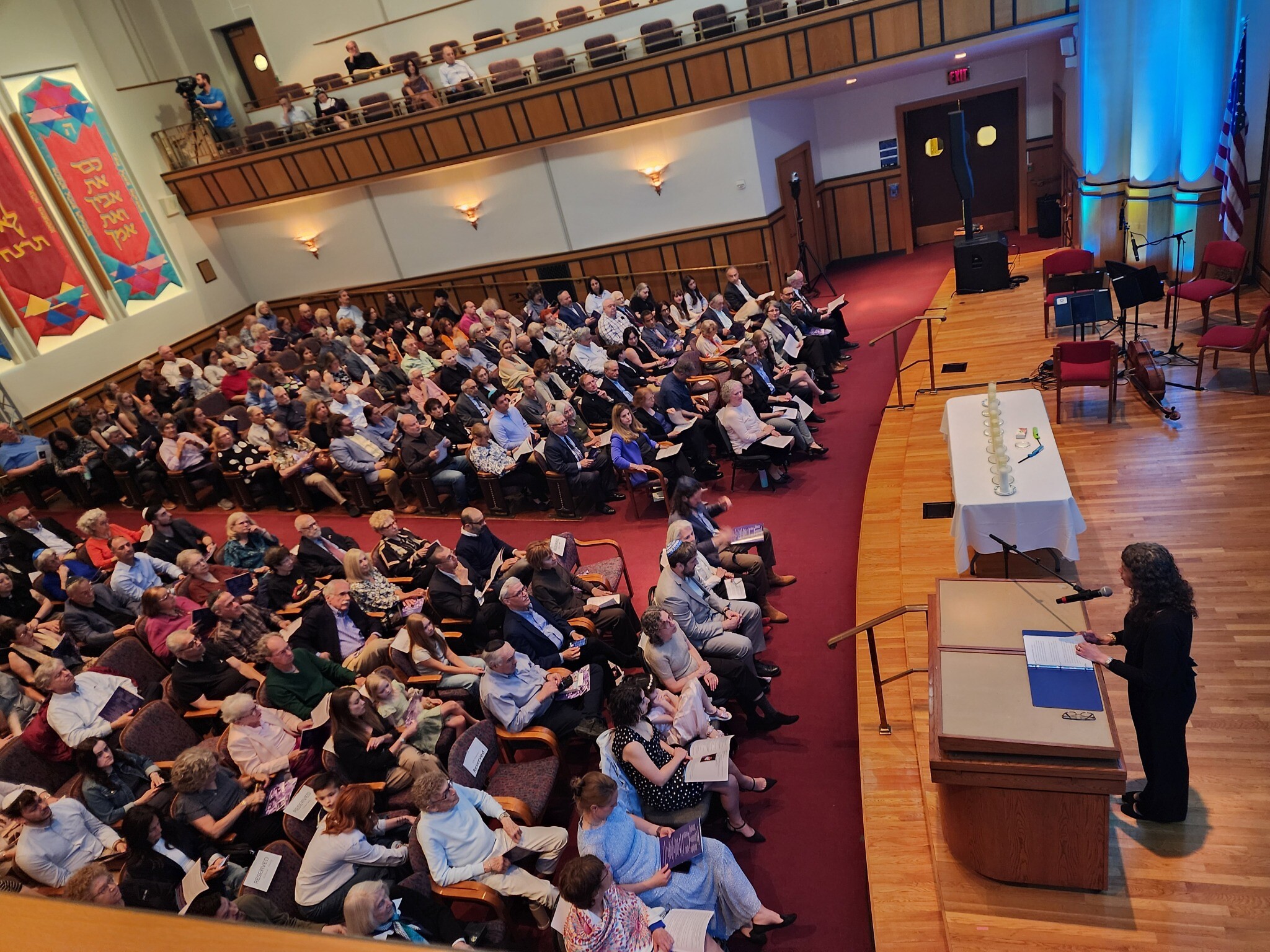
Community members commemorated Yom HaShoah by listening, observing, singing and remembering. With the aid of video projections, live music and candle lighting inside Levy Hall at Beit Kulanu (the building formerly housing Rodef Shalom Congregation, now home to the unified congregation of Temple Sinai and Rodef Shalom), nearly 200 Pittsburghers marked Holocaust Remembrance Day on April 13.
Holocaust Center of Pittsburgh Director Emily Loeb framed the program as one dependent on testimony.
Despite a dwindling survivor community, their voices must still be heard; commemorating Yom HaShoah, with reliance on survivors, is “one of our most enduring traditions,” she said.
“For years, survivors have stood at this podium and shared their experiences with our community,” said Veronica Rocher Schmerling, a member of the Yom HaShoah Planning Committee. “With the passage of time, those of us who are children and grandchildren of survivors now have the responsibility of helping to ensure that the survivors’ stories continue to be heard.”
For more than an hour, testimonies, poetry and reflections were shared.
Taped remarks from survivors Sarah (Luel) Brett, Leon Brett, Harry Drucker, Elka Kolski and Moshe Kolski, Jack Sittsamer, Ilona Weiss and Jerry Guttman, addressed faith, humanity and resolve.
“God wanted us to live, so I lived,” Elka Kolski said.
“Be a decent person, that’s all. Be good to everybody,” Harry Drucker said.
“But life, you accept I guess,” Sarah Brett said.
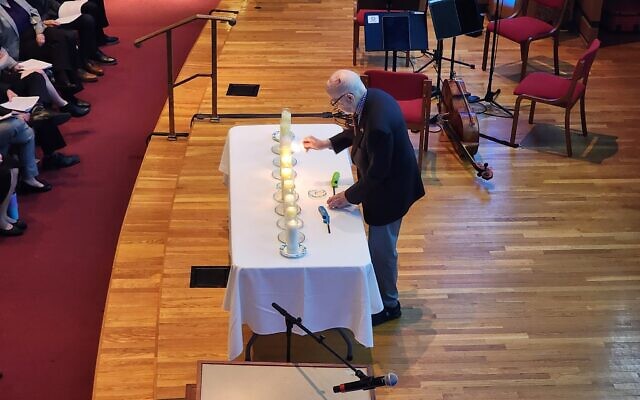
Descendants of the survivors lit six candles for the 6 million Jews who died in the Holocaust.
Holocaust educator Michele Russo read “Music is Life,” a poem written by her student Aubri Holland. Local poet Valerie Bacharach read her poem “Begin Again.”
Cantor David Reinwald of Beit Kulanu sang “Ani Ma’amin,” a song whose lyrics stem from 12th-century philosopher and sage Maimonides’ 13 principles of faith.
Eric Lidji, director of the Heinz History Center’s Rauh Jewish Archives, reflected on survival and storytelling.
“Every story matters because every person matters,” he said. “More so, every story matters for the encouragement that it gives to the next person.”
Rabbi Hazzan Jeffrey Myers, of Tree of Life Congregation, recited “El Maleh Rachamim,” a prayer typically reserved for funerals and remembrance periods.
Rabbi Aaron Meyer, of Temple Emanuel of South Hills, led attendees in the Mourner’s Kaddish, a prayer sanctifying God’s name.
Lynne Rosenbaum Ravas, a 2024 Righteous Among the Neighbors Honoree, lit a candle for the Righteous Among the Nations.
Christine and Robert Pietrandrea, children of World War II veterans, lit a candle for the liberators of the concentration camps.
Jonathan Kessler, of PNC Bank, lit a candle for World War II veterans.
Kannu Sahni, of Highmark Health and a 2025 Righteous Among the Neighbors Honoree, lit a candle for Holocaust survivors.
After 10 candles were lit, Nancy Zionts sang “Hymn of the Partisans,” first in English then in Yiddish.
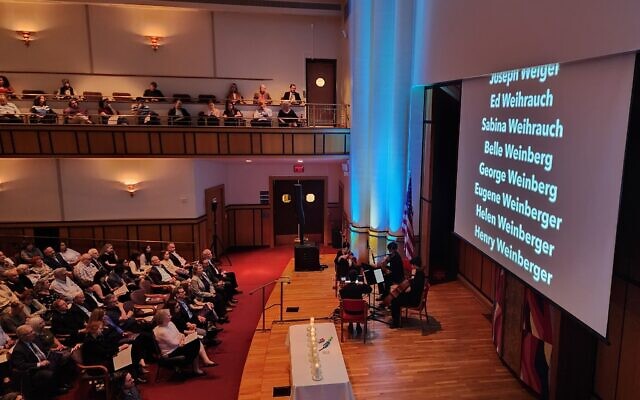
Musicians from Pittsburgh Youth Symphony Orchestra closed the program with a 10-minute selection of pieces, while names of more than 300 Holocaust survivors who settled in the Pittsburgh region, and are now deceased, scrolled on a screen.
After exiting the building, Reinwald told the Chronicle that preserving survivors’ voices requires more than safeguarding mere words.
“A lot of people don’t always know a lot about the music that came out of that era,” he said. “I think it’s important for us to keep those voices alive.”
As was mentioned during the program, “many of these victims have died double deaths: once when they actually physically passed away, and once when their names were forgotten. It’s kind of up to us to try to keep that second death from happening,” he said.
Sonja Wimer, who lit a candle for her grandparents Sarah Brett and Leon Brett, told the Chronicle the responsibility of testifying didn’t end with the survivors.
“It’s incredibly important to continue to tell the stories — not just of the horrors, which we need to acknowledge, but of the resilience of the people I descend from, the resilience of all the people that were honored,” she said. “That is something that is incredibly meaningful, beautiful and powerful about the Jewish people then and the Jewish people now. They have instilled within us that tradition, and we will not let that go.” PJC
Adam Reinherz can be reached at areinherz@pittsburghjewishchronicle.org.
comments