
My own memory lane
Revisiting a core memory with help from the historic record
This is my 100th monthly column for the Chronicle, and I’m going to risk a little autobiographical reflection. If I promise not to make it a habit, I hope you’ll indulge me.
As a freshman at Pitt in the fall of 2000 into the spring of 2001, I took many night classes at Wesley W. Posvar Hall. The enormous Brutalist structure from the early 1970s had been renamed a year earlier. “Forbes Quadrangle” still adorned campus materials.
I had a routine. I would stop at the Vegeteria food truck for a massive kosher falafel with a full pickle spear nestled into the pita, and then I would head inside for class.
Get The Jewish Chronicle Weekly Edition by email and never miss our top stories Free Sign Up
Coming into the building one evening, I noticed a line of bricks incongruously embedded in the sidewalk out front. I walked them like a balance beam and came upon a plaque commemorating Babe Ruth’s final homeruns at Forbes Field in 1935. The bricks continued, zigzagging charmingly down a small set of steps toward the sidewalk and then hopping the street. On the other side, they became a small section of an outfield wall.
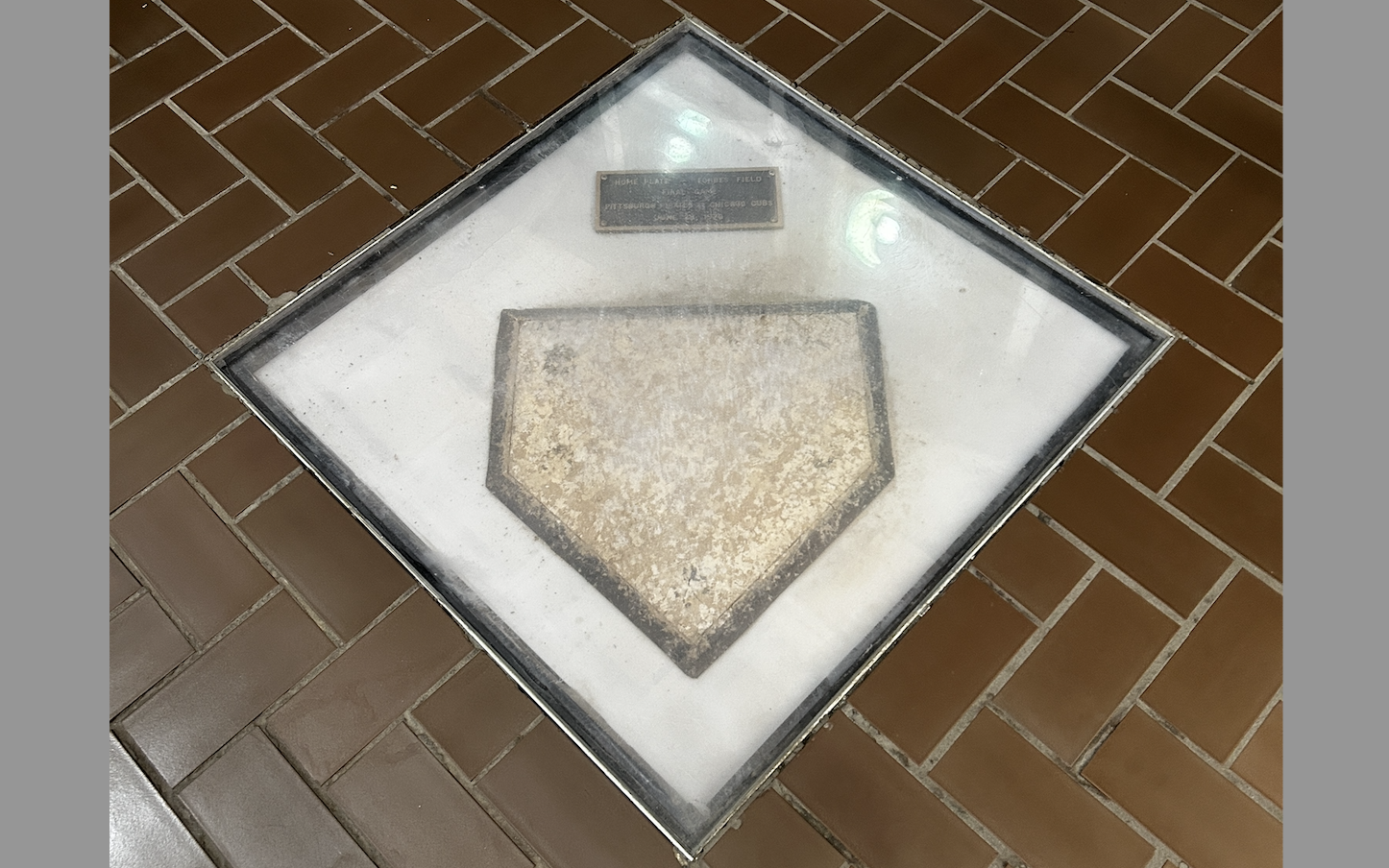
If this is the outer wall of Forbes Field, I thought, then home plate should be somewhere inside. I headed infield and entered the building. Scanning the first floor Galleria, I found a scuffed square of Plexiglas embedded in the brown herringbone tile, just outside the women’s bathroom. It framed an upside-down pentagon, a home plate speckled with cleat marks and dirt. A small bronze plaque above the artifact read: “Home Plate — Forbes Field/Final Game/Pittsburgh Pirates vs. Chicago Cubs/June 28, 1970.”
A magical sensation settled over me, the sense of existing simultaneously at two points in time. I was standing on the ground floor of a massive concrete campus building at the dawn of the 21st century, while at the same moment I could envision myself at the home plate of a baseball stadium, staring down an opposing pitcher, surrounded by fans.
This sense of layered time was exhilarating. I spent the entire summer between my freshman and sophomore years researching the former lives of campus buildings — the William Pitt Union, Alumni Hall and the Cathedral of Learning. I compiled all my findings into a series of articles for the Pitt News student paper in the fall of 2001.
Had I known about archives, I would have spent that summer in local reading rooms, digging through primary sources. But it would be almost a decade before I discovered archives. What I knew at that time was libraries, and so I checked out books.
I relied heavily on Robert C. Alberts’ volume “Pitt: The Story of the University of Pittsburgh 1787-1987.” In reading about Forbes Field, I was proud to learn that a German Jew named Barney Dreyfuss had built the stadium. But some other assertion in the book hit me wrong. What it was, I no longer remember, something about the way Forbes Field had been publicly received upon its opening. I still recall the visceral compulsion to investigate. I turned to the endnotes, and I found a citation for a newspaper article.
I knew you could read old newspapers on microfilm, and so I went into Hillman Library. There was a media room in the back left corner of the main floor. You could walk in, browse hulking cabinets filled with boxes of microfilm, and take them to reading machines to view. I recall my self-satisfaction at figuring out how to thread the machine.
Scrolling through the pages, I found the article. I have a clear memory of the page. It had a giant photograph above the fold and a huge headline. I read it, and I had another profound insight: I disagreed with the book. This was the moment I understood the power of the archives. They allow anyone in the present to reassess the past.
Everyone has foundational memories. Discovering the outfield wall of Forbes Field is one of mine. It is the story I tell myself about my initial interest in archiving.
It’s been 25 years since that moment. To commemorate, I thought it would be interesting to recreate the experience, to follow my own footsteps to gauge the fidelity of my memories and to see what new insights I might have with the benefit of experience.
The other day I visited campus and walked the line of bricks. Here came my first surprise. I found one plaque memorializing Forbes Field and another marking the spot where Bill Mazeroski’s home run cleared the wall during the 1960 World Series. A state historical marker referenced Babe Ruth, but it wasn’t installed on the site until 2006, and so I couldn’t have discovered the Babe Ruth connection in late 2000 or early 2001.
I entered the Posvar Hall. Home plate is still there, barely legible now beneath another quarter century of scuff marks. Surrounding it is a new exhibit about the impact of Forbes Field. It includes Dreyfuss but makes no mention of his Jewish identity.
Coming home, I found my copy of Alberts’ book. It still had stickums marking the pages I read when I researched the series 25 years ago. The book also did not mention that Dreyfuss was Jewish, and I couldn’t find anything about the opening of Forbes Field in 1909. I reviewed the relevant footnotes, also without any recognition.
So I tried a different approach. I went looking for the article, instead. In my original research, I had listed the date of the opening of Forbes Field as July 30, 1909.
Historic newspapers are now online, and so I started reading the issues from around that day. I soon realized I had transposed the date. Forbes Field opened on July 3, 1909. I found a lot of interesting coverage, but nothing that matched my memory.
All this was humbling. A defining plot point of my life story was riddled with inconsistencies. I am sure I saw a footnote and made a trip to the microfilm, but perhaps it was a different book or a different subject. I suspect that I have been conflating a few experiences into one memory, a memory that neatly explains the path my life has taken.
This discovery was also delightfully validating. Archives exist because people are forgetful. We evolve, adapt and invent, and the historic record pulls us back to reality.
What was most meaningful about this experiment was seeing the world through my eyes then and now. When I first walked the outfield wall years ago, my surroundings had no past to me. Revisiting the area today, I saw all sorts of references to our Jewish community history: the Joseph M. Katz Business School, sculptor Victor David Brenner’s fountain outside the Frick Fine Arts Building, the Aaronel deRoy Gruber sculpture peeking out from a corner window at Hillman Library, and the Stark Media Collection. If not for the archives, I would know nothing about any of these things.
A final note: I would like to thank the Chronicle for giving space for this column each month, and I would like to thank everyone who reads it. The world is full of enthusiasts yearning for a willing audience. I am perpetually grateful for your interest. PJC
Eric Lidji is the director of the Rauh Jewish Archives at the Heinz History Center and can be reached at rjarchives@heinzhistorycenter.org or 412-454-6406.
comments