
What does DSA actually want? Its national co-chair can’t say.
Backlash follows an interview in which the co-chair, Megan Romer, says she would have attended Oct. 8 protests
This story was originally published in the Forward. Click here to get the Forward’s free email newsletters delivered to your inbox.
It’s been a heady couple of months for the Democratic Socialists of America. Candidates the organization rallied behind ousted establishment Democrats in New York, Michigan, Colorado and Wisconsin state primaries. Pundits who doubted the movement last year are now eating crow.
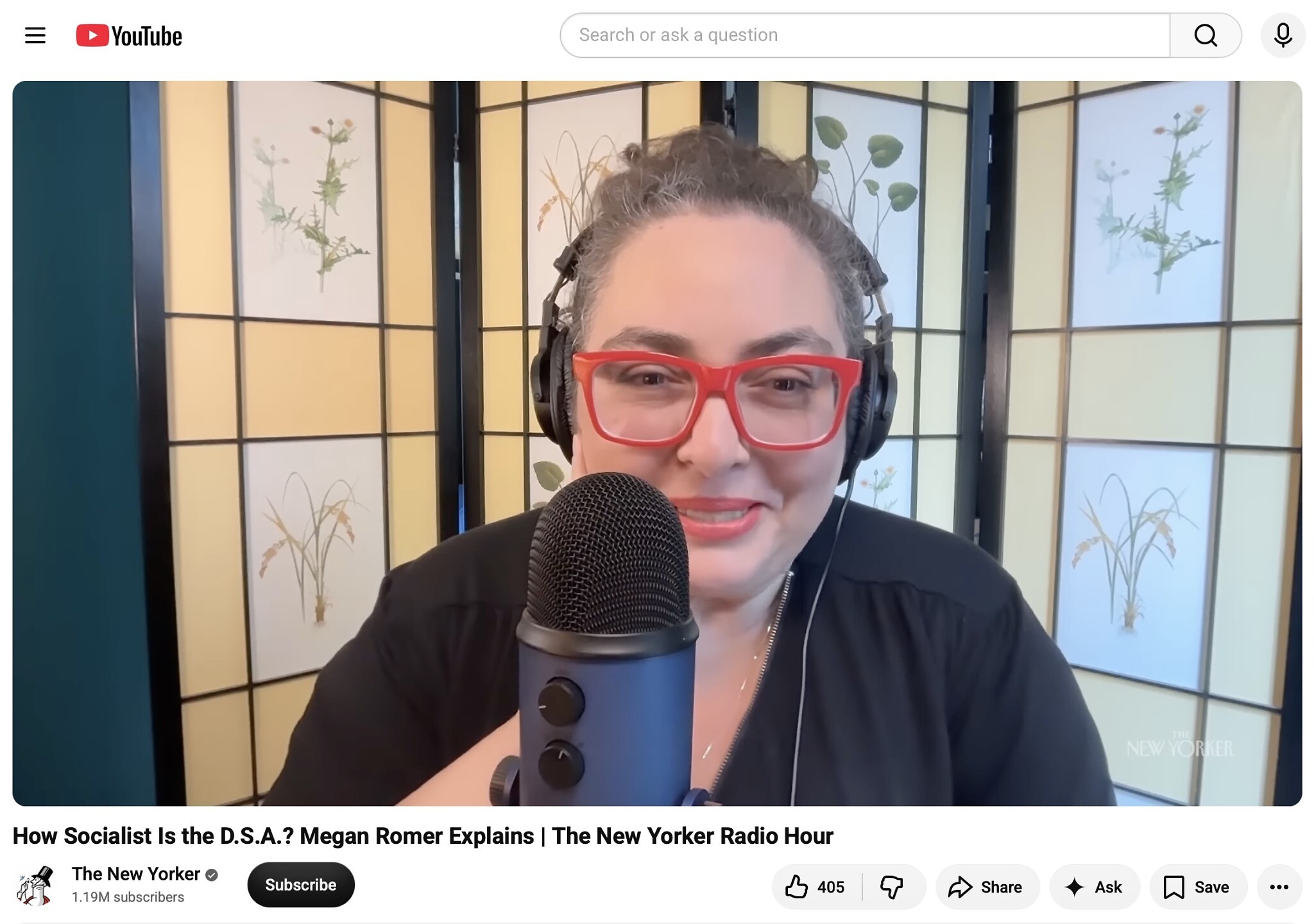
With the DSA having forced its way into the spotlight, national co-chair Megan Romer went on The New Yorker Radio Hour podcast to share what the movement is all about. But the interview has elicited an online backlash — and some ridicule — after Romer said she would have attended an Oct. 8 protest and that she would have sought to stop Russia’s advance in Ukraine through diplomacy.
Just as damning to some viewers was Romer’s reluctance to provide specifics on a number of DSA policy positions when pressed for them by New Yorker editor David Remnick.
The backlash to the interview put Romer on the defensive. The day after its publication the national co-chair called Remnick a “debate bro” who had tried to make her look and feel stupid during the conversation. Remnick, a Pulitzer Prize–winner and former Moscow correspondent for The Washington Post, has edited The New Yorker since 1998.
“Luckily lots of practice keeping my temper in check when debate bros are well-actually’ing me, tho it still flusters me,” Romer wrote Saturday on X. “I am def particularly sensitive when people are actively trying to make me look/feel stupid and it can throw me off my game.”
The interview highlighted a challenge that faces the organization as it gains members and breaks through on the Democratic stage: Translating its rallying cries into the gritty work of partisan politics — or, for the candidates DSA champions, getting things done while remaining true to the movement’s ideals.
Nowhere was that clearer than Romer’s talking points on Israel. Romer said the organization’s position was “a free Palestine with a capital in Jerusalem, and so I think that can safely be read as a one-state solution.” When Remnick asked her if DSA would have supported the proposed terms of the Camp David summit in 2000, had the Palestinians accepted it, Romer said: “Good question — I’d have to actually look at what the specifics there were.”
(The exact terms discussed at the summit are in dispute, but most agree it would have involved a separate Palestinian state with a capital comprising several Palestinian neighborhoods in Jerusalem.)
A testy exchange followed around Romer’s stance on the Hamas-led attacks of Oct. 7, 2023.
Asked whether she supported New York congressional primary winner Darializa Avila Chevalier in attending a “pro-Hamas” rally on Oct. 8, Romer said yes — she would have gone herself.
“If you put people in an open air concentration camp, and you deprive people of rights, of dignity, of food, of the ability to live in safety,” Romer said, “you have to expect that they are going to not take that for that long. And that is not defending any harm of civilians or of non-combatants.”
Remnick replied, “Well, sure it is — you said you’re supporting it.”
Romer said, “I’m saying that I think it was inevitable.”
On issue after issue, Remnick pressed Romer for details and found few.
- Romer said DSA wanted to “tax the hell out of millionaires” but demurred on what that would mean in practice.
- Romer said she believed in open borders, but not in “throwing the gates open.” When Remnick asked if that wasn’t just immigration reform — which is to say the Democratic policy platform — Romer replied, “It means reforming the system we have while we rethink the system, while we build this new one from the ground up, and then hopefully eventually flipping the switch.”
- Romer said she did not believe in sending arms to support Ukraine in its war against Russia. She asked Remnick, “Why aren’t we doing any amount of actual diplomacy? Why aren’t we doing any amount of actual sending actual human beings to talk to human beings?” Remnick pointed out that there had been many attempts of diplomacy, “however failed,” since the beginning of the war.
- Remnick asked Romer what she meant when she said she believed in prison abolition. She answered that the safest communities were not ones with cops on every corner, but ones with “good schools, good jobs, good park systems, good recreation for their teenagers, things like that. Those are the safe communities.”
- As for her support for defunding the police, Romer said she was “not in favor of getting rid of police entirely tomorrow” but that she supported decreasing their budgets until a point where social services were sufficiently funded.
For the most part, Remnick — trying to fit Romer into a 30-minute podcast slot — let Romer’s answers speak for themselves whether they answered his question or not. But he did hint at a broader argument in one of his final questions, about the DSA’s position in favor of abolishing the U.S. Senate.
Given the scant likelihood of such a measure passing, Remnick asked, didn’t it distract from policy goals that were more likely to succeed?
“I don’t think so,” Romer replied. “I think taking principled positions tells people that you’re principled, and I think we see voters really responding to that, and we see people saying, ‘Oh, you’re actually thinking about the systems.’”
This story was originally published on the Forward.
comments