
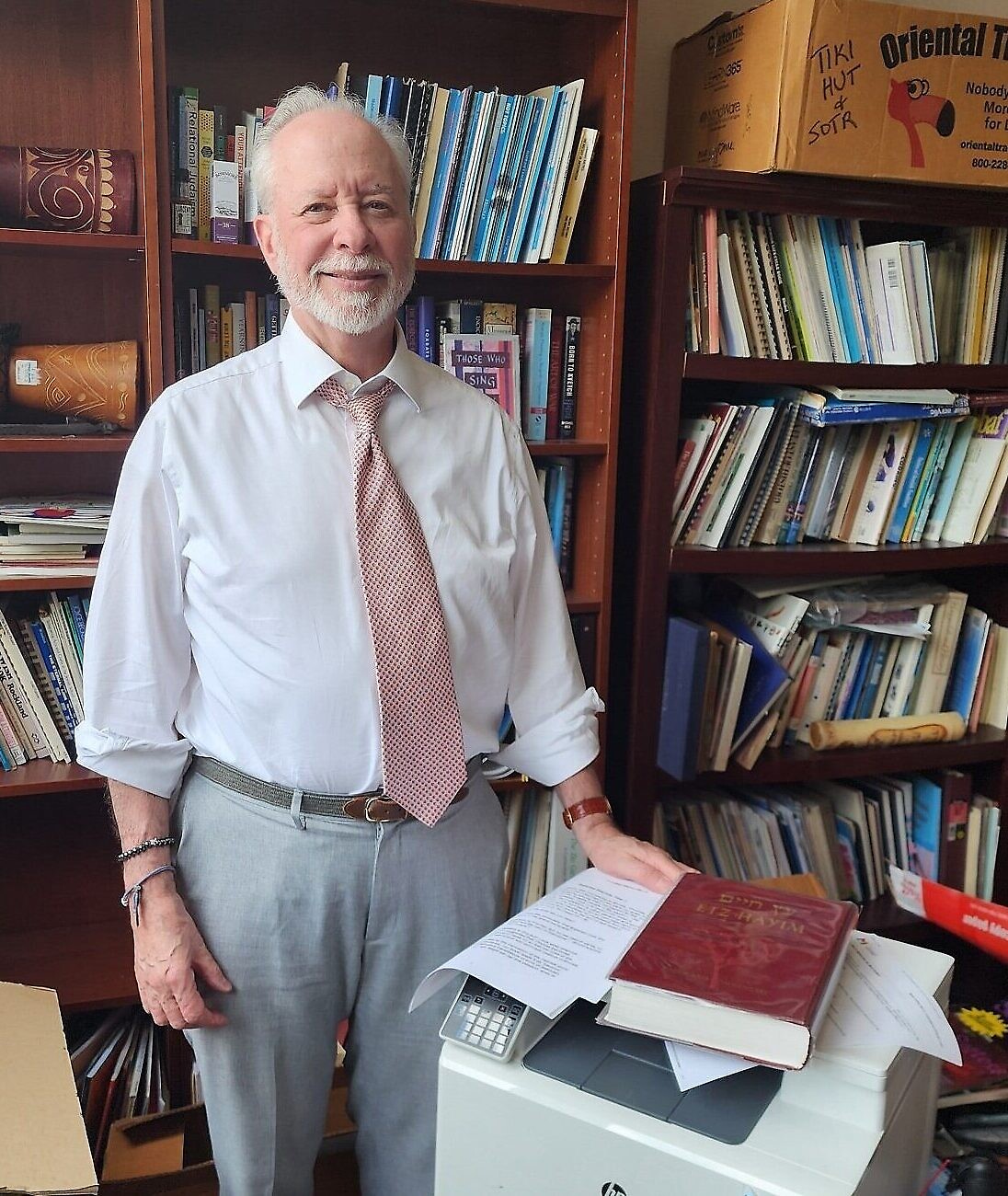
A rabbi often associated with tragedy, resilience and the aftermath of horror is leaving Pittsburgh. Rabbi Hazzan Jeffrey Myers, Tree of Life Congregation’s rabbi and a survivor of the Pittsburgh synagogue shooting, is retiring on July 31. His upcoming departure marks a new beginning. For the first time in 49 years, Myers, an ordained cantor and rabbi who began teaching Hebrew school in 1977, will not hold a professional Jewish post. Though he’ll finish out his two-year stint as president of the Cantors Assembly, Myers, 70, said the majority of his time post- retirement will be dedicated to writing a book, seeing the bimah from the pews and visiting with his 3-year-old granddaughter. Before beginning this next phase of his life, Myers spoke with the Chronicle.
This interview has been edited for length and clarity.
Congratulations on your upcoming retirement. Before we talk about the future, let’s talk about the past. Tell me about joining Tree of Life 10 years ago.
At the time I was in the process of looking for a new pulpit, and the opportunity was available here. We just began with, as I think in most congregations, exploratory conversations with leadership search committees and it just continued on. I recall saying to my wife at the time, “Pittsburgh? I have no idea what Pittsburgh is. I know it’s out there, but I have no idea.”
Until that point you’d spent your career on the East Coast. What were your initial impressions of Pittsburgh?
I remember when I was picked up at the airport the first time. They detoured and we went up to Mount Washington to take in the view. It’s stunning. Subsequently, anybody that comes here, I’ll drive them up there. Really, there’s no view like it. The other thing is I tried to read up on the history here to some degree to get a better sense of community — so kudos to the Jewish Chronicle for their archives. I read quite a bit there.
You began working in Pittsburgh on Tisha B’Av 2016. What did you discover about the community after moving here?
I was immediately pleased that there was a communal Tisha B’Av program. It’s not as easy to have a fulsome minyan for summer observances like Tisha B’Av, and the fact that the Conservative and Reform community — collectively in Squirrel Hill — recognized that and did something about it, I thought was good. That’s not always the case in communities. I thought that’s a really great way to start. Similarly, I was really impressed by the Shavuot-o-thon [Tikkun Leil Shavuot]. Every range of the Jewish community is present. We’re able to ignore any differences we may have to gather together to study Torah — and by Torah, not just the narrow but the wide sense. That’s really impressive.
Tree of Life dates to 1864. What was your sense of the congregation?
Early on we worked to rebuild the volunteer infrastructure. That became my No. 1 priority. Actually, during the High Holidays of 2018 I gave an appeal — but not for money, it was for time, which to me is the most valuable commodity people have these days. We never have enough time. We always seem to have $1 here and $1 there, but time is something people just don’t have enough of. I appealed to the congregation for time. Everyone got an envelope with two red stickers, and I asked people to pledge their time by putting a sticker next to something on a list of priorities that resonated with them. That was the High Holiday sermon for the first day of Rosh Hashanah. The envelopes were all collected, they were sorted and divided up into different units. Then Oct. 27 came.
Walk me through that.
I came to realize that that’s why God sent me here. I thought after having served my first year, that it was to address what I thought were the pressing needs. What I came to realize — and I don’t think God ever really communicated to me, even though I’ve asked him why me — but this is what God wanted me to do. That doesn’t mean I didn’t, and don’t, regularly ask God, question God, look for God’s guidance; but for whatever the reasons, God wanted me to be the one here. I can’t say I enthusiastically accepted the call. I did it with much regret that that needed to be the case, but it was.
What do you mean ‘with much regret?’
That there needed to be a call for someone to be here, to serve a totally different set of needs. It’s easy, I think, for us to blame God for all the bad that happens in life. I’ve never had that attitude, so that’s never changed. We know in Pirkei Avot that everything is preordained, but there’s freedom of choice, so God does not intercede in preordination, just God knows, it’s going to happen. God’s the one we turn to — as I continue to do every day — for strength and guidance. The shooter had freedom of choice. He chose badly.
Tell me about your choices in the aftermath of the shooting.
There were really two crystal clear choices for me: one was to drown my sorrows in a bottle of liquor and just fade away — and I don’t think anyone would have looked askance at me — and say ‘I can’t do this,’ and leave. I can’t tell you what drove me to not make that choice, other than God. This is why I was here. The question is what do you do with that mantle of responsibility? I accepted that God foisted that upon me, and I’m not going to be like Jonah — getting in a moving van and going to Tarshish. I accept it and I will continue to do what I can, no matter where I am.
You speak pretty certainly about God’s decision-making process. Why do you think God selected you for this path?
I think only God can answer that one. I really don’t have an answer per se because there’s no — shall we say — preparation work. I like to think that the experiences lived all prior years, perhaps in some way, could offer elements of training in terms of things that you’re expected to do, that you’ve never done before, that you don’t know that you have the ability to do.
Could you tell me more?
The metaphor I’ve used is there’s a big red toolbox. You open the lid, it’s got that black tray where you pull those little parts. I have no idea what to do with them, but if you pick up the tray you see there’s the hacksaw or the spare blade. You pick it up and discover, “Wow, I got stuff in the toolbox I didn’t even know I had.” Psychologists call that discovery post-traumatic growth, and what they mean is after you suffered a trauma like we in Pittsburgh have, the trajectory of your life beyond that is you discover things that you didn’t know that you could do, that you can do.
Can we talk about your journey since Oct. 27, 2018?
Healing will never be fully realized. I don’t think it ever can be. In a case like this, we will be continually healing. I’d like to think that if you look from 30,000 feet, the trajectory of healing is like on an xy-plane, it continues to go upward, but if you can put it under a microscope, it looks like an oscilloscope, peaks and valleys, peaks and valleys, peaks and valleys, over the course of every single day.
Your role in the healing journey is as both a survivor and someone tasked with shepherding a community. Can we speak about that?
The unique nature of me being a survivor, and then also being called upon to pastor the congregation, is like that image of justice with the two scales: Sometimes it’ll be heavy in one direction, and then sometimes it’s in the other. The scales I think are always going up and down. There’ll be moments when I need to step back and just give attention to good self-care, and there are moments when you’re entangled in doing both simultaneously. Again, because there’s no guidebook, you just have to have faith in God and trust your instinct to do what it’s telling you to do.
You mention that there was “no guidebook.” How did you make it through the first days and what helps you now?
I found just in the overall set of years my colleagues have been so supportive, encouraging, complimentary. I’m grateful that they’ve been there to hold me up, kind of like in the Torah, when Israel’s in battle, and Moses can’t keep his arms up anymore he gets help. Whether it’s been rabbinic and cantorial colleagues doing that, or my own congregants doing that, or communal leaders, or not even community leaders, just ordinary decent folk here in Pittsburgh — of which there are so many — all doing that. To me I think that’s the most beautiful part of Pittsburgh.
What comes next for you?
We’re moving to New Jersey because we want to be near our granddaughter, who’s 3, and to be in her life. To us, the most critical thing is family. We love Pittsburgh, we would stay here, but a six-hour drive, that’s too much. I’m not moving to another pulpit, I’m retiring from the pulpit world. Does that mean I might not be engaged on a High Holiday or something like that? Anything’s possible. I’m open to what possibilities might exist. I’m also looking forward to writing a book with Pastor Eric Manning [of Mother Emanuel AME Church in Charleston, South Carolina] on our shared journeys, because they are so similar. We’re on that same path together, but it’s not like we’re in separate cars. He and I are in the same car. We speak regularly. Our trajectories are the same. To write about that — that shared journey — to think about how do we find hope, and how might we teach America how to find hope, that’s a commodity that’s missing.
Do you feel like your work here is done?
I believe that the mission God wanted me to do has reached a conclusion. There will always be healing, but I believe we’re on a trajectory that we understand enough about it to be able to look out for each other and promote it. That doesn’t mean that there won’t be two-steps-back moments, but in the overall scheme of things I think we’re moving in a positive way to promote healing. And I think that that’s what God wanted me to do. I think that healing will still continue in the background — that switch never gets turned off — but there are other things simultaneously for Tree of Life to look into as it moves into its 163rd year, and I believe that it’s poised to continue to be a tree of life to all who hold fast to it.
Rabbi Myers, thank you for your time and insights. What do you want the takeaway to be?
He tried his best.
What do you mean?
As an educator, I’ve always had the approach when it came to b’nei mitzvah training, we have this expectation of perfection, which is so unrealistic and unfair. I’ve always said to kids, if your best is an 89 and you achieve an 89 that day then I say, “Congratulations, I’m so proud of you.” As I grade myself, whatever that number is, I gave my best and I’ll let everyone else give their score. Whatever that number is, I accept it. I recognize I’m human. I make mistakes — because that’s the nature of being human — but I accept whatever that score is. As much as you want that one day not to define you, it did, so I accept it. That’s what was foisted upon me. And OK, I can only say upon reflection, I did my best. I’ll let historians determine what kind of legacy that is to be. PJC
Adam Reinherz can be reached at areinherz@pittsburghjewishchronicle.org.
comments