
ADL launches new initiative to help universities address antisemitism
"Universities cannot claim to be addressing antisemitism seriously if they ignore what happens behind the classroom door and inside faculty governance."
As students were returning to campuses across the country last week, the Anti-Defamation League announced a new initiative, “When Antisemitism comes to Class,” designed to help colleges and universities address antisemitism.
The initiative includes the Campus Classroom Reporting mechanism, a portal serving as a support channel for students, staff and faculty who have “concerns about antisemitism or biased content related to Jews or Israel in classroom experiences, instructional framing, assignments or faculty conduct,” according to the ADL. It also includes two new reports: “Antisemitism Among Faculty and in the Classroom: Trends, Patterns and Institutional Dynamics,” and “The Faculty Factor: Inside the Networks Driving Anti-Israel and Anti-Zionist Activism on Campus.”
In a statement announcing the new initiative, Jonathan Greenblatt, ADL’s CEO, said that antisemitism doesn’t just occur through student protest chants or anti-Israel encampments, but can also be present in syllabi, lectures or even casual remarks by professors.
“Because classrooms and faculty organizing spaces are largely invisible to those outside the institution, this problem has been allowed to fester with far less scrutiny than it warrants,” Greenblatt said. “Universities cannot claim to be addressing antisemitism seriously if they ignore what happens behind the classroom door and inside faculty governance.”
The Campus Classroom Reporting Mechanism will allow students, faculty and staff to report concerns about perceived antisemitic or biased content; ask whether a specific classroom dynamic, course requirement or interaction may raise antisemitism concerns; talk through a situation involving Jews, Jewish identity or Israel before deciding whether to make a formal complaint; and get help understanding what support options are available.
The report “Antisemitism Among Faculty and in the Classroom” focuses on six areas: one-sided framing and the blurring of education with advocacy; the introduction of “pro-terrorism” narratives; academic incentives and the subtle pressure to conform; classroom dynamics and the singling out of students; faculty governance, institutional positions and support for BDS initiatives; and, faculty activism and its influence on academic culture.
The report concludes that university faculty play “a significant role” in how “political and identity-related issues are experienced within higher education.”
A “discernable trend” was found among multiple campuses and disciplines “in which discourse surrounding Israel, Zionism and Jewish identity is framed in ways that go beyond critical inquiry.”
These trends were found over a wide spectrum, including individual classroom interactions and institutional choices about curriculum and programming.
The “Antisemitism Among Faculty in the Classroom” report identifies a recurring pattern of “pro-terrorism” narratives in coursework, extra credit for attending anti-Israel rallies, and singling out Jewish students, resulting in a double standard that normalizes bias.
The ADL’s second report, “The Faculty Factor,” concentrates on networks of professors and staff members who actively participate in or lead anti-Israel and anti-Zionist organizing on and around campus.
Since 2024 some faculty, the ADL found, have collaborated with anti-Israel and anti-Zionist student groups, providing “institutional cover for student activists,” normalizing “hostility towards Israel as legitimate academic discourse,” and “creating hostile environments for Jewish students, staff and faculty.”
According to the report, this behavior has resulted in disciplinary cases against some faculty members, several of which are still being resolved.
The report notes that in a 2025 ADL/Academic Engagement Network survey of more than 200 Jewish-identifying faculty, nearly three quarters reported observing anti-Jewish activity that originated from other faculty, staff or administrators causing them to feel “traumatized.”
Anti-Israel and anti-Zionist faculty and staff have sought to influence university policy, curricula, institutional ties and public discourse, the report found. Antisemitic tropes, the targeting of Jewish organizations and individuals, open hostility toward Jewish students and colleagues, protests which have led to clashes with law enforcement, arrests and property damage, are all cited in the report.
These same networks, the report states, challenge institutional relationships with Israel, advance the BDS movement and seek to disrupt university events.
Some faculty participated in the wave of anti-Israel encampments across the country or canceled classes in solidarity with the protesters. In some cases, the encampments were protected by faculty from law enforcement, the report said.
Faculty with an anti-Israel agenda have used resolutions and statements to influence public discourse in favor of BDS resolutions, a push for amnesty for students who violated campus conduct policies and obstruct the adoption of formal antisemitism definitions, it said.
Two groups — Faculty and Staff for Justice in Palestine and the American Association of University Professors — along with several unions are highlighted for their growing influence and anti-Zionist and anti-Israel rhetoric.
The post-Oct. 7 campus protest movement, the report concludes, “is sustained by an interconnected network of faculty activists, professional associations, unions, student organizations, and community groups that increasingly operate across organizational and geographic boundaries.”
No Pittsburgh college or university was cited in the report, but several — including the University of Pittsburgh and Carnegie Mellon University — have been touched by anti-Israel, anti-Zionist or antisemitic activity.
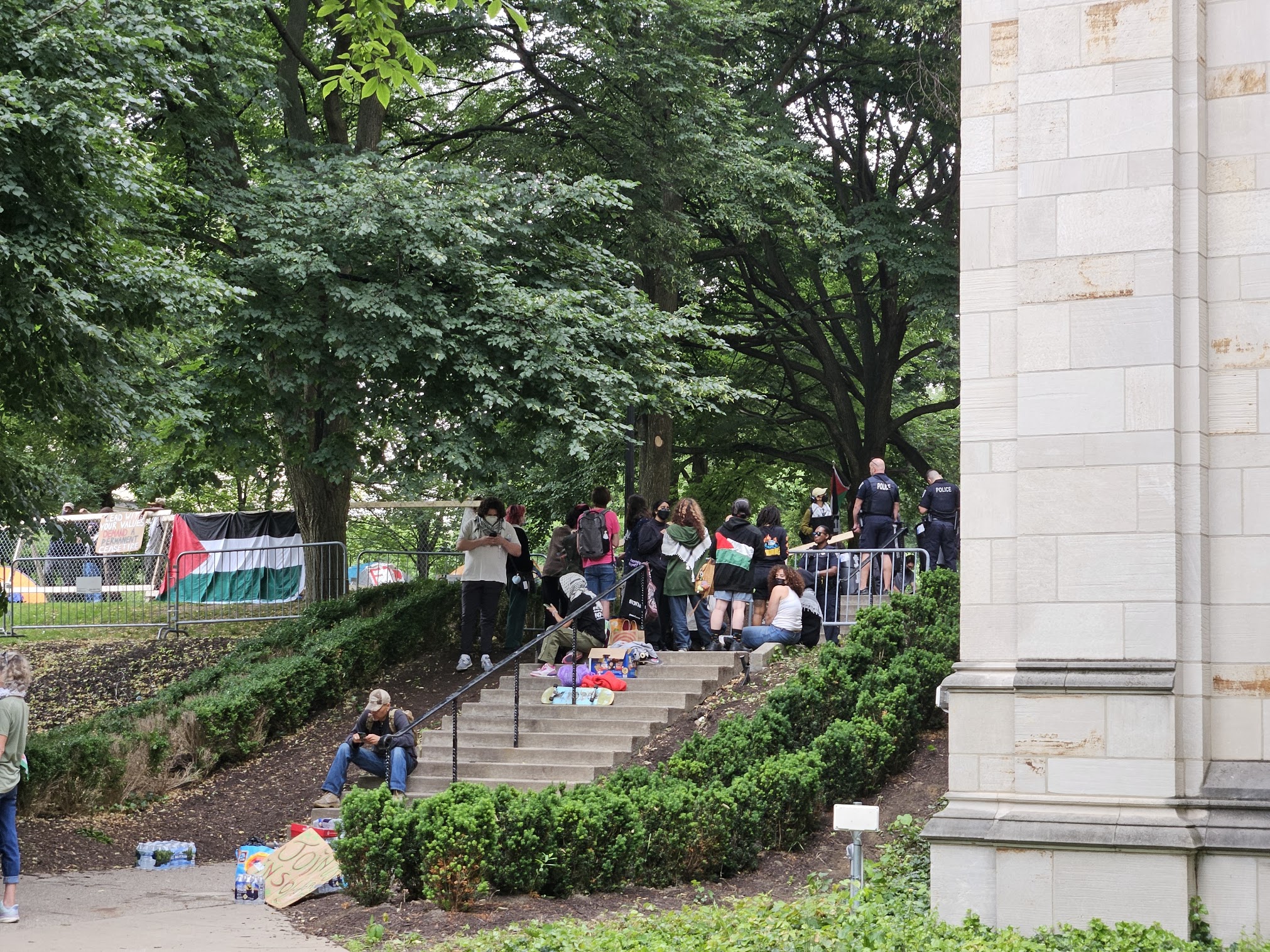
Pitt was home to two anti-Israel encampments after Oct. 7, one of which resulted in several arrests, including some that are still being adjudicated. Three Pitt students were physically attacked in two separate incidents around the campus, as well.
Earlier this year, Pitt’s Working Group on Antisemitism, convened by Chancellor Joan Gabel, issued its final report, making recommendations in five broad areas: institutional capacity to respond to antisemitism; institutional policies; training, education and contextual understanding; incident response and enforcement mechanisms; and external events and off-campus influences.
The university issued a response to the report, agreeing with much of the group’s findings, and stating what steps it was taking to combat antisemitism on campus and to ensure the safety of Jewish students, faculty and staff.
A group of self-identifying “Jewish faculty, staff, students, and alumni of the University of Pittsburgh, and “friends and allies of our Jewish colleagues and neighbors” published an open letter voicing criticism of the Working Group’s report and created its own list of suggested steps for Pitt to undertake. Those steps included situating the university’s “responses to antisemitism within a broader context that recognizes antisemitism as one of many kinds of injustice that impact members of the University of Pittsburgh community.”
The group sought signatures from the community and said the letter would be presented to Gabel. It is unclear how many people signed the document or if it was delivered to the chancellor.
Pitt’s chapter of the American Association of University Professors also published a letter, saying it was “deeply alarmed” by the Working Group’s report and the university’s response, and that it was “concerned about the process through which the report and the response were generated, about their implications for academic freedom, and about the proposed path forward.”
A letter from the Faculty and Staff for Justice in Palestine called for Pitt to “rescind and renounce” the Working Group’s report.
Throughout the summer, Carnegie Mellon University saw several anti-Zionist messages painted on its Fence, including “Death to Zionism” and “By Any Means Necessary,” which prompted a response from CMU President Farnam Jahanian. He wrote that it “is categorically unacceptable for an anonymous message painted on CMU property to incite or imply support for violence, and it is equally unacceptable for members of our campus community to feel physically threatened or unsafe.”
CMU is reportedly in the process of investigating several students for their role in painting the messages.
At Point Park University, professor urged students to “stand up against Israel’s attacks on Palestine by staying educated, boycotting, contacting their elected officials and protesting,” during a 2024 lecture, according to the school’s newspaper, The Globe.
The Chronicle reached out to Pitt and CMU for comments about the ADL’s new initiative but did not receive a response before publication. PJC
David Rullo can be reached at drullo@pittsburghjewishchronicle.org.
comments