
‘Stop Them At The Bypass’
A short-lived plan to bypass the Squirrel Hill Tunnel animated Jewish involvement in local politics in the early 1970s.
With an existential dread once reserved for Yom Kippur afternoon, all Allegheny County spent early July wondering what would happen when PennDOT closed the Squirrel Hill Tunnel for a month to finish the Commercial Street Bridge. My first few days outbound on the Parkway East were delightful. There was hardly any traffic at all.
Was it like this in the old days? The Squirrel Hill Tunnel opened June 5, 1953. By the end of July, state police had issued more than 1,350 warnings, mostly for speeding.
The Parkway East initially had a speed limit of 50 miles per hour. To combat all the flagrant speeding, authorities soon dropped the speed limit to 35 through the tunnel.
Get The Jewish Chronicle Weekly Edition by email and never miss our top stories Free Sign Up
As we all know, this problem solved itself.
By the early 1960s, perpetual traffic jams had made it impossible to speed through the tunnel except in the middle of the night. Today, lamenting slowdowns approaching the Squirrel Hill Tunnel is a foundational aspect of life in the eastern part of the county.
State transportation officials — along with thousands of amateur transportation experts crawling along in traffic — have spent decades batting around a fix for this problem. Dedicate three lanes to inbound traffic during the morning rush hour. Issue tickets for driving two slowly. Restrict truck traffic at certain hours. Add a third tube.
The most enduring proposal has been a Squirrel Hill Tunnel bypass. The current iteration emerged in the late 1980s, as one of many projects tacked onto the Mon-Fayette Expressway. It would essentially create a Y-shaped junction at the Glenwood Bridge with each branch connecting to the Parkway East on opposite sides of the existing tunnel.
There was briefly an alternate idea for bypassing the Squirrel Hill Tunnel. It didn’t last long, but it played an important role in the history of the neighborhood.
At the end of the 1960s, the leading idea for improving the Parkway East was adding a third tube to the Squirrel Hill Tunnel, creating six or seven lanes instead of four.
As PennDOT was advancing these plans in early 1972, rumors emerged that the agency might also be secretly developing an alternate plan to build a six-lane bypass immediately south of the Squirrel Hill Tunnel. This bypass would have required the demolition of several hundred homes between Morrowfield and Caton streets.
Within a few days of news spreading, two Squirrel Hill men called a press conference to oppose the idea. Both were Jewish and both active in local politics.
Dr. Martin J. Krauss was a North Side optometrist who lived in Squirrel Hill. He had gained notoriety in the early 1970s as president of the Highway Emergency and Relocation Team, better known as HEART. The citizens’ group opposed the Parkway North, which was proposing a similar scale of demolitions in the East Street Valley.
Krauss brought along Ivan Itkin. Itkin was one of the many Jewish engineers who had come to Pittsburgh from New York in the late 1950s to work for Westinghouse. He made a shift to politics in the early 1970s, serving as Democratic chairman for the 14th Ward and chairman of a conglomerate of local Democratic groups called Coalition ’71.
After the press conference, PennDOT insisted there were no definite plans for an open-cut bypass, only preliminary work to outline alternatives. It preferred a third tube. It said any opposition was premature, and it accused the two men of political motivation.
Krauss was running for a spot as Democratic committeeman. Itkin was one of seven Democratic candidates running for the 23rd district of the Pennsylvania legislature.
The 23rd district was created during statewide redistricting in the late 1960s. Rep. Gerald Kaufmann was elected in 1966 as an at-large representative for Allegheny County. With the 23rd district, he represented greater Squirrel Hill, home to some 24,000 Jewish people, more than 60% of the entire Jewish population of the county.
Kaufmann left office before the 1972 election. As often happens when an incumbent departs, a rush of people filed candidacies during the primary season.
A few days after the press conference, state Transportation Secretary Jacob Kassab ruled out an open-cut bypass in Squirrel Hill. He described the communal anger as a “politically inspired scare tactic not in the best interest of the community.”
Even with this reassurance, Krauss and Itkin maintained pressure. They arranged a meeting at the Y-IKC in Squirrel Hill called “Stop Them At The Bypass” on April 10.
In the middle of the meeting, Councilman John Lynch arrived. He had just met with Gov. Milton Shapp at the William Penn Hotel and claimed Shapp had issued a statement saying he would not approve an open-cut bypass during his term in office.
With that, the idea was effectively dead.
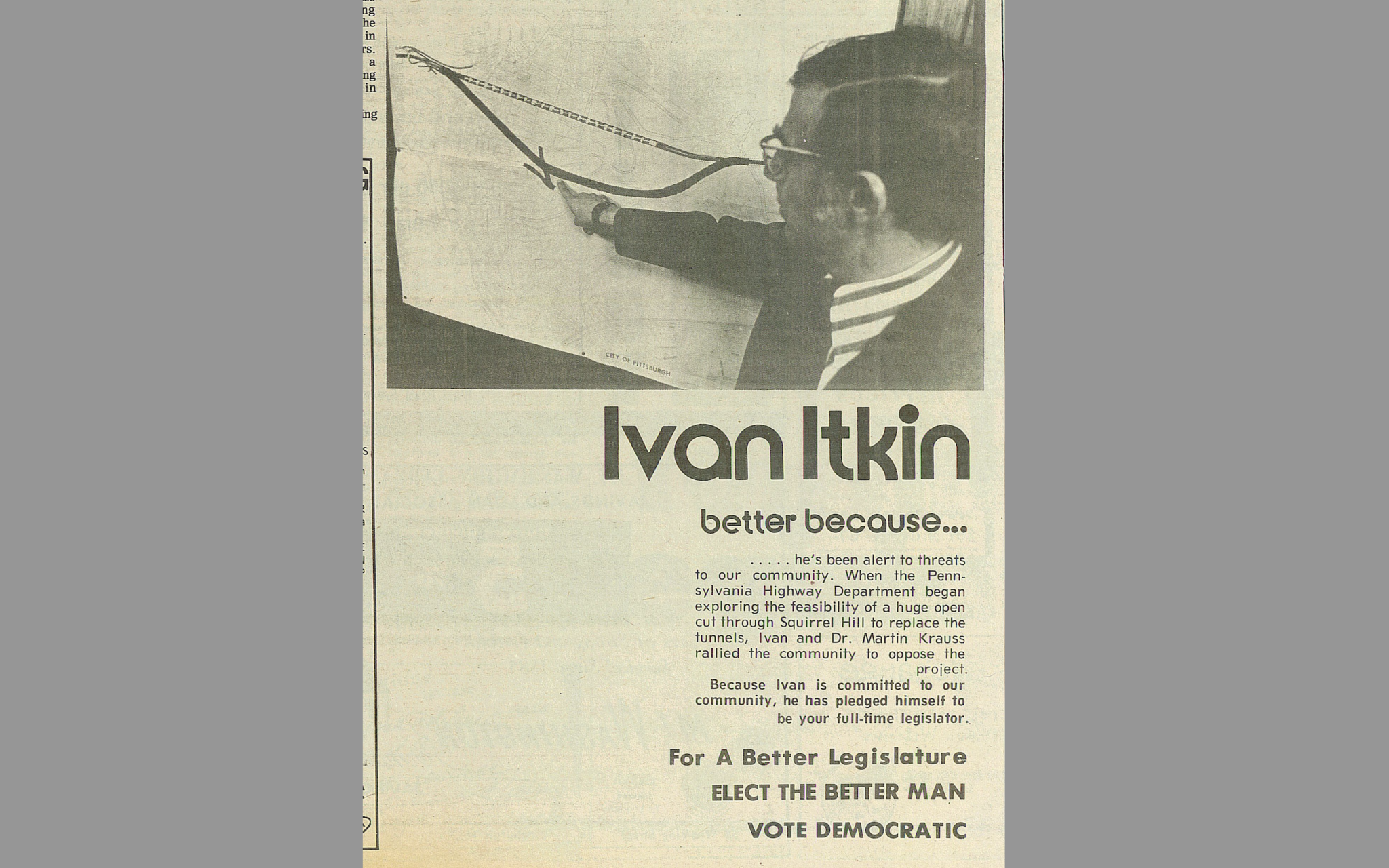
About two weeks after the meeting, Itkin easily won the Democratic primary, taking more than a third of the votes in the seven-way race. He made the open-cut bypass part of his general campaign, running an ad highlighting his role fighting the proposal.
Itkin faced Republican Bernard Markovitz in the fall, winning by 277 votes. At that margin of victory, every issue is decisive. Itkin held the seat until he retired in 1999.
The open-cut bypass came at an introspective moment for Squirrel Hill. In a forum on the future of the neighborhood in 1970, a city planning official had said, “My opinion is that if the present state of affairs continues — unchecked, unchanged and untampered with — Squirrel Hill in 15 years will be what the Hill District is now.” The insensitive comparison ignored the vastly different historical circumstances of the two city neighborhoods, but it must have resonated with many in Squirrel Hill who still remembered the old Jewish neighborhood of the Hill District before World War II.
The open-cut bypass symbolized the moment. Without action, aging infrastructure in the city and public investment in the suburbs would have likely meant the end of Squirrel Hill as a pluralistic Jewish community set into a multicultural neighborhood.
This newspaper led communal efforts to revitalize the neighborhood. A few days before news broke of the open-cut bypass, it devoted an entire issue to the state of Squirrel Hill. Editor Al Bloom noted that a Jewish out-migration from the neighborhood would mean millions to relocate communal institutions, drawing funds from other needs.
This is what prompted the Urban Affairs Foundation of the United Jewish Federation to propose bringing together all relevant neighborhood groups to deal with emerging issues. The Squirrel Hill Urban Coalition was incorporated in July 1972. PJC
Eric Lidji is the director of the Rauh Jewish Archives at the Heinz History Center and can be reached at rjarchives@heinzhistorycenter.org or 412-454-6406.
comments