
Observance and observations: Seminar spotlights Vilnius
For generations, Vilnius was a colossus of Jewish culture. Before World War II, the 'Jerusalem of Lithuania' possessed 80,000 Jews and more than 100 synagogues. Intellectual titans wrote texts creating Ashkenazic norms. An influential Jewish publishing house set the standard for scholars worldwide. While libraries and exhibitions honor what was, a Classrooms Without Borders seminar asked participants to consider ties between people and paper

Pittsburgh Jewish Chronicle Senior Staff Writer Adam Reinherz accompanied educators and lay leaders on a two-week trip to northern Europe. Traveling through Lithuania, Latvia, Estonia and Finland, Reinherz reported on modern Jewish life, vanished communities and the quest to create a new European Jewish story. Coverage relied on dozens of site visits and more than 75 interviews. This is the second article of a five-part series.
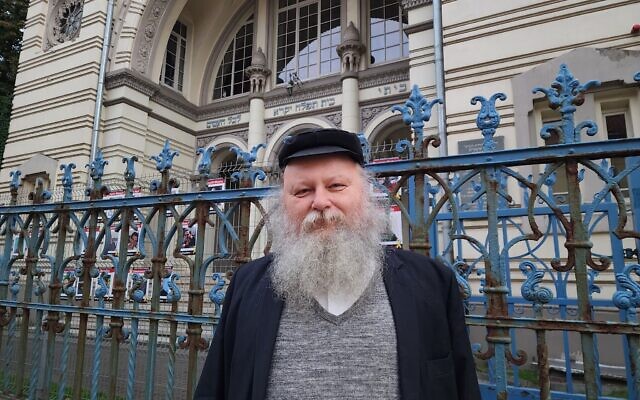
VILNIUS — Standing in the back of the Choral Synagogue in Vilnius, Lithuania — an early 20th-century structure and the city’s only extant synagogue — Cantor Shmuel Yatom articulated a challenge for observant Jews in Vilnius: “There’s no kosher bread here.”
Historically, such a statement would have been inconceivable; for generations Vilnius was a colossus of Jewish culture.
Known as Yerusholayim d’Lite (Jerusalem of Lithuania), there were 80,000 Jews and more than 100 synagogues in Vilnius before World War II. One place of worship — the Great Synagogue of Vilnius, a nearly 300-year-old building desecrated by the Nazis and later demolished by the Soviets — seated 5,000 people. Vilnius’ Strashun Library (also plundered by the Nazis) once contained 40,000 prized Jewish writings. The Vilna Gaon, an 18th-century intellectual titan whose rabbinic glosses established Ashkenazic norms, lived and wrote in Vilnius. And, texts issued by Romm Widow and Brothers Printing House, a 19th-century Vilnius-based Jewish publisher, became the standard for students and scholars worldwide.
Over two nights, before and after evening services, Yatom, 60, spoke with this reporter about Jewish life in Vilnius.
Of the city’s 80,000 pre-war Jews, nearly 90% were murdered in the Holocaust. About 2,000 Jews now call Vilnius home. The number of kosher consumers in the city, Yatom said, are “fewer than the palm of your hand.”
Religious dietary adherence in Europe is different than in the U.S. As opposed to purchasing grocery store items bearing symbols marked by certifying agencies, most European products lack such stamps.
Finding something in the supermarket with a hechsher (a rabbinic symbol or trademark) is unexpected, Yatom said. “It’s like fishing.”
The quest reflects long-standing connections — not merely between packaging and consumers, but between Vilnians and the printed word. The relationship between people and paper was repeatedly mentioned by guides and experts throughout an early September seminar operated by Classrooms Without Borders, a Pittsburgh-based organization that provides professional development for educators.
Vivo YIVO
Standing inside the National Library of Lithuania, while describing an exhibition marking the “origins, journey and legacy” of YIVO — founded 100 years ago in Vilnius as the Yiddish Scientific Institute — Lara Lempertienė said, “Not many people realize how central YIVO was.”
Its founders sought to document and preserve the history, culture and language of Eastern European Jewry by academically scrutinizing Yiddish. Materials were collected, articles and books were published, conferences were held and talks were delivered globally. Through the 1930s, YIVO branches spread worldwide.
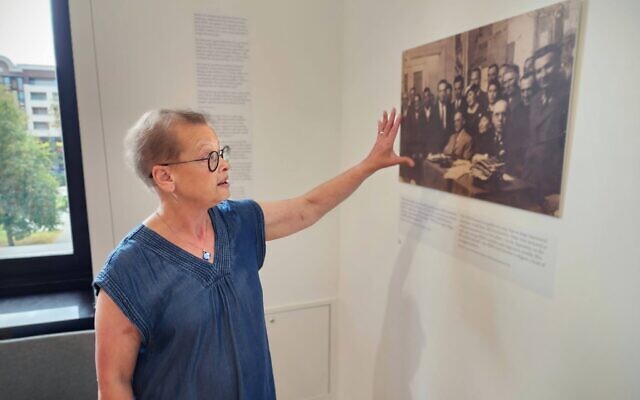
Lempertienė, head of the library’s Judaica Research Center, led visitors past 71 exhibits, including manuscripts, signage and other printed pieces highlighting YIVO’s continuous mission.
“We wanted the documents to talk,” she said.
Though the Holocaust decimated Eastern European Jewry, and ensured the near-cessation of Yiddish as a primary language among Jews, YIVO survived.
In fact, the organization “never ceased to exist.” Pointing to glass-covered materials, including an undated 6-year-old’s Yiddish language notebook alongside cards of participants in autobiography and diary competitions from the 1930s, Lempertienė continued. “What they did didn’t perish.”
Take a risk and paper
Preservation proved so important that during the Holocaust Vilnius’ Jewish ghetto prisoners risked their lives for print, explained Hadas Kalderon, an Israeli actress, playwright and creative director, who flew from Tel Aviv to share her grandfather’s story.
Before the war, Abraham Sutzkever (Kalderon’s grandfather) was a member of Yung Vilne, an avant-garde literary collective. Recognized for his talents, the Siberian-born Sutzkever, who moved to Vilnius at a young age with his mother after his father died, found himself caught between “life and death.”
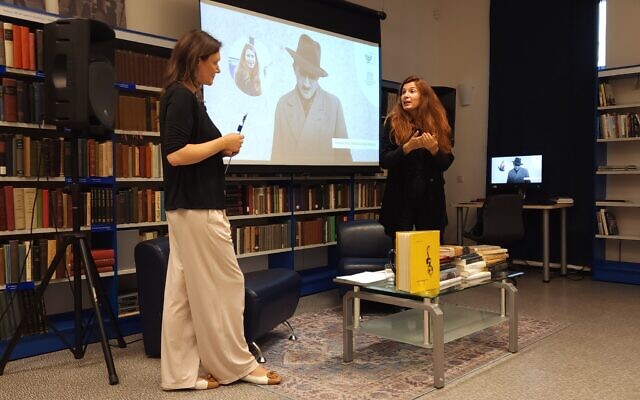
Recalling a tale told by her grandfather, Kalderon, 49, continued. With the Holocaust unfolding, chaos covering the land and the world “on fire,” what was there to write? Sutzkever questioned whether to continue creating. A supernatural instruction followed: The “Angel of Poetry” promised him that upon delivering “brilliant verses” the poet would be protected with a “flaming sword.”
Consequently, every day in the ghetto, Sutzkever wrote — sometimes in unimaginable conditions.
As recounted in his diary, Sutzkever once hid in an attic only to discover a dead Jewish person beside him. After noticing the body, the poet located charcoal and “began to write a poem on the corpse as if I were writing on paper.”
Later, after seizing YIVO’s headquarters, the Nazis told Sutzkever to “bring us your treasures,” Kalderon said.
The Nazis intended to move YIVO’s rare books and art to the Institute for Study of the Jewish Question in Frankfurt; but the Nazis didn’t know what was most valuable. They demanded the assistance of 40 imprisoned Jewish writers and artists. The group was nicknamed the Paper Brigade.
Faced with a dilemma, and possible death, Sutzkever and other brigade members responded. They delivered some materials to the Nazi looters. However, more precious items — including, original writings of Sholem Aleichem and manuscripts by the Vilna Gaon — were discretely transported, in homemade diapers, back to the ghetto and buried.
The perceived absurdity of risking life for leaflets was mentioned by Paper Brigade member Shmerke Kaczerginski in his diary.
“Ghetto inmates looked at us as if we were lunatics,” he wrote. While they were smuggling in food, “We were smuggling books, pieces of paper, occasionally a Torah scroll or mezuzahs.”
Writings on the walls
Kalderon spoke about her grandfather again at an evening program at the Vilnius Jewish Public Library with the library’s head, Liana Jagniatinskytė.
Following the event, Jagniatinskytė said the library, between its books and programs, perpetuates the “very long history of Jewish life” in Vilnius.
Surrounded by thousands of volumes, Jagniatinskytė continued. “We are trying to keep the memory of those who lived here alive, and to continue the tradition of Jewish books.”
When asked about the oddity of a nearby exhibition boasting YIVO’s Vilnius origins in a city with few remaining Yiddish speakers, or a Jewish library’s operations in a place nearly stripped of Jewish vitality, Jagniatinskytė cautioned against pessimism.
“The community is shrinking in numbers, but there are people who are coming back,” she said. “Some of them are coming and living here. Some are coming partially and spending summers. Some come for a few months.”
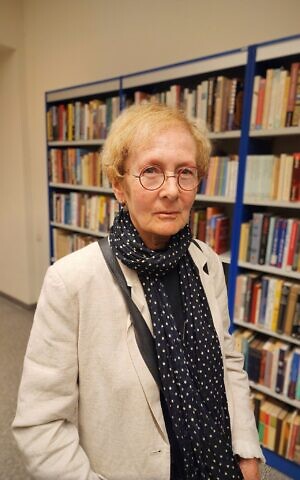
Jagniatinskytė pointed to Tamara Garon, 77, a former Vilnius resident who moved to Israel in 1992 but returns to Lithuania one week each year.
The annual trek, Garon said, is about reconnecting “with her roots.” Her grandfather, she said, maintained a seat at the Great Synagogue of Vilnius and would bring his son there (Garon’s father) to hear famous cantors sing.
Tamara Garon’s father, Aaron Garon, became a Yiddish journalist and soldier who fought against the Germans as a member of the Red Army’s 16th Division. After the war, Aaron Garon continued writing about Vilnius and contributed regularly to “Yerusholáyim d’Líte,” a Lithuanian Jewish community newspaper that appeared in Yiddish, English, Lithuanian and Russian. Aaron Garon emigrated to Israel, but like his daughter repeatedly returned to Lithuania.
“He couldn’t forgive the Jewish state for holding Yiddish in such low esteem,” she said.
Because of her father’s stories, and her own observations, Tamara Garon told this reporter she understands Vilnius’ altered landscape.
“Before the war, it was a very important center of Jewish life. The Jewish community was very vibrant,” she said. “Now, there are almost zero Jews left here.”
Less than an hour later, at the Choral Synagogue, Yatom would articulate the realities of Jewish life in Vilnius.
Before this reporter headed to the worship space for evening services, Garon was asked what to make of it all.
She paused.
Surrounded by thousands of Jewish books in a room with merely a handful of Jews, she replied. “It is the destiny of this place.” PJC
Adam Reinherz can be reached at areinherz@pittsburghjewishchronicle.org.
comments