
Thinking about divine inspiration
What does our tradition mean when it says that God dictated the Torah to Moses, when using the word “dictated” makes it sound like the task took place in a cubicle?

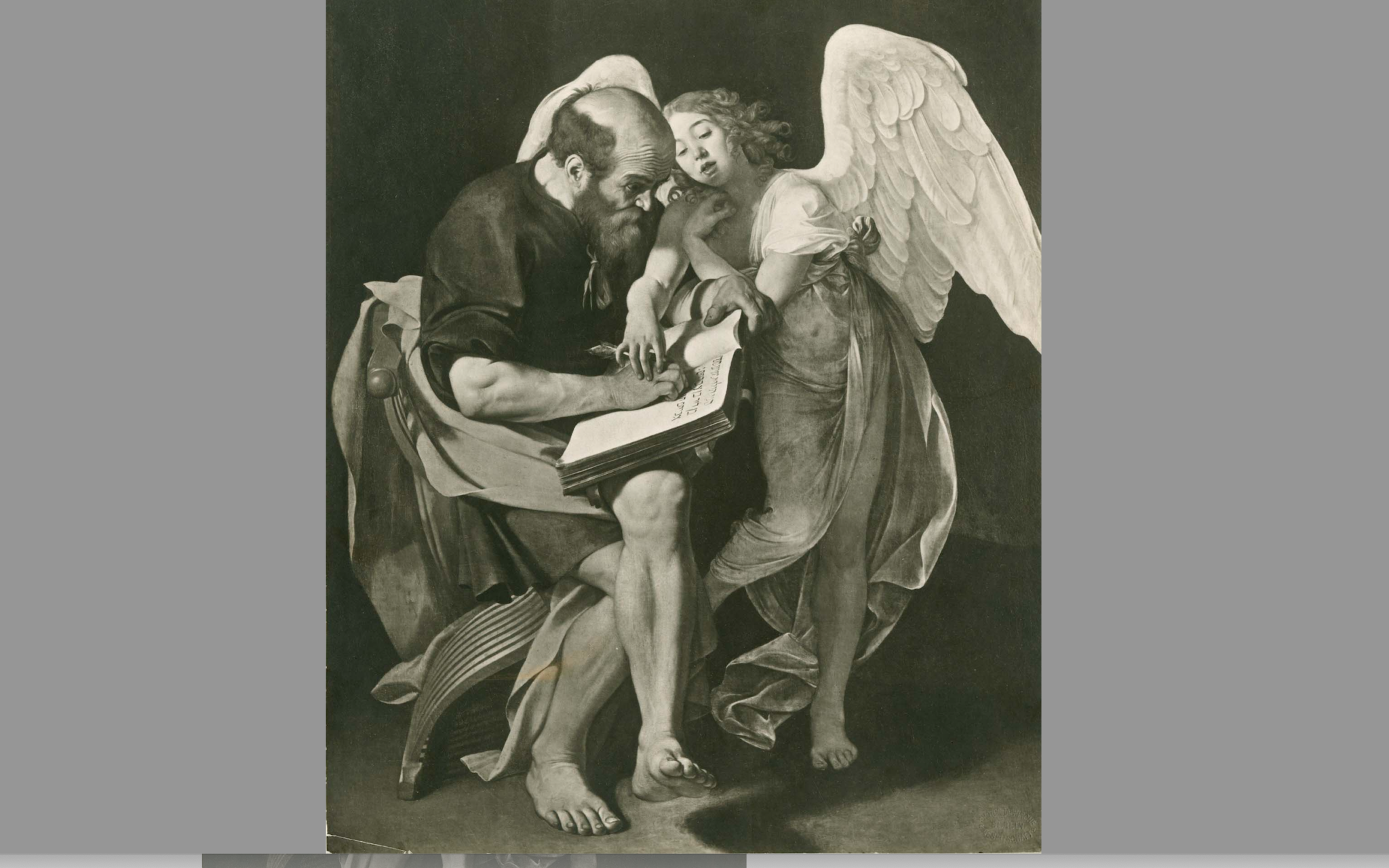
When we talk about the Bible being divinely inspired, what do we mean? The Baroque painter Caravaggio put it one way. When he was commissioned to paint the Christian Saint Matthew composing his eponymous gospel with an angel at his shoulder, Caravaggio knew that making an unambiguous image of such a moment was ill-advised, so he had fun with it. Matthew looks more bewildered than enthralled by the divine and, as one writer memorably put it, the resulting painting shows “a puzzled barefoot peasant taking an adult literacy lesson from God’s smirking pubescent messenger.”
What’s most interesting for Jews in this painting is that the angel is trying very hard to teach Matthew how to write Hebrew. The larger question is what exactly “divine inspiration” is supposed to be. What does our tradition mean when it says that God dictated the Torah to Moses, when using the word “dictated” makes it sound like the task took place in a cubicle? As Rav Kook said about the dangers of talking too much about God, “every definition is spiritual idolatry… even the term divine, the term God, suffers from the limitations of definition.”
The idea of Moses writing the entire Torah with the inspiration of God took centuries to develop. Once it took hold in (give or take) the early centuries CE, the rabbis expanded on the Torah’s history, since if its origin was divine it must have existed in heaven first. Indeed, the Talmud mentions that this heavenly Torah was written “in black fire on white fire, resting on the knees of the Holy and Blessed One.” Ever since the time of Ibn Ezra (1089-1164), many of our greatest commentators have pointed out numerous passages in the Torah that Moses could not have written himself, and this chipping away has continued. Over the past two centuries at least, the historicity of Moses in particular (and the Exodus more generally) has been questioned, leaving the idea of divine inspiration in the hands of the most devout.
Get The Jewish Chronicle Weekly Edition by email and never miss our top stories Free Sign Up
This is a shame, first of all, since the concept of divine inspiration seems to be more fruitful as poetry and mysticism, than as an excuse to impose authority. Secondly, I’ve never understood how the literary or archeological study of the Hebrew Bible can truly take away from its possible divine source. Speaking of the Tanakh as a whole, the idea that a tiny and largely insignificant people in the ancient world, after being defeated and experiencing exile, should gather their scattered traditions of narrative, poetry and prophecy into a book; and that this book only found its current form after centuries of compilation and redacting by many hands; and that this book — not to mention the people it serves — should have outlasted every empire, then and now, in part because of the myriad ways in which it was read and interpreted, told and retold; and that this book still rewards study and investigation … this entire process seems very nearly divine to me, as much as anything written “in black fire on white fire.”
Put another way: I spent the last month or so listening to the late Chaim Grade’s posthumously published novel, “Sons and Daughters.” As good as it is, I was struck every time I took a break from the book to read the weekly parashah, and was perhaps not surprised to find that the Torah remained more compelling. Grade’s novel — which includes a Jew whose faith crumbles after reading Nietzsche — began to feel dated very quickly, while the Torah somehow remained, as ever, new. And the most obvious thought came to mind: We are only Jews at all because of the Torah.
It was striking to hear about the philosopher Hannah Arendt’s work after World War II with an organization that sought to preserve Jewish property found in American-occupied Germany, among which were hundreds of Torah scrolls. Whatever Arendt made of the Torah’s origins and meaning, she could not abandon these scrolls. And it is only because of the Torah that we’ve heard our neighbors say things like, “I am not religious at all, but I want my children and their children to be raised Jewish.”
Whatever we make of the Torah and its origins, there is something about its persistence that goes beyond a compulsion to merely carry on a tradition.
I don’t mind calling that “something” divine, even though I also can’t describe it in any more detail than that. But what it means is that long after Netflix and Donald Trump’s tweets and another dismal Pirates season have become dust, the Torah will still be sitting right there, waiting. It is like the stranger that Jacob encounters on the other side of the Jabbok river: If we continue to call ourselves Jews, the Torah will remain, and we might as well wrestle with it. PJC
Tim Miller is a poet and writer living in Pittsburgh. He is online at wordandsilence.com.
comments