
At The New Riverview, residents share in spirituality on Shabbat
"We found a haven here."
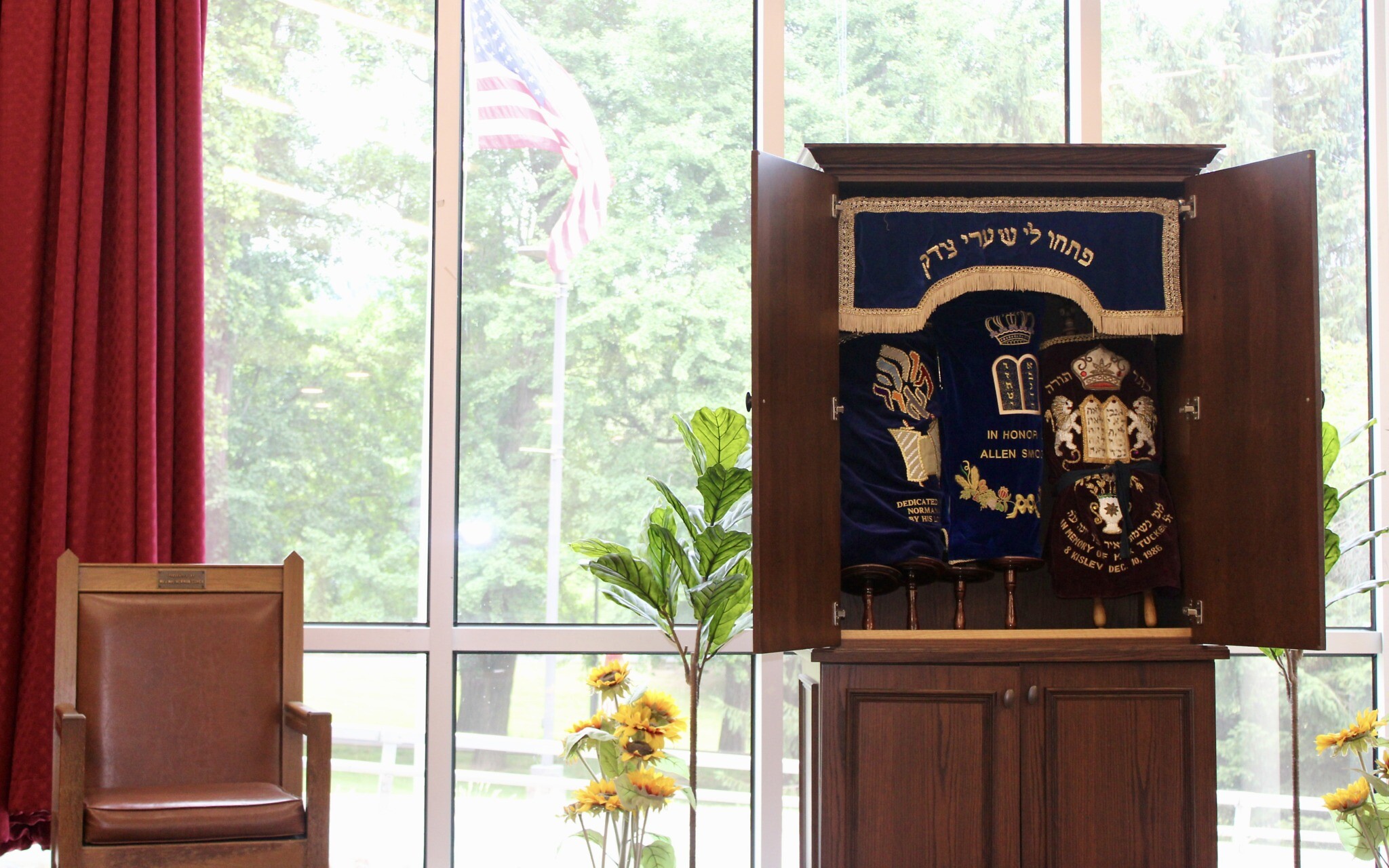
Howard Meyerowitz takes his usual seat in the synagogue, facing the sun. In the honeyed light, he rests his oak walking stick against a chair. Ahead stands the ark, and a vast window overlooking Garetta Street.
“I was just struck by this view, because every congregation I’ve been in has had windows,” he told the Chronicle. “For me windows are important, because I feel that’s what God is, as much as being in the room.”
Hailing from Southington, Connecticut, Meyerowitz has been a resident at The New Riverview Apartments, a senior living community, for over two years. He moved to Pittsburgh in the winter of 2024 to be closer to his oldest daughter and her family, who are affiliated with the Chabad community in Squirrel Hill.
Get The Jewish Chronicle Weekly Edition by email and never miss our top stories Free Sign Up
Meyerowitz came from one of around 30 Jewish families living in Southington. Finding a place to congregate and worship as a community there proved to be a challenge.
“We were meeting in churches for a while, until one church gave us use of their chapel on a Saturday morning,” he recalled. “You’re wandering — almost like Israelites — and the concern was [that] we don’t have our own place.”
As a first-generation American, he said he never takes the freedom to practice his faith in the United States for granted. At Riverview, he found a shul to call his own.
“There was snow on the ground, and I heard about the minyan [at Riverview], so I got up, got dressed, washed up, had a bite, came down the elevator, and I walked to the synagogue,” he recalled. “It’s been part of my life since”
For some time, Riverview’s Saturday morning Shabbat services were led by Rabbi Dovid Small and Service Representative Mischa Gelman. Over time, Gelman assumed the responsibility of becoming the sole “spiritual leader” during the Saturday service.
“Mischa, to me, is not only what he does here for Shabbat. I can see him interacting with a number of residents who need some extra care,” Meyerowitz said. “He comes here on his own volition Saturday morning … with the help of Yeshiva boys who’ve been coming over.”
Gelman said that Shabbat services offer a “great opportunity” to “give back to the residents.”
“I help them with a lot of things, but that’s all part of my work,” Gelman said. “Here it’s an extra opportunity. I get to volunteer and help contribute to this wonderful congregation.”
Meyerowitz also points to fellow resident Joanna Butler, who started her own Friday afternoon service. She even put together her own siddur, carefully cutting and pasting different prayers to create what Meyerowitz described as a “beautiful balance” of Hebrew and English.
“It doesn’t matter. Every Shabbat morning — whatever the weather is — it’s part of the creation, God’s creation of nature,” he said. “Even if it’s dismal and rainy, the fact is it’s almost a dramatic background to whatever liturgy we’re reading.”
The Friday services, filled with prayer and song, are brief, lasting “maybe 40 or 50 minutes.” But the result, Meyerowitz said, is a community that transcends synagogue walls.
“There’s one man who comes — he said he hasn’t been to synagogue since his son’s bar mitzvah — and he’s got to be 70. Two of our regular attendees are Catholic, and they like coming because it’s the Old Testament,” he added. “There’s a spiritual community.”
At 82, Meyerowitz has come to realize there is a distinction between “people who life happens to, and those who make life happen.” He strives to be the latter, finding “role models” in his fellow residents at Riverview.
One, Meyerowitz noted, is a man 13 years his senior named Earl Parker, who organizes the Jewish Community Center of Greater Pittsburgh’s chorus and bakes for various community events.
Upon further reflection, Meyerowitz wrote to the Chronicle that another man — George Markowitz — had a similarly indelible impact on his outlook.
“For the better part of my first year here at Riverview, George Markowitz sat behind me. He walked with a walker and it was often a struggle for him to make services, but still he came to services — usually a little bit later,” he wrote. “As soon as he came to his chair he would touch my shoulder with his fingertip to let me know he was here. It was my signal that my morning would be okay. George Markowitz was a mensch.”
When asked whether he had always been religiously observant, Meyerowitz laughed.
“No, no. At 13 it was like, my bar mitzvah, just take a picture. I had been away from it,” he said.
But he recalled the influence of his aunt on his fledgling spirituality when he was young.
“When I was 6 and 7, we lived three big blocks from the synagogue, and she [his aunt] was Orthodox, so I would walk with her on Shabbat. She walked with a limp, up two flights of concrete steps, and a flight of wooden steps to the women’s section every Saturday.”
“Instinctively or by osmosis — and she barely spoke English, so we didn’t have long Jewish conversations — she planted the seed of Yiddishkeit in my soul.”
Today, he says he sees that same sense of Yiddishkeit among congregants at Riverview.
“I mean, I use a walking stick, and there’s at least two others with some kind of appliance. That’s not going to stop anybody from praying,” he said. “Whatever space you’re in on Shabbat should be the most influential, if it’s touching your heart and touching your soul.
“We found a haven here.” PJC
Octavia Liku can be reached at oliku@pittsburghjewishchronicle.org.
comments