
Clean mural prompts call for conservation and Pittsburgh connection
'Just look up, pay attention, and ask yourself, ‘What is this? Do I know this?’'
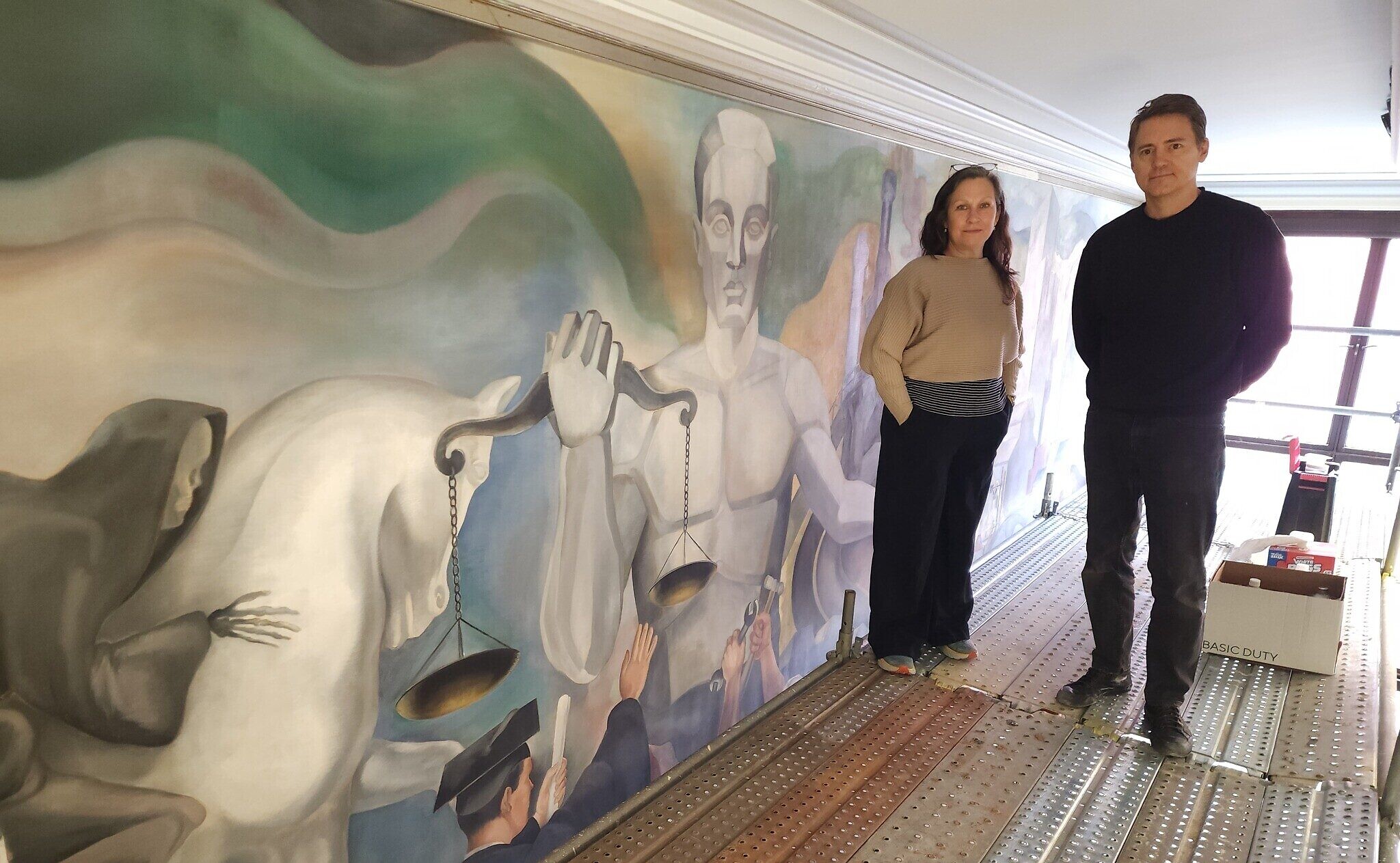
Justice is often preserved inside a courtroom. Weeks ago, “Justice” was conserved.
The nearly 70-year-old mural, which hangs in Courtroom 711 at the City-County Building, received long-due repairs. Under the watchful eye of conservator and Squirrel Hill resident Chantal Bernicky, 58, “Justice” was cleaned and restored.
For days, Bernicky and conservation assistant Noah Emhurt dipped small cotton pads in a chelating agent before gently applying a salty solution to the 36-by-9-foot canvas. Standing atop scaffolding, the conservationists worked their way, inch by inch, across a painting that had been damaged by a leaky ceiling and decades of pollution.
“As far as we know, it has never been cleaned,” Bernicky said.
Created by painter Harry Scheuch, with assistance from Robert Wisniewski and Peter Paul Murnack, “Justice” was supported by the Federal Art Project, a New Deal program implemented by President Franklin D. Roosevelt.
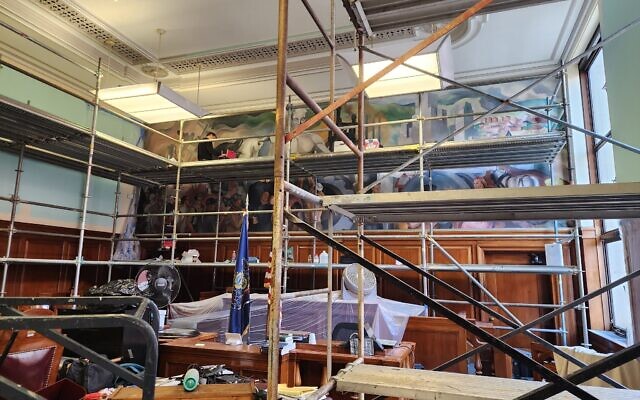
The 1940 mural has recognizably historic western Pennsylvanian cues, including a smoke billowing factory and news-broadcasting radio announcer, along with more universal references to Death, parenting and law: a brown-hatted mother clutches a red-haired baby; a black-hooded skeleton rides a white horse; Justice holds a scale.
Though often personified by Themis, a Greek goddess known for divine law and natural order, Scheuch portrayed Justice as a gray-skinned, muscular, unblindfolded, animatronic-looking man holding a scale.
In a 1952 interview with the Pittsburgh Press, Scheuch said he chose the depiction because “That blindfold conception is hackneyed,” and added, “Judges and juries aren’t blindfolded, why blindfold Justice?”
Speaking with the Chronicle, Bernicky moved from the courtroom floor to atop the scaffolding.
She praised the mural and Scheuch’s decision to showcase early 20th-century Pittsburgh beside wider American themes of expansion, war and education.
“Everything becomes interesting when you start working on it,” she said. “As a conservator, your job is to be knowledgeable of the artist’s technique and where that piece stands in time.”
The conservator’s process, she explained, not only involves mindful labor but a transformation of perspective.
As opposed to approaching a piece with a mindset of “Wow, it’s beautiful, I don’t have words for it,” the outlook becomes “a little more knowledgeable,” she said. “You place it in time. And whether or not it’s the best thing I’ve ever seen in my life doesn’t really matter, because it becomes relevant. So if it’s relevant, it’s interesting.”
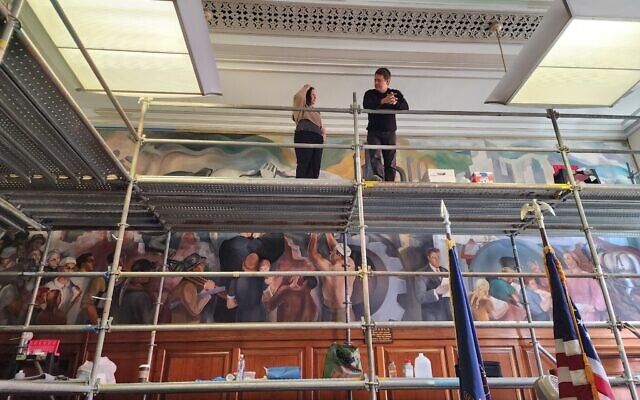
Bernicky, a Jewish conservator who has long aided local organizations, including Chabad of Squirrel Hill, Congregation Poale Zedeck and Hillel Academy of Pittsburgh, leads Fine Art Conservation Services alongside her husband Michael Belman. She received her bachelor’s degree in art history from the Université du Québec à Montréal and a master’s degree in art conservation from Queen’s University in Kingston, Ontario, and held posts at the Museum of Fine Arts in Montreal and the Costume Institute at the Metropolitan Museum of Art in New York.
Bernicky additionally worked at the Williamstown Art Conservation Center, the National Gallery of Art and the Carnegie Museum of Art.
Fine Art Conservation Services, which she and Belman opened in 2007, operates from a studio in West Homestead, with conservationists working on “everything,” Bernicky said.
Past projects included sculptures, paintings, textiles and paper conservation.
“Justice” is not the first project the group has worked on with the city, but it’s a great example of Pittsburgh’s commitment to the arts, Bernicky said.
There are numerous dedicated individuals in the city who wish to see art preserved. Judge Patrick M. Connelly is “sensitive to this because he sees it every day. The people that work with him are sensitive to this because they see it every day,” she said.
Emhurt, who carefully applied a small pad to Death, said, “This painting signifies so many things, so to see it sort of come to life again is just one of the most satisfying things of this job.”
Bernicky hopes the conservationists’ work spurs wider realization: “People have to just look into places they didn’t before and pay attention. If there’s a painting somewhere — whether you’re in City Hall or another public building, the libraries, the post offices — just look up, pay attention, and ask yourself, ‘What is this? Do I know this?’”
Those questions should prompt awareness.
“If there’s a plaque, read the plaque. People take the time to offer it to us, and it’s just for us to appreciate,” she continued. “I think the more that people do that, the more they will feel like me, like the city belongs to them.”
Standing feet from “Justice,” Bernicky paused and added, “This is part of us. We are part of the city.” PJC
Adam Reinherz can be reached at areinherz@pittsburghjewishchronicle.org.
comments