
A semiquincentennial tribute
Mordecai Moses Mordecai and his family came to the Forks of the Ohio before the Declaration of Independence to start a life on the frontier. Or, maybe not.
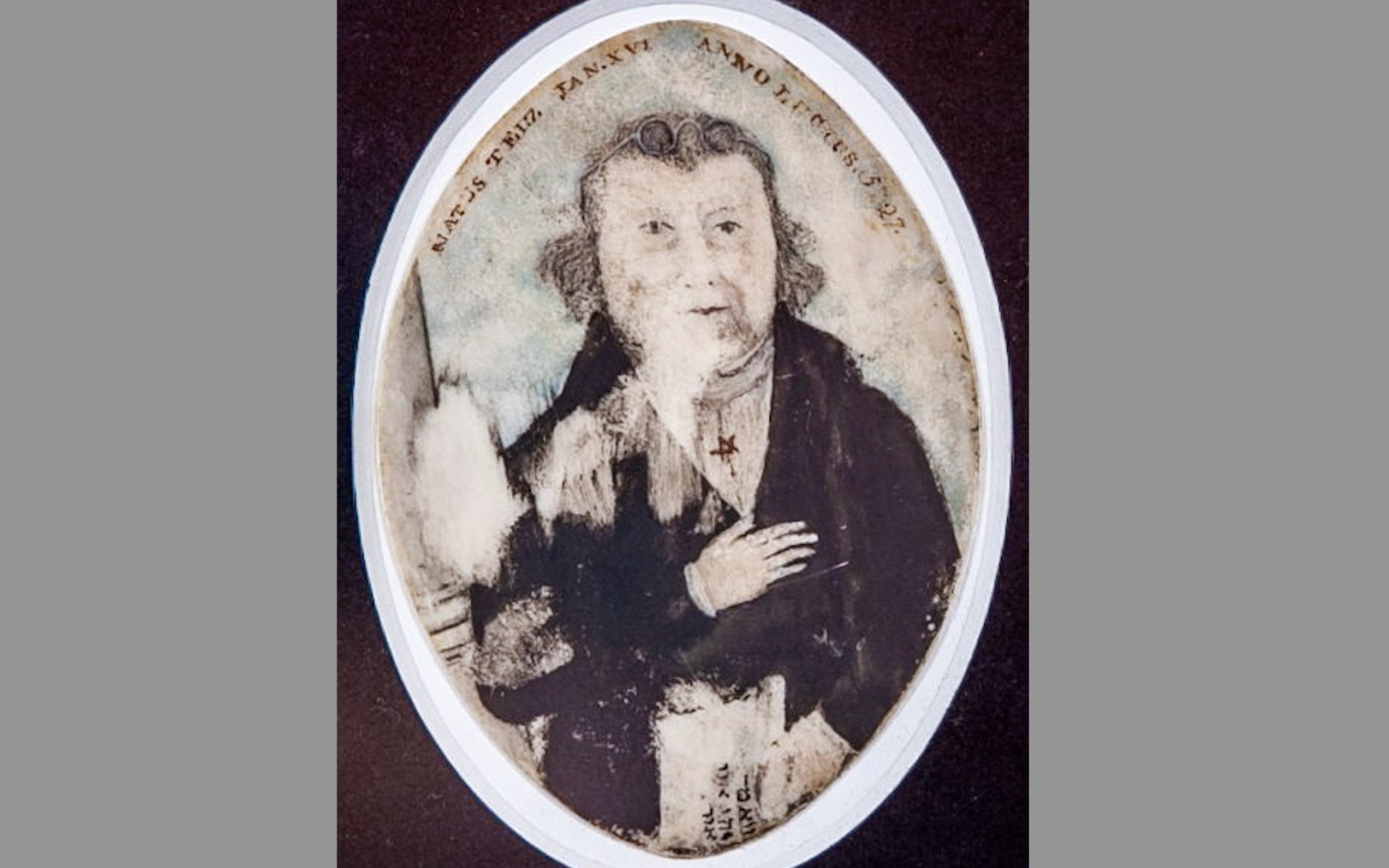
The British signed a treaty with the Six Nations in November 1768, acquiring a large swatch of Appalachia. A few months later, in April 1769, a Land Office opened in Philadelphia to handle claims for surveyed lands across western Pennsylvania. Some tracts went to Jewish businessmen from back east, including Levy Andrew Levy, David Franks and Joseph Simon. These men came to these parts for extended stretches and sent agents to supervise their interests. They never really quite settled here permanently.
The first Jewish family in western Pennsylvania is thought to be Mordecai Moses and Zipporah (De Lyon) Mordecai. They ran a distillery east of downtown. In his 1977 book “Jews On The Frontier,” Rabbi I. Harold Sharfman provides a vivid account of their arrival “in the valley at the approach to Pittsburgh” in spring 1769 with their young daughter Esther bouncing alongside them in their cushioned wagon: “The Mordecai family was given a hearty reception by their old friends the Levy Andrew Levys. Crude as their cabin appeared from the outside, the Mordecais were certainly surprised within. The interior was like a fashionable Philadelphia residence. The culture-conscious Mordecai glanced at almanacs, spelling books, English and Hebrew books, and copies of ‘Gentleman’s Magazine.’ Zipporah’s fancy was caught by Susannah’s gold lockets and hair powder, as well as gold and silver thread. All the Mordecais admired the newly planted pear and cherry trees brought over the mountains from the East for transplanting.”
Such a commonplace encounter between two Jewish families in 1869 or 1969 would hardly be noteworthy. A meeting in 1769, on the other hand, would mark the beginning of Jewish communal life in our region, and so the story pulses with intensity.
Get The Jewish Chronicle Weekly Edition by email and never miss our top stories Free Sign Up
Unfortunately, almost none of it happened. Some is imagined. Some is false.
Mordecai is not listed on warrantee maps for 1769. It’s unlikely he arrived that spring. Available documentation suggests he got here between January 1772 and July 1775. If so, he may have had two or even three children and possibly a fourth on the way.
It’s unclear, though, whether his wife and children accompanied him. A corroborating detail comes from the 1829 death certificate of their son Samuel Mordecai, whose birth is listed as Virginia, 1775. In the years surrounding the Declaration of Independence, Virginia held a claim over parts of present-day western Pennsylvania. Or perhaps Samuel was born as the Mordecais arrived or left through Virginia that year.
It is also unclear whether the Mordecais and Levys reunited here. Levy is believed to be the first Jew to live in what we now call Pittsburgh for any extended period. He arrived around 1760 and left around 1762 or 1763 after being taken hostage by native tribes. It is unclear whether his wife, Susannah, ever stepped foot in this part of the state.
Assuming such a reunion did occur, no documentation survives describing the Levys’ well-appointed cabin, nor any documentation of the Mordecais’ reaction to it.
Sharfman’s account is grounded in research but is ultimately fiction. He was “bringing the past to life.” Reality is less conclusive but has the advantage of being real.
Sharfman bases his story largely on “Two Jewish Functionaries in Colonial Pennsylvania,” a 1967 article by legendary Jewish genealogist Malcolm Stern. The article presents Mordecai as atypical, a Litvak amid the western Sephardim of colonial America.
Mordecai came from Telz, apparently from a rabbinic family. It’s unclear why he left Europe — why he alone of all the Lithuanian Jews of that era came over. In a one-eyed-leading-the-blind situation, he became a religious authority in North America. He appears in many better-known Jewish debates of the 18th century: the Kohen engaged to a convert, the man accused of shaving on the Sabbath, and the secret interfaith wedding.
(As an aside, that interfaith couple made an arrangement. They would raise their future daughters as Jews and their future sons as Christians. Their ostensibly Christian but halachically Jewish son Samuel Pettigrew became mayor of Pittsburgh in the 1830s.)
Mordecai’s time in western Pennsylvania was a brief interlude in a life lived back east in Philadelphia, Easton, Allentown, Lancaster, Baltimore and Richmond. Stern assumes Mordecai left our side of the state because he wasn’t as good at distilling as his Scotch-Irish competitors. That is also fiction, backed by nothing more than a hunch.
We know Mordecai was here because he sold his distillery to Joseph Simon in a deed dated July 19, 1775. It situates the property “on Suck’s Run near Pittsburg (sic).”
In “The Jewish Experience in Western Pennsylvania,” historian Jacob Feldman uses colonial era records to locate this property on land east of town called “Bellefield.”
Bellefield was an early name for part of Oakland, and so for years, I have used that scrap of information to place Mordecai’s business near the current site of the Cathedral of Learning. I assumed they set up east of town to intercept travelers coming from the other side of Pennsylvania. This is also fiction, based on my own assumptions.
In maps from the late 18th and early 19th century, Suck’s or Suke’s Run begins downtown near the Panhandle Bridge and branches throughout the Hill District, creating all its distinct hills and hollows. So perhaps the distillery was along current Fifth Avenue.
Anytime I research the past, I imagine the scene. And as the research unfolds, the scene changes. There is a hint of vaudeville to it. The characters rush around, adapting to my evolving understanding of the past. Now they have one kid in the wagon, now three, now none. A well-appointed cabin springs into existence and then suddenly it disappears.
This is especially pronounced for eras without much documentation. I am sympathetic to Sharfman. I also want these 18th-century pioneers to say something profound about the origins of our Jewish community in Pittsburgh. They might not.
Sharfman’s book argues that the earliest Jewish families in North America gradually abandoned their Jewishness through assimilation but established the institutional framework that allowed future waves to build Jewish lives on this continent.
That might have been true in Philadelphia, but not in western Pennsylvania. You can imagine an alternate reality where Mordecai was a great success. His distillery grows, attracting Jewish workers from back east. They establish a synagogue, a cemetery and a school around the turn of the 19th century, laying the foundation for a Jewish future here.
That didn’t happen. Mordecai and the others did not establish any communal presence here. If they hadn’t come, history might have developed exactly as it did, with Jewish merchants arriving in the late 1830s and creating new institutions in the 1840s.
When you strip away all the fiction, what remains is a document: a deed of sale between two Jewish merchants roaming the wilds of western Pennsylvania one year prior to the Declaration of Independence. In its quiet and modest way, that is profound, too. PJC
Eric Lidji is the director of the Rauh Jewish Archives at the Heinz History Center and can be reached at rjarchives@heinzhistorycenter.org or 412-454-6406.
comments