
Liberty, justice and responsibility: The Jewish ideas behind the American Experiment
As the nation celebrates its 250th anniversary ... it is worth asking not simply what America has meant for Jews, but what Jewish ideas and values have meant for America.
In 1790 President George Washington assured the Hebrew Congregation in Newport, Rhode Island, that the new government of the United States “gives bigotry no sanction, to persecution no assistance … ” Those words were more than a statement of toleration; they were a ringing declaration of religious liberty. For Jews who had long faced restrictions, blatant discrimination and violence in Europe, Washington’s statement represented something extraordinary: the promise of America.
As the nation celebrates its 250th anniversary, however, it is worth asking not simply what America has meant for Jews, but what Jewish ideas and values have meant for America.
No Jews sat in the Constitutional Convention, and none were among the Founding Fathers. Yet many of the ideas that shaped the new nation were deeply familiar to the generation that created this government because they were rooted in the Hebrew Bible and the experience of the Jewish people.
Get The Jewish Chronicle Weekly Edition by email and never miss our top stories Free Sign Up
Benjamin Franklin, John Adams and Thomas Jefferson proposed that the seal of the United States depict the Israelites crossing the Red Sea with an inscription “rebellion to tyrants is obedience to God.” The design was never adopted, but its symbolism was revealing. The American Revolution was understood by many through the lens of the Exodus story — a people escaping oppression and claiming liberty.
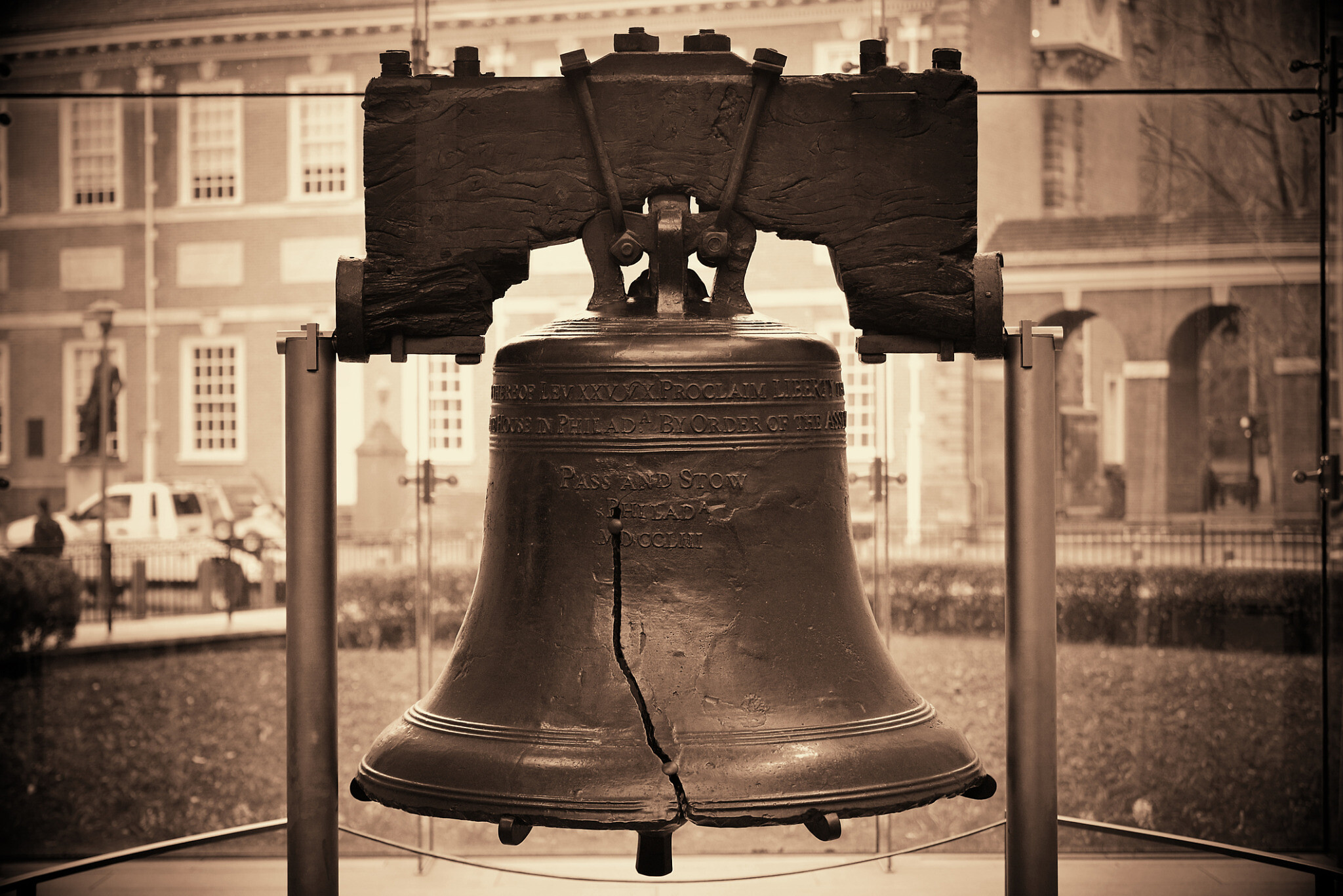
The same influence appears elsewhere. The inscription on the Liberty Bell, “Proclaim liberty throughout the land to all the inhabitants thereof,” comes directly from Leviticus. (25:10) Most of the men who drafted the Declaration of Independence and the Constitution were well acquainted with the Hebrew Bible. Many even studied Hebrew in college since it was often required at that time.
They didn’t have to look very far to encounter the powerful words of Genesis: “So God created Man in his own image … male and female he created them.” The implications were profound. If every person is created in God’s image, then every human being possesses an inherent worth that does not depend on birth, status, wealth, or power. Such ideas helped create the intellectual environment in which the Declaration of Independence could proclaim that “all men are created equal.”
The Hebrew Bible also emphasized justice, moral accountability and the responsibility of those in authority to the people and to one another. Former Supreme Court Justice Ruth Bader Ginsburg displayed in her chambers the biblical injunction from Deuteronomy (16:20), “justice, justice shall you pursue.” She knew that the demand for justice runs through the Jewish tradition. The Hebrew concept of tzedakah, often translated as charity, reflects the belief that generosity is not merely an act of kindness, but is a matter of righteousness.
The influence of Judaism on the new republic rested less upon direct contact with Jews than upon its ideas. There were only a few thousand Jews living among nearly two and a half million Americans in the late 18th century. Most of the Founders hardly knew any Jews. Yet biblical concepts of liberty, covenant, justice, religious freedom and moral responsibility became part of the moral vocabulary of the new nation.
Those ideals decades later would find expression not only in political documents but in the lives of American Jews themselves. Pittsburgh’s Jewish community offers compelling examples.
In 1929 Maurice Falk established the Falk Foundation with a gift of 10 million dollars in memory of his first wife, Laura. He explained that “it is my firm belief that any surplus of material wealth which may come to a man is properly to be regarded as a trust to be employed for the welfare of mankind.” The foundation was dedicated to the uplift and betterment of humanity. Falk’s philanthropy reflected a belief that privilege carries obligations.
A. Leo Weil demonstrated that same conviction in public life. He was head of the Voters League at a time in the early 20th century when according to Lincoln Steffens, a famed “muckraker,” Minneapolis was an example of police corruption and St. Louis an example of financial corruption, but Pittsburgh was an example of both!
Weil, a wealthy corporate lawyer was determined to tackle the corruption and graft of the Magee-Flynn machine, which he considered a violation of the public trust. Rabbi Samuel Goldenson likened Weil to the prophet Amos, who “could forget himself utterly in the championship of some noble cause or in his indignation against some wrong perpetrated upon innocent persons.” As a young man, Weil resolved to give one third of his time and money to the “welfare of humanity.” He did that and before his death, he commented, ”I have done only that which I conceive to be the like duty of every man.” Two years after his death in 1938 the Pittsburgh Board of Public Education voted unanimously to name its new school on the Hill in his honor.
Rabbi J. Leonard Levy brought similar values to the public square. A charismatic religious leader and reformer, he preached that no city could produce happiness unless “righteousness be done.” As a vice president of the Voters League he worked alongside A. Leo Weil in his fight to improve city government. Levy set out a vision for American Jews when he said that “Our purpose as Jews is not to go back to our old land, but in the new world, to set ourselves on the side of liberty and justice and truth and right and to teach that aspect of religion which shall enable men, to accept the Divine Fatherhood and establish a human Brotherhood.” In 1904, only three years after his arrival in Pittsburgh, Levy spearheaded the formation of the Pittsburgh Peace Society with Andrew Carnegie accepting the role of honorary president. He urged the writing of a “peace novel” that would have the same impact that “Uncle Tom’s Cabin” had. In 1905, in an age of widespread racism, Levy boldly invited Booker T. Washington, the preeminent Black leader of the day, to address the congregation on “Race Problems in the United States.” He believed liberty and justice belonged to all people regardless of race or background.
Jewish women also played important roles in advancing these ideals. Bertha Floersheim Rauh founded or led a staggering number of reform organizations, appropriately earning a whole host of laudatory epithets, including “Pittsburgh’s First Citizen,” “Mother Pitt,” “Pittsburgh’s Foremost Citizen” and “Pittsburgh’s Best Citizen.” In 1922 she was officially appointed “Director of Charities” of Pittsburgh, the first woman to be appointed to a mayoralty cabinet in Pennsylvania.
The Silberstein sisters, Sadie Silberstein Alter and Florence Silberstein Reizenstein, were totally dedicated to social justice, and both won the Distinguished Daughters of Pennsylvania Award. Sadie Alter was the president of the Urban League from 1936 to 1941 and a charter member of Camp James Weldon Johnson, a camp for Black youth. She was described by the Pittsburgh Courier, a national African American newspaper with a local section, as a “conscientious and militant worker in efforts to breakdown racial discrimination and misunderstanding.”
Her sister, Florence, even outdid Sadie in her social activism. As one notable Pittsburgher said, “there is nobody I can think of who had as great and as lasting an impact as Florence Reizenstein.” In 1946 Reizenstein pushed Mayor David Lawrence to set up a new city agency, the City Unity Council, devoted to improving community relations. Reizenstein served on the Pittsburgh Commission on Human Relations, a successor to the City Unity Council. She also was a founder and vice president of the Pennsylvania Human Relations Commission. She became a vice president of the local chapter of the NAACP and helped found NEED — the Negro Education Emergency Drive — to fund scholarships for Black students. The Reizenstein school (no longer in existence) was named after her.
Sophie Friedman Masloff became the first female and first Jewish mayor of the city of Pittsburgh. She was a beloved character who had character. Her compassion for the neediest in the city was incontrovertible and her integrity was unchallenged. She was a devoted public servant who steered this city through tough economic times to make it a better place for all Pittsburghers.
These individuals differed in background, temperament and occupations. Yet they shared a common belief that justice requires action, not merely words. Their lives reflected values deeply rooted in Jewish tradition — values that also helped shape the American experiment.
On the 250th anniversary of this nation, there is much to celebrate. America has been a remarkable blessing to millions of people, including our Jewish ancestors. Yet the story runs in two directions. America opened its doors to Jews, but Jews in their turn helped strengthen America by embracing and advancing ideals that were deeply rooted in their own tradition.
Pittsburgh Jews demonstrated that liberty, justice, human dignity and responsibility to others are not merely ideals to be admired but obligations to be lived. From Maurice Falk’s philanthropy to Sophie Masloff’s public service, Pittsburghers helped translate enduring Jewish values into public action. They have demonstrated the enduring connection between Jewish values and the American experiment. It is a connection that has allowed this nation to flourish over the generations.
America for 250 years has held out the promise of freedom and opportunity. Even in this turbulent and challenging time, America still stands, and will continue to stand, as a unique and radiant beacon of hope. PJC
Barbara Burstin teaches at the University of Pittsburgh and has written several books on Pittsburgh Jewish history.
comments