
CMU Fence emblazoned with ‘Death to Zionism’
“It’s troubling that this is the third time in two weeks that language targeting the Jewish community has been on The Fence."
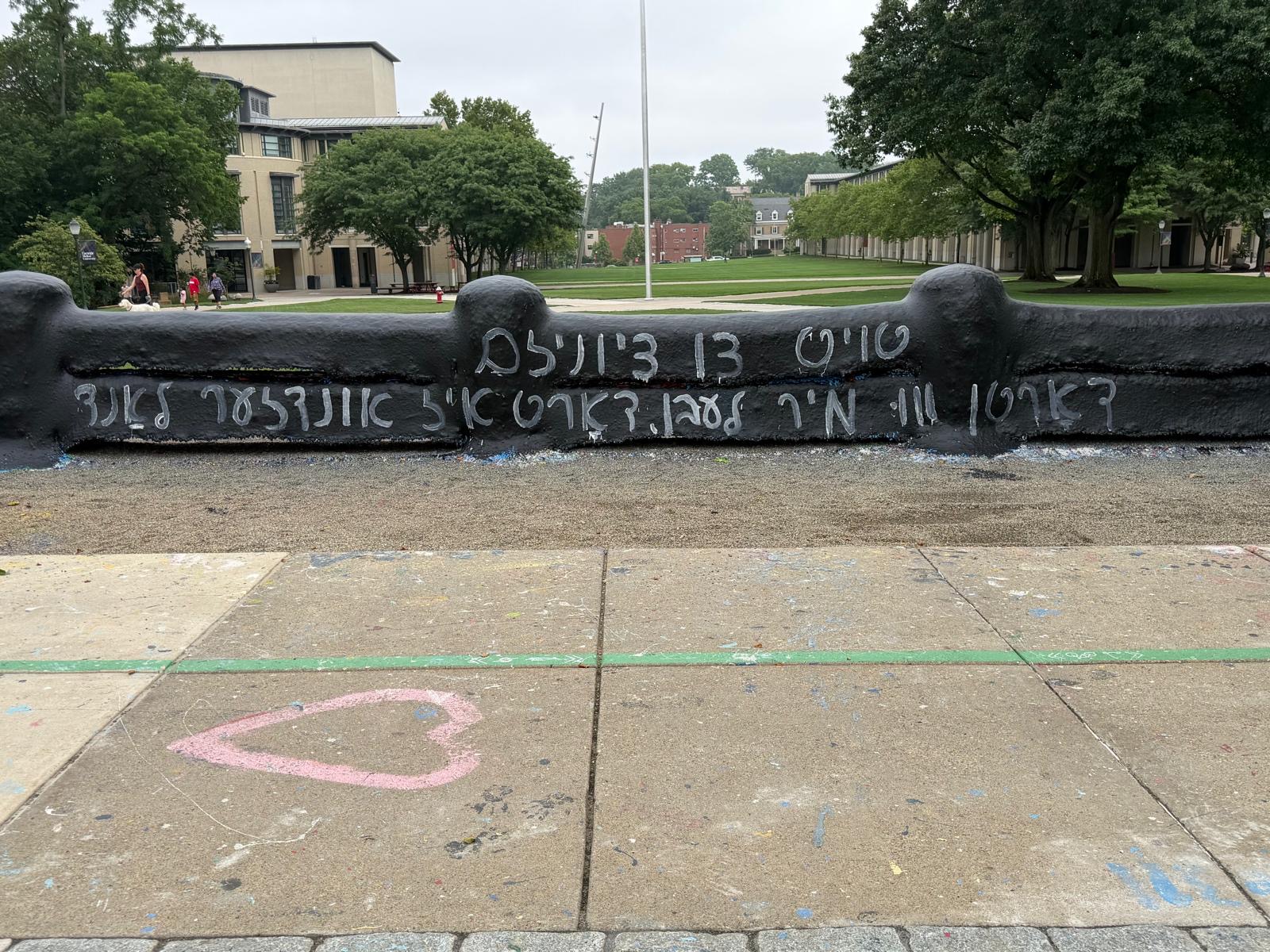
The Fence at Carnegie Mellon University was again painted with messages targeting the Jewish community.
Yiddish words translating to “Death to Zionism” were painted on one side of The Fence on the night of June 28, along with the historical Bund saying, “Wherever we live, there is our country.” The other side of The Fence was painted with the message, “Forcing ideological conformity on Jews is antisemitic.” The Palestinian flag also was painted on The Fence.
The Bund is a Jewish socialist, anti-Zionist movement that emerged in Poland, Russia and Lithuania in the 19th century. Historically, it promoted Jewish political and cultural autonomy, the Yiddish language and the idea that Jews have a right to live and organize where they reside.
By the evening of June 29, two photos of The Fence were included on the Instagram page cmufence, which is not affiliated with or run by the university. The first, depicting the painted fence with the anti-Israel messaging, was credited to “a few Jewish students.” A screed is included with the photo, calling Israel an “apartheid regime.” It goes on to say that “expecting a diverse nation of people to subscribe to one particular ideology, is in fact antisemitic.”
In the lead-up to World War II, the Bund encouraged Jews to stay in Europe instead of joining the Zionist movement. Consequently, many Bundists, along with millions of other Jews, were murdered in the Holocaust.
A second photo on the cmufence Instagram account showed The Fence painted over in black, with only the Palestinian flag remaining.
The post accompanying that photo was titled, “Shameful Censorship by CMU,” and railed against the anti-Israel messages being scrubbed.
The most recent anti-Zionist messaging follows two other anti-Israel messages painted on The Fence in early June. The first contained the phrase “By any means necessary,” an axiom seen by many as justification for a political movement to use any means available — including violence — to achieve its goals.
The earlier anti-Zionist messages were widely criticized by local Jewish community members and prompted a response from CMU President Farnam Jahanian, who wrote that it “is categorically unacceptable for an anonymous message painted on CMU property to incite or imply support for violence, and it is equally unacceptable for members of our campus community to feel physically threatened or unsafe.”
He acknowledged that some members of CMU’s campus community, as well as “the broader Pittsburgh Jewish community,” felt the messages were “antisemitic and threatened their sense of safety and belonging.”
The most recent anti-Israel messages seem to be a reaction to the Jewish community’s concerns and the university’s response to the previous messages on The Fence.
Created in 1923 by seniors commemorating their graduation, The Fence has been a space for students to share opinions and events with the campus community. Over the years, it has been an occasional source of controversy.
In 2025, the university took the unusual step of painting over a message that read “No rapists on our campus,” during a visit by President Donald Trump, and closing access to The Fence. It was the first time in at least a quarter-century that access was limited.
Following the controversy, Jahanian convened The Fence Working Group. The group delivered its final report on May 15.
David Knoll, vice president of public affairs at the Jewish Federation of Greater Pittsburgh, said the new messages on The Fence were “troubling.”
“That’s the bottom line,” he said. “It’s troubling that this is the third time in two weeks that language targeting the Jewish community has been on The Fence. Any language that incites or implies support for violence is totally unacceptable.”
It is also “unacceptable,” he said, “to make members of the CMU community feel physically threatened or unsafe.”
Julie Paris, StandWithUs’ Mid-Atlantic regional director, noted that “Death to Zionism” is not a critique of Israeli government policy.
“Zionism is the belief that the Jewish people have the right to self-determination in their ancestral homeland,” she said. “This idea is central to the identity of the overwhelming majority of Jews. Calling for the ‘death’ of Zionism is therefore experienced by many Jews as a call to eliminate the world’s only Jewish state and an attack on their identity.”
Contrary to what the most recent messaging appears to champion, Paris said that those who painted the message are attempting to define for Jews which beliefs about their own identity and history are acceptable.
“We hope CMU uses this moment to deepen education about Jewish history and ensure that The Fence remains a place for robust debate, rather than rhetoric that targets or marginalizes any community,” Paris said.
In a community message, Jahanian confirmed the translation from Yiddish of the phrase “Death to Zionism,” and said the CMU police responded to the “latest threatening message” by “launching an investigation and engaging the appropriate local and federal authorities. We also heard from members of our Jewish community, who described the translated text as alarming and antisemitic and shared concerns about their physical safety and well-being.”
Jahanian confirmed that university painted over the controversial messaging “following conversations with concerned community members.”
“I am grateful for the individuals who made this decision onsite and who recognized that a call for ‘death’ violated our longstanding policy against such threats of violence, including threats based on an individual or a group’s affiliation or identity,” he wrote. “Moving forward, we will continue to quickly remove threatening language wherever it appears on campus, fully investigate these incidents and intervene as necessary.”
Anonymous messages, he noted, are open to interpretation and “[l]anguage that can reasonably be viewed as threatening — whether performative or substantive, direct or ambiguous, painted on the Fence or printed in a flyer — has no place at Carnegie Mellon.”
Jahanian noted that over the years there have been other strongly worded political statements that were allowed to remain because they did not violate CMU’s policy against threats of violence. Other phrases painted alongside “Death to Zionism,” he said, did not constitute a threat and are “inconsequential” to the university’s investigation.
“CMU has long been a place where individuals learn, teach, discover and disagree without jeopardizing the safety and wellbeing of others. We must continue to engage one another thoughtfully — even, and especially, when confronting difficult and deeply divisive issues,” he wrote. “Only by doing so can we sustain the culture of trust, curiosity and mutual respect that defines Carnegie Mellon at its best.” PJC
David Rullo can be reached at drullo@pittsburghjewishchronicle.org.
comments