
Torah Walk celebrates unification of Temple Sinai, Rodef Shalom into Beit Kulanu
“Until today, it was a house for all. Now it is a home for all.”
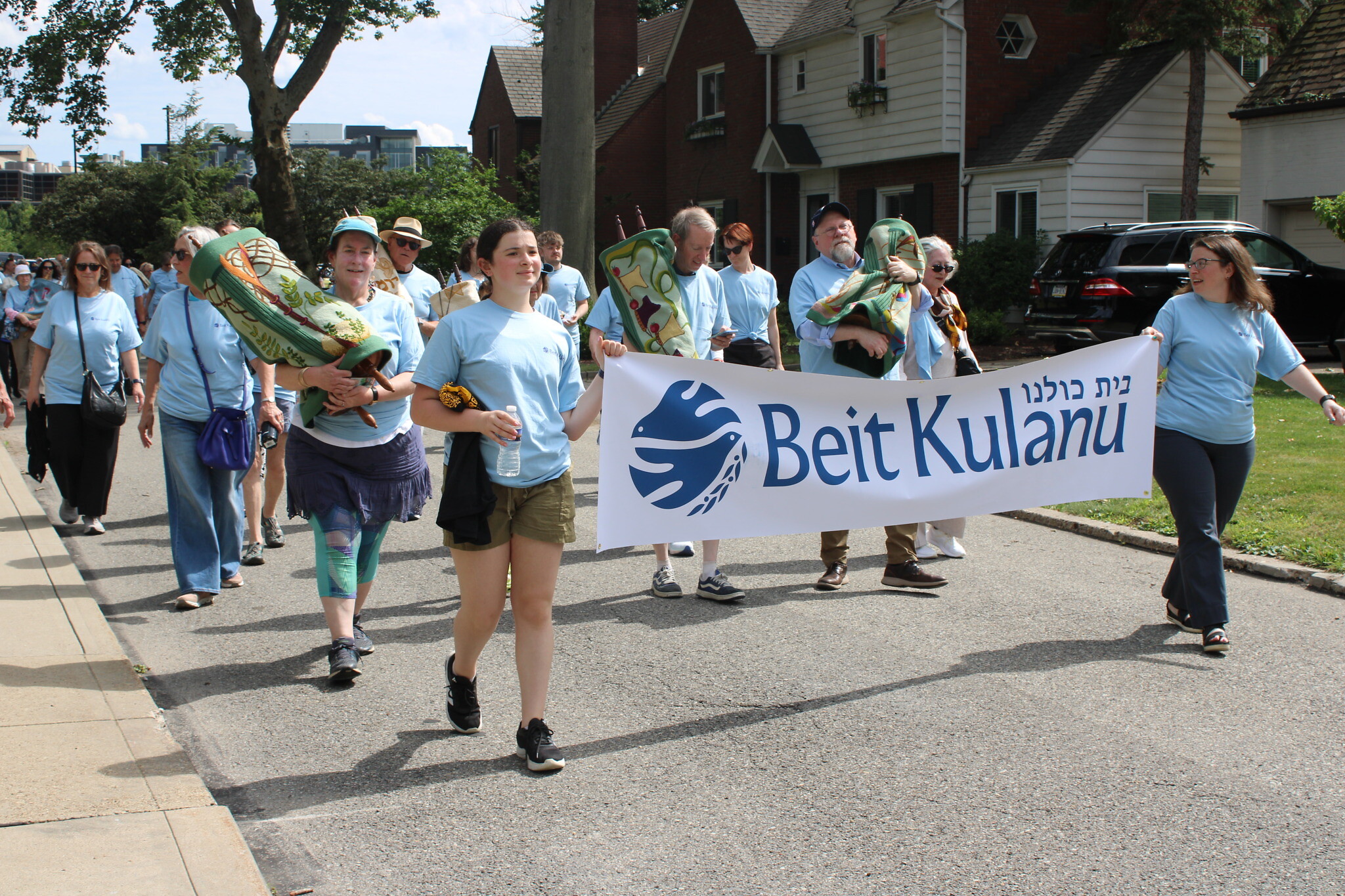
Hundreds of members of Temple Sinai and Rodef Shalom Congregation took to the streets on June 21 for a celebratory Torah Walk, marking the historic unification of the two Reform congregations as Beit Kulanu.
Along Forbes Avenue, members of the former Temple Sinai cautiously carried the congregation’s Torah scrolls for more than a mile on foot. Other congregants walked beside the procession or followed in convertibles, before joining members of the former Rodef Shalom outside Carnegie Mellon University’s Tepper School of Business for a brief program.
“This is the beginning of a dream. This is the culmination of a whole lot of work and dreaming and building, but it’s also the beginning of a whole new process of imagining and reimagining and creating — listening, loving,” Rabbi Daniel Fellman, senior rabbi of Beit Kulanu and formerly senior rabbi of Temple Sinai, told the Chronicle. “It’s a really exciting, powerful time, and it’s also a time of real holiness.”
The merger comes after years of debate, deliberation and discussion.
Temple Sinai was founded in 1946 by members of Rodef Shalom to help serve the needs of Pittsburgh’s growing Jewish community. The two congregations began to discuss unification in 2023, following a decline in both congregations’ membership over the past two decades.
In 2025, the congregations announced plans to unify. Now, Beit Kulanu represents nearly 1,300 households — one of the largest Reform congregations in Pennsylvania.
“There’s so much work to do in engaging people in Jewish life,” Jeff Finkelstein, president and CEO of the Jewish Federation of Greater Pittsburgh, told the Chronicle. “I think the force multiplier of being together will end up with great results.”
Community members from all walks of life have come to recognize the significance of the two Reform congregations merging as a “once in a lifetime opportunity,” said Sarah May-Stein, a member of the former Temple Sinai.
“This unification has been kind of talked about — not in a real serious way — for a long time,” said Anne Molloy, a member of the former Rodef Shalom. “We had the right pieces in place to have some real serious conversations. I think that Temple Sinai and Rodef Shalom have a lot more in common than we have differences. The differences are small, and the commonalities are big.”
Pennsylvania state Rep. Dan Frankel, whose family was affiliated with Rodef Shalom for generations, emphasized that the unification of the two congregations represents a moment of “hope” for the Jewish community at large.
“I was here as the Jewish community changed and shifted — fewer people affiliated,” Frankel said. “But [with] these two historic congregations — I think you can see the energy here today gives us a lot of hope to recreate the energy.”
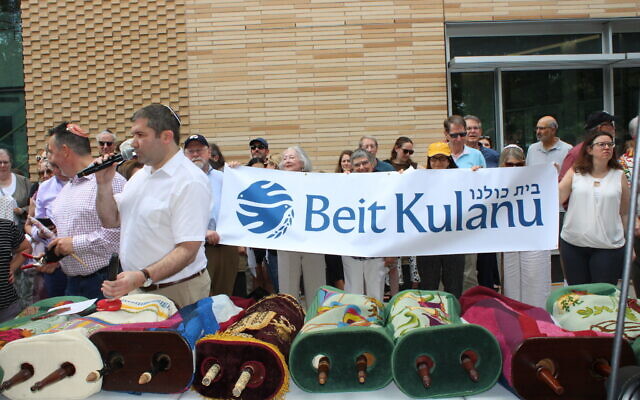
At the Tepper School of Business, members of the newly unified congregation joined in song and celebration, unfurling a banner with the congregation’s name — “Beit Kulanu.”
To many, the name rings true to their experience within the community. Adam Wise, who is converting to Judaism, expressed his gratitude for the inclusive nature of the congregation.
“I’m a few months into the conversion process. I’m glad that I’m welcome to come here, because I wasn’t really sure when I started. But I asked Rabbi Fellman, and he said, ‘Yeah, come along,’” Wise said. “I’m glad I can be part of this, because this is a once in a lifetime event.”
Religious leaders from a range of faiths and traditions attended the celebration. The Rev. Canon Natalie Hall, rector at the Episcopal Church of the Redeemer in Squirrel Hill, noted that the merger presents a “unique opportunity” for interfaith connection and collaboration.
The Rev. Liddy Barlow, executive minister of Christian Associates of Southwest Pennsylvania, emphasized the hopeful nature of the unification.
“Today is such a beautiful and thoughtful opportunity to ritualize this process, to move it beyond an administrative merger and a bureaucratic transition into something that tells this ongoing and hope-filled story of this community,” Barlow said. “That makes it a wonderful day.”
Dressed in a sea of blue T-shirts, members of the now unified congregation made their way to the Rodef Shalom synagogue building on Fifth Avenue — where Beit Kulanu will be housed — for a brief service led by Fellman, Rabbi David Young, who has served as Rodef Shalom’s interim rabbi for the last year, and Cantor David Reinwald, formerly cantor at Temple Sinai, now cantor of Beit Kulanu.
Young led the congregation in prayer and song, before finally affixing a mezuzah to the synagogue door.
“The moment the mezuzah comes up, that is the moment the house becomes a home,” Young said. “Until today, [Beit Kulanu] was a house for all. Now it is a home for all.” PJC
Octavia Liku can be reached at oliku@pittsburghjewishchronicle.org.
comments