
Dancing with words
Some thoughts on a "new" festival
A new festival
As far as festivals go, Simchat Torah is fairly new — that is, it is around 1,400 years old. It was only during the period of the Geonim (sixth through 11th centuries) that the second day of Shemini Atzeret became Simchat Torah. As the Torah had probably been codified for a thousand years by this point, one might ask why it took so long for a holiday celebrating the reading of it to develop.
Up until this time, though, the cycle of reading through the entire Torah could run anywhere from a year to three years. Once the Geonim solidified a yearly cycle for most of the Jewish world, the idea of Simchat Torah arrived almost ready-made: Moses dies and Deuteronomy ends, but only so we can start over with Genesis — and soon enough, the infant Moses is hidden away in a basket once again.
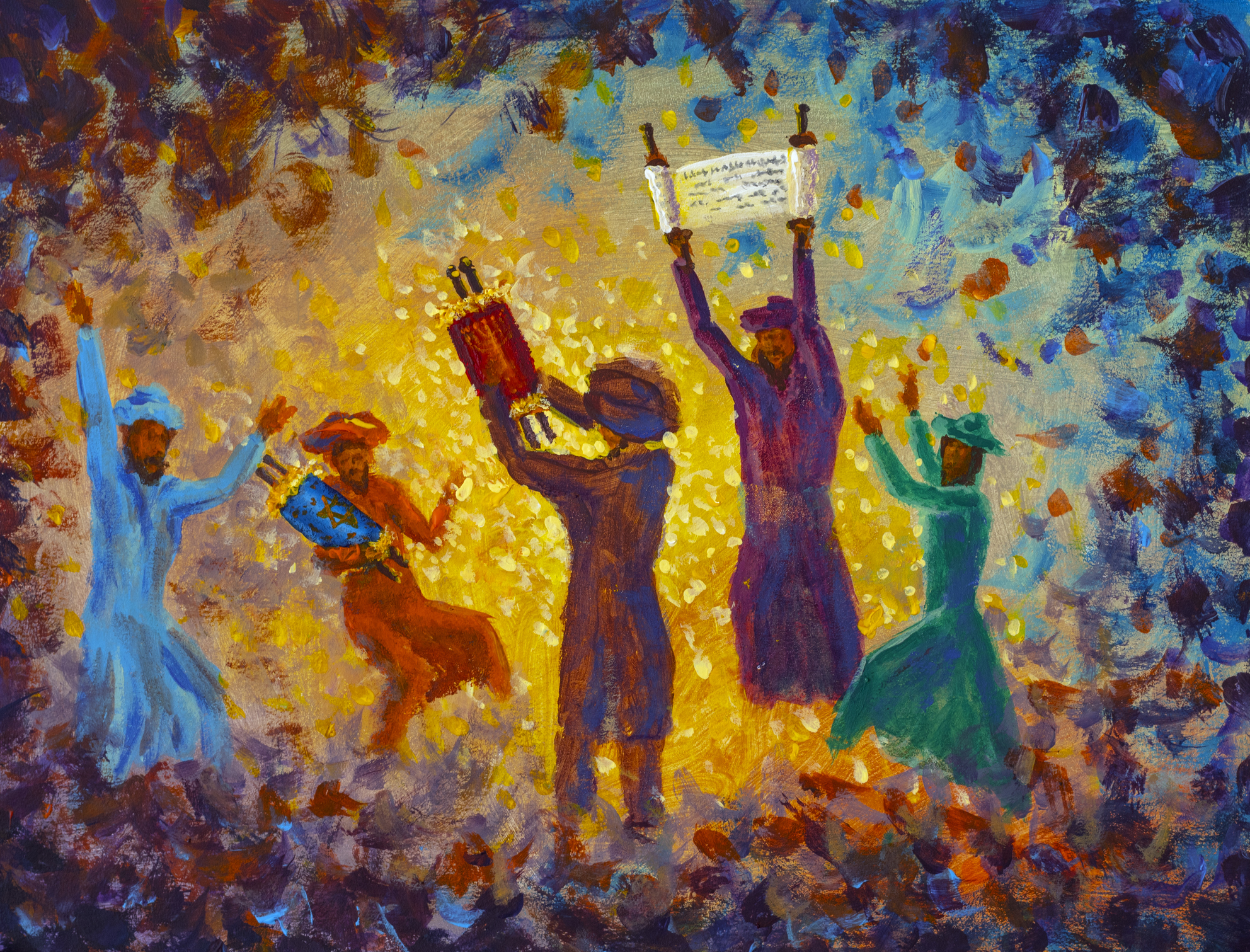
Rabbi Arthur Waskow writes that the mood of Simchat Torah resembles the water drawing ceremony that occurred during Sukkot while the Temple still stood. Following the Temple’s destruction, eventually the singing and dancing and music associated with Sukkot was redirected to the Torah itself: This is our chance to dance with the scrolls during the hakkafot. The overflowing nature of the moment is right there is Waskow’s description of it: “the scrolls are carried by dancing congregants around the raised pulpit area or around the prayer hall —or even around the building itself, with excursions into the streets.”
Get The Jewish Chronicle Weekly Edition by email and never miss our top stories Free Sign Up
The moment seems to ask, “Where will the Torah lead us in the coming year — and where will we lead it?”
Dreaming of Moses
In 1609, Rabbi Hayim Vital had an incredible dream. Vital was a rabbi in Safed and a disciple of Isaac Luria, and in the dream the body of Moses was brought to the synagogue there. The prophet’s body was immense, almost the size of a giant, and it required many people to carry it in and place it on a table: “But as soon as the body of Moses was stretched out on the long table, it became transformed into a scroll of the Torah that was opened to its full length, like a long letter, from the first words of Genesis to the end of Deuteronomy.”
Those gathered at the synagogue began to read this Torah scroll from the beginning and didn’t stop until the end. “And when the scroll of the Torah had been completely read, the scroll of the Torah became the body of Moses once again, and they clothed it and set a girdle around it.” The story concludes: “That is when Hayim Vital awoke, and for hours afterward it seemed to him as if the soul of Moses was present in that very room.”
What the dream suggests is that wherever the Torah is, there Moses is, too, in all of his dual identities: as an Egyptian and a Hebrew, as a father and husband but also a national leader, as a mere shepherd as well as a prophet of God, a military leader and a mystic, and a man who loved his people and argued on their behalf even as he frequently lost patience with them. Whether we believe that Moses wrote the Torah or not, the two are inseparable.
Celebrating the Torah
There is no end of ways in which we have honored the Torah. I like to think this is because the Torah also honors us with its ability to be reinterpreted and retold, without end. This sense of endless giving seems to be at the heart of Simchat Torah.
The Talmud, along with generations of scholars since, have made the remarkable point that the Torah and the Bible are themselves forms of midrash and interpretation. Every generation — maybe even every individual reader — has their own Torah.
Another remark from the sages says that, “Everything that a diligent student will teach in the distant future has already been proclaimed on Mount Sinai.” This idea neatly wraps up the entire Jewish past and its possible future into the very moment any one of us takes up the Torah for ourselves. Shaye J. D. Cohen makes the vivid point that, for the Jews who compiled the Torah, the act of creating a text that could only change during the act of interpretation “set free the wellsprings of the imagination … They could claim loyalty to the sacred text even as they freed themselves from it by interpreting it … All Jews who affirmed the validity of scripture had to engage in exegesis … ”
In case all this seems to be mere scholarship, Holocaust survivor and theologian Emil Fackenheim once described a picture of Jews fleeing a pogrom that hung in his parents’ house. The old, bearded Jews in the picture are terrified “to leave behind what is most precious to them.” What is this most precious thing? “In view of anti-Semites,” Fackenheim says, “these Jews would doubtless be clutching bags of gold. In fact, each of them carries a Torah scroll.”
Alexander Alan Steinbach put it even more starkly: “In some countries where laws prohibited our fathers from studying the Torah, many were thrown into the fire together with the Torah Scrolls. But always they cried out, ‘The Scrolls burn but the words ascend to heaven.’ Neither fire nor water, neither rack nor dungeon, hate nor cruelty, ever succeeded in shaking our fidelity to our Torah Bride. And that is why we live today.”
When the Baal Shem Tov became aware of Jews who mocked his followers for moving around so much during prayer, he compared such gestures to the flailing of someone drowning in water. Moving in such a way, the person at prayer “is saving himself from the raging waters that come upon him to distract him from his prayer.”
With this in mind, perhaps the dancing and music of Simchat Torah can be compared to the joy of surviving, and reaching the shore once again. PJC
Tim Miller is a freelance writer living in Pittsburgh. He is online at wordandsilence.com.
comments