
A look back at 2025: Stories of significance
Here are a handful of local stories from the past year that feel especially noteworthy.

In a year that tested both resolve and resources, Jewish Pittsburghers moved forward with resilience and hope. The Chronicle’s coverage this past year included stories of perseverance despite challenges, as well as pride in community.
Events in the Middle East had a ripple effect at home, often playing out in antisemitic incidents in our neighborhoods. We were not silent in the face of threats; instead, we continued to proudly celebrate identity, tradition and community. Throughout the year, we gathered in vigil, in memory and in joy.
There’s no perfect way to sum up 2025, a year that brought not only anxiety and uncertainty, but also a myriad of everyday acts of connection.
Here are a handful of local stories from the past year that feel especially significant.
Groundbreaking eye transplantation project unites top experts from Pittsburgh and beyond
A team of doctors and scientists from around the country — co-led by Jewish Pittsburgher Dr. José-Alain Sahel — announced in January the advancement of a groundbreaking project to reverse blindness and an award of up to $56 million from the federal government. The project has a six-year timeline.

Anti-Israel activists renew BDS referendum initiative
In January, Not On Our Dime, an anti-Israel activist group, renewed its effort to get a referendum on Pittsburgh’s May ballot calling for the city to divest from the Jewish state. The proposed referendum was endorsed and promoted by several other anti-Zionist groups, including Pitt Divest from Apartheid, Students for Justice in Palestine at the University of Pittsburgh and Jewish Voice for Peace Pittsburgh.
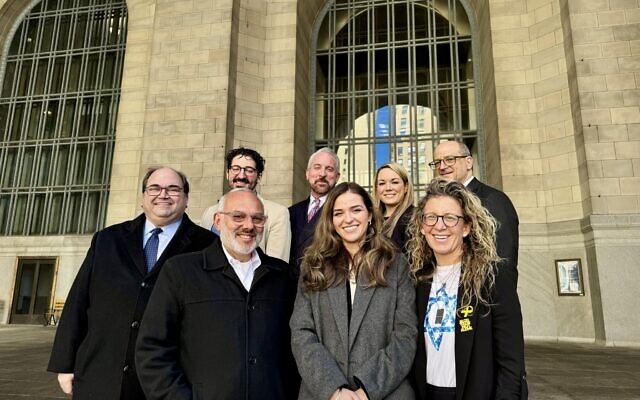
The effort was defeated during a March 7 Allegheny County Court hearing when Not On Our Dime and its fiscal sponsor, The Project for Responsive Democracy, stipulated they did not collect enough valid signatures to get the referendum on the May primary election ballot. The Jewish Federation of Greater Pittsburgh, StandWithUs and the Beacon Coalition had worked together to assemble more than 200 volunteers who reviewed every signature collected by Not On Our Dime and found 12,530 to be defective.
Pitt suspends Students for Justice in Palestine
The University of Pittsburgh placed the anti-Israel group Students for Justice in Palestine at Pitt on an interim suspension in March. The suspension followed a Feb. 4 disciplinary hearing held after the group hosted a “study-in” at Hillman Library that university officials said may have violated Pitt event policies. During deliberations regarding potential disciplinary actions against the anti-Zionist group, SJP “improperly engaged in communications to members of the Conduct Hearing Board,” according to a letter signed by the university’s associate director of student conduct Jamey Mentzer.
In April, the American Civil Liberties Union filed suit against Pitt on behalf of SJP. In August, a federal judge lifted the suspension, finding that the university violated the group’s free speech rights by suspending it from campus.
Pittsburgh residents charged with conspiracy, possession of destructive devices
A federal grand jury returned a superseding indictment in April against three Pittsburgh residents, charging them with conspiracy, defacing and damaging religious property, making false statements and possession of destructive devices. The charges were related to antisemitic vandalism at Chabad of Squirrel Hill and the Jewish Federation of Greater Pittsburgh in 2024.
The nine-count indictment identified the defendants as: Mohamad Hamad, 23, of Coraopolis; Talya A. Lubit, 24, of Pittsburgh; and Micaiah Collins, 22, of Pittsburgh. Collins is the daughter of Chad Collins, a pastor at Valley View Presbyterian Church in Garfield and a national organizer with Friends of Sabeel North America, an organization the Anti-Defamation League has characterized as “a driving force behind various Boycott, Divestment and Sanctions campaigns.” Lubit is Jewish.
Hamad “openly expressed support for Lebanon, Hezbollah and Hamas,” acting U.S. Attorney Troy Rivetti, said. “In addition to his previously charged role in defacing Jewish religious property, he conspired with others named in the Superseding Indictment to manufacture and detonate destructive devices.”
In late April, Hamad was ordered to be detained in jail pending his trial. In May, Lubit pled guilty to conspiracy to commit an offense against the United States and damaging or defacing religious property. In September, Lubit was sentenced to five years of probation and to pay $10,534 in restitution. Collins is on home detention as she awaits trial.
Rodef Shalom, Temple Sinai members approve unification
The members of both Rodef Shalom Congregation and Temple Sinai approved a unification of the two Reform congregations during separate June 8 congregational meetings.
As the “vote symbolizes endings as well as new beginnings, we can and should be joyful,” the presidents of the two congregations wrote to their members. “We have much to be excited about as we build a robust and inspired future together.”
The vote was the conclusion of an 18-month process that engaged leadership from both congregations, hundreds of volunteers across several committees and merger consultant David Weinberg.
The new congregation will represent about 1,300 family units and will be the largest Reform congregation in the region. It will be housed at Rodef Shalom’s building on the corner of Fifth and Morewood avenues. Temple Sinai’s Rabbi Daniel Fellman and Cantor David Reinwald will become the spiritual leaders of the new congregation, along with Rodef Shalom’s interim Rabbi David Young. When Young’s term ends in 2026, the new congregation will add an assistant or associate rabbi.
Jewish pride shared, tributes paid at JCC Maccabi Campus Games Opening Ceremonies
Nearly 2,000 teenage Jewish athletes came to Pittsburgh in August to compete at the JCC Maccabi Campus Games.

“The power of this moment isn’t just what we have built; it is what we have believed,” said Jason Kunzman, president and CEO of the JCC of Greater Pittsburgh. “We have said loudly and clearly, we believe in our youth. We believe in Jewish connection. We believe in experiences that last a lifetime.”
The event was held at the University of Pittsburgh. It was the first time in the Games’ history that participating teens were housed and competed on a college campus.
For 18 months, organizers strategized and planned the JCC Maccabi Campus Games, according to Scott Sewald, JCC Pittsburgh’s board chair. Along with celebrating Israel, community and heritage, the experience was about “Jewish pride.”
JAA unveils new senior residences, centered on community and Jewish values
In August, the Jewish Association on Aging began leasing 30 new personal care residences on its Browns Hill Road Campus, in the former Charles M. Morris Nursing and Rehabilitation Center.
The residences were announced in 2024 as the first phase of the JAA’s new urban senior village.

When completed, the two-phase project will be home to a senior community of almost 400 people across a spectrum of support: independent living, personal care and memory care. That includes up to 58 people in the new units, as well as those at the AHAVA Memory Care Residence and residents at The New Riverview Apartments.
The new personal care residence includes two studio apartments, 18 one-bedroom units and 10 two-bedroom units, with the option of converting another 30 units.
Continental Real Estate Cos., a Columbus-based developer, partnered with the JAA on the new residences, assisted by the Jewish Federation of Greater Pittsburgh, which helped put together a task force dedicated to the project.
Kosher food is available for those who observe kashrut, supervised by the Vaad Harabonim of Pittsburgh.
A ribbon cutting and guided tour of the new units was held at the JAA’s annual meeting on Sept. 4.
Tree of Life unveils new building design
The Tree of Life held a ceremonial groundbreaking in June 2024, but rebuilding the site of the most violent antisemitic attack in U.S. history has not yet begun.
That’s because after the groundbreaking, plans were reevaluated, according to Michael Bernstein, board chair of The Tree of Life organization. Leaders wanted to ensure the new building would be right, he said, not only for today but for decades into the future.
To do that, The Tree of Life examined three criteria: cost, sustainability and how the new building will fit within the neighborhood.
Tree of Life went back to Studio Libeskind and its principal architect, Daniel Libeskind, and began a new relationship with local architect IKM.
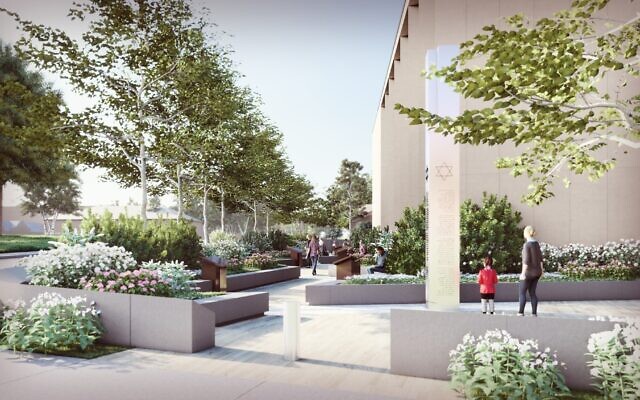
“We took a solid six months and reviewed a number of different options,” Bernstein said. “The long and the short of it is, we’re very excited to have a design that meets all the requirements that we are now pushing quite aggressively into construction drawings and permits.”
Besides a reimagined facade, the building will include a 300-seat state-of-the-art sanctuary/theater that will provide space for both religious and cultural programming, and will feature the Tree of Life Congregation’s stained glass windows.
While the classrooms and social hall will be about the same size as they were in the original design, Bernstein said the exhibition space is about 4,000 feet smaller than initially planned.
The Tree of Life organization has already raised more than $46 million, which Bernstein said covers the capital requirements for the building. It continues to work toward a $60 million goal, down from $75 million of the original design. The additional funds, he said, will be used for the museum costs and the memorial design.
Construction is expected to begin in the first quarter of 2026 for what is estimated to be an 18-month project.
Notable comings and goings
Each year, several Jewish organizations in our community find themselves bidding farewell to longtime leaders and welcoming new ones.
While this list is not comprehensive, here are a few of the notable comings and goings in Pittsburgh’s Jewish professional landscape.
Laura Cherner:
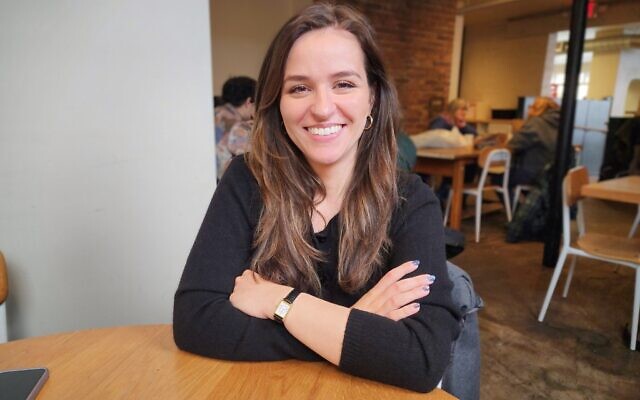
Laura Cherner left Pittsburgh’s Federation last month to join the JCRC Bay Area, in Northern California.

Rabbi Sharyn Henry: After serving as a rabbi at Rodef Shalom Congregation for more than 20 years, Rabbi Sharyn Henry retired in June, marking the end of a career that focused on improving the lives of her congregants. She served as a rabbi with Senior Rabbis Marc N. Staitman, then Aaron Bisno, but she began her tenure at the Reform congregation in 1999 as the religious school principal, then the youth and education director. Before joining Rodef Shalom, she was a rabbi and educator at Temple Ohav Shalom in Allison Park.

Cantor Kalix Jacobson: Cantor Kalix Jacobson, who has served at Temple Emanuel of South Hills since 2023, will assume the role of spiritual leader of Temple David in Monroeville in July, 2026. Jacobson will be the first cantor to lead the suburban Reform congregation.

Yikara Levari: Yikara Levari, who served as interim principal and educational director at Hillel Academy immediately following Rabbi Sam Weinberg’s resignation, was recently named principal and educational director. Levari has been with Hillel for 20 years, spending the last 12 as the girls’ assistant principal, grades 5-12.

Rabbie Howie Stein: Rabbi Howie Stein was a fixture in Pittsburgh’s Jewish community since finishing rabbinic school in 2009 and moving here with his wife, Debbie Swartz, for her job with the Jewish Federation of Greater Pittsburgh. Stein worked at several different congregations, including Temple Hadar Israel in New Castle and Temple Beth Israel-Shaare Zedek in Lima, Ohio, before serving as rabbi at Temple B’nai Israel in White Oak.
When Temple B’nai Israel closed last summer, Stein found a new position as rabbi of Temple Emanuel in Roanoke, Virginia.

Rabbi Sam Weinberg: Hillel Academy of Pittsburgh’s longtime Principal and Educational Director Rabbi Sam Weinberg resigned in April. Weinberg was employed at Hillel for 16 years — 13 as principal and educational director; one year as principal for both the boys’ and girls’ high school and middle school; and two years as the principal of the boys’ school. PJC
Toby Tabachnick can be reached at ttabachnick@pittsburghjewishchronicle.org.
comments