
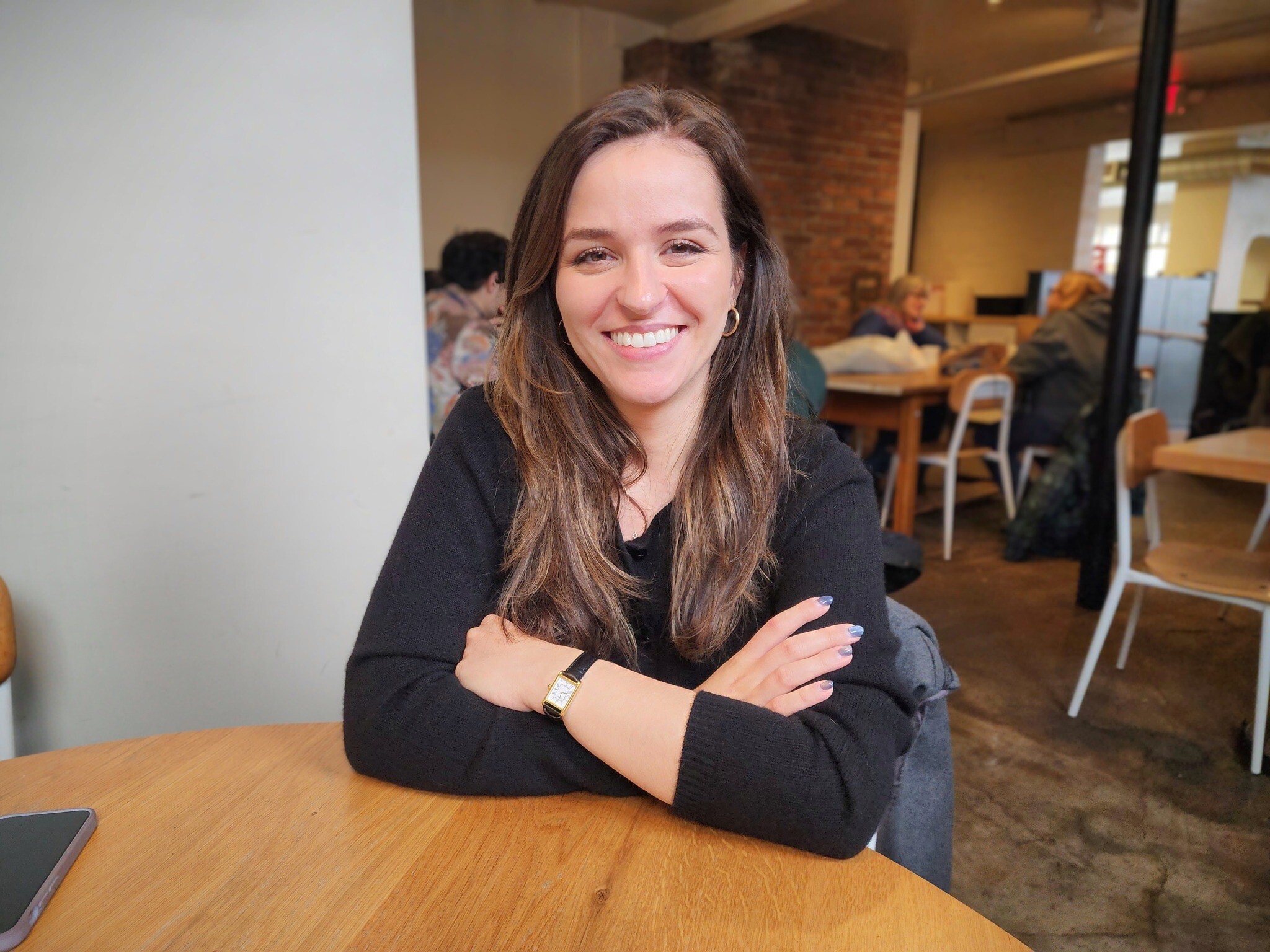
Laura Cherner, a homegrown Jewish professional known for pairing quiet conversation with public activism to better Pittsburgh’s Jewish community, is leaving her post as director of the Community Relations Council at the Jewish Federation of Greater Pittsburgh. With commitment to fostering relationships and respect between Pittsburghers — particularly among those holding diverse and competing views — Cherner has served the CRC through sizable challenges, including the Pittsburgh synagogue shooting and its trial, COVID, Oct. 7 and the Israel-Hamas war.
Weeks from beginning her role as chief community relations officer at the JCRC Bay Area, Cherner, 30, spoke with the Chronicle about her growth as a professional and the lessons she’s bringing to San Francisco.
This interview has been edited for length and clarity.
As CRC director, you’re a Jewish communal contact for many Pittsburghers, as well as state and national figures. Tell me how this started.
I really fell into it to be honest with you. A week after I graduated from the University of Pittsburgh, I started working at the Federation as an administrative assistant. I really had no idea what I wanted to do with my life. I was interested in politics. I worked for a congressman and I completed a Jewish studies certificate in college, but being a Jewish communal professional wasn’t really on my radar. Pretty soon after I started, Federation created an assistant director of community relations position, which combines a lot of the things I care about, like being able to incorporate advocacy and building relationships with different communities. Federation hired me for that — I think they took a leap — and the rest is history.
Major events occurred during your time with the CRC. Could you reflect on the beginning?
I became assistant director when I was 21 years old. I was passionate about young adult engagement and getting the next generation of people involved in CRC, so I created the young leaders CRC, which I’m still proud of. We also marched in the Pittsburgh Pride Parade, which was a nice way for the community to come together in a really visible way with the broader community. That first year we had about 140 participants, and one of the great things we did was the “Love is Kosher” campaign, which has had a lasting power as a message. When the shooting happened I was 23, and it was just kind of a reset moment in how I understood my job, my own community, and what responsibility and opportunity someone like me has. My concept of a crisis situation in the community relations realm just completely went on its head.
What do you mean?
One of the things we always said about Oct. 27 was that the embrace we felt from the community was because of the work that we’d put into building relationships on the day prior and the decades prior. When I look back on the shooting, one of the things that really sticks out in my mind is the day of the shooting I went to the JCC, which ended up being the point of gathering for families and for the FBI, and the first person that ended up showing up for me was Tim Stevens (founder of the Black Political Empowerment Project). He called me on my way that morning to make sure I was OK, and then he showed up at the JCC just to be with me. That
always sticks with me. The power of the work we do has an ability to build genuine, real connections for times of calm and also times of crisis.
Building relationships requires time and trust. You became director during COVID. What was that like?
It was challenging in a lot of ways. I was 25 years old. I was the youngest director of community relations in the country. I’m still probably one of the younger ones. Federation and our board were taking a leap of faith and trusting me to do something big. At the same time, the work was virtual, there was a feeling of isolation and distance from the community, so for that first year there was a lot of learning.
Tell me more about that period.
It was a really weird time to start building my own relationships in the community, because a lot of relationship-building is in person. Also a lot of community relations is government relations. There were a lot of social service needs during COVID, so we were constantly asking, “How do we take the relationships that we have at the federal level and help people?” In 2021 there was also Operation Guardian of the Walls (an 11-day military conflict between Israel and Palestinian forces), and we learned that when there’s violence in Israel there’s an uptick in antisemitism, typically in the Diaspora. I remember we did the Stand Against Antisemitism event outside of the City-County building, which was one of the first times I saw a lot of people in person after COVID. On the one hand, it was nice seeing people but on the other hand the reason why we were gathering was because of a rise in antisemitism. That event kind of helped me get my footing as director. We brought together a lot of allies we have in the community, and we called upon the relationships that we built to stand with us, in a way that we hadn’t since Oct. 27.
How has your work evolved?
When I reflect back on what community relations looked like in the beginning, it was a lot more gathering together, and trying to build relationships for the sake of building relationships, so that hopefully when you need to call on people they’re there for you — and there are times that has happened in this community, and in other instances it hasn’t. When I think about it, particularly post-Oct. 7, it’s unfortunate that so much of the work has really become about addressing antisemitism. What I will say is I’m grateful for the leadership and the partners that we have in the community, and at the Federation, that give me and give others confidence that we’re addressing it in a collaborative and holistic way.
Tell me about some of the successes.
One of the programs I’m proud of is our Coffee and Conversation series, where I’ll do a question and answer forum with different candidates across levels of government. It’s a really great way for the candidates to understand some of the issues our community is thinking about, and also for our community members to connect with candidates and promote civic engagement. A lot of community members are interested in government relations — so along with engaging our city and county officials on different issues, we’ve taken groups to Harrisburg and Israel — and we’ve been able to accomplish a lot of significant things, like the Nonprofit Security Grant Program.
With help from the Federation, nonprofits can pursue grants from the Pennsylvania Commission on Crime & Delinquency State Security Grant Program and the federal Nonprofit Security Grant Program. Why is that such a big deal for the CRC?
Making sure that people are safe, and feel safe, is one of the most important unifiers. Going into other communities and training them on how to apply for a grant or doing a walkthrough in a church or in a mosque, which Federation’s director of community security, Shawn Brokos, does, is a really important community engagement tool. Regardless of what may have happened in the relationship, or what someone may have said, or the perception of how a community may feel about the Jewish community, at the end of the day one unifier is that we all want everyone to be safe. This program gives our community a lot of confidence and reassurance that we’re actively taking steps to make sure we’re safe and so many opportunities to collaborate with other communities around this common goal.
You’ve had an interesting vantage point on the community. What do you see moving forward?
I think it’s a moment of opportunity. There are members of the community who are more activated, engaged and passionate about community building and Jewish continuity than ever before. At the same time, the backdrop is a lot of significant challenges. One concern I have is that I don’t want our community, but also others, to define us based on antisemitism — because that’s not what the community is. We are an incredibly resilient, vibrant, strong, diverse Jewish community, and members of the community show up in different ways and express that in different ways. We need to figure out how we define ourselves during this moment, for ourselves but also for the broader community, when we are making that introduction and saying, “I’m a member of this Jewish community, and here’s what community means to me.”
We’ve talked a lot about community. The word is in your title, but what does ‘community’ mean to you?
Community is coming together, seeing everyone and taking care of each other. This is from our young children — and being able to send them to pre-K and giving them a good Jewish education — all the way up to our older adults and making sure that they’re aging with dignity. Something I’ve thought about more post-Oct. 7 is that community also means connection and peoplehood. There’s such a shared understanding and experience when it comes to being Jewish, that regardless of where you are politically, religiously or where you’re from, we’re all connected, and connection has built so many beautiful things and wonderful people. Community is everything, and we wouldn’t be able to do anything without the people who make it what it is.
Before you leave, what do you want people to know?
Everything we’re able to do is because of the collection of people around us. I’m so grateful and amazed that we have such strength and infrastructure in the Jewish community. We have really learned how to take care of each other. For me personally, I’m grateful that the community has uplifted me so much. You’ve given me the opportunity to be where I am and to professionally contribute to things I care about. It has been really gratifying, and I just want to say thank you. PJC
Adam Reinherz can be reached at areinherz@pittsburghjewishchronicle.org.
comments