
Pitt researcher helping restore sight through groundbreaking implant
Older adults experiencing irreversible blindness may now be able to see thanks to a system relying on a wireless retinal implant and high-tech glasses
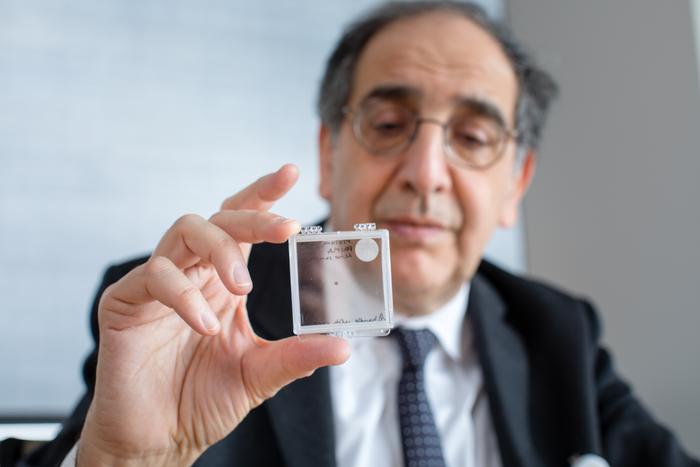
For Jewish Pittsburgher Dr. José-Alain Sahel, the dream of giving sight to the blind is becoming a reality. A new system — relying on a wireless retinal implant and high-tech glasses — helped most patients in a major study regain measurable vision, according to results published in the New England Journal of Medicine.
Released last month, the study showed that of 32 people who completed 12 months of follow-up, 26 achieved meaningful visual improvement. Study participants, on average, improved by 25 letters (about five lines on a standard eye chart) thanks to the device; 81% percent of people studied gained 10 or more letters.
Sahel, a Squirrel Hill resident who serves as distinguished professor of ophthalmology at the University of Pittsburgh Medical School, told the Chronicle that the research represents a “long-term investment” from partners worldwide.
Nearly two decades ago, Sahel and other researchers, including Stanford University Professor of Ophthalmology Daniel Palanker and colleagues throughout Europe, undertook measures to develop necessary technology, surgery, clinical protocols and the clinical trial.
“The device we imagined in 2005 now works in patients remarkably well,” Palanker told Stanford Medicine News Center following last month’s announcement.
Geographic atrophy due to age-related macular degeneration affects more than 5 million people worldwide. For these individuals, no known therapies are currently available.
The PRIMA (photovoltaic retina implant microarray) system hopefully can help. Relying on a 2×2 mm wireless chip, implanted in the back of the eye, and a pair of high-tech glasses, PRIMA allowed some study participants to read with acuity equivalent to 20/42 vision.
“The fact that we are able to restore some vision — it’s not perfect — but some vision to these people is important,” Sahel said.
Countless hours preceded last month’s announcement. Reflecting on the tireless contribution of multiple partners, Sahel said researchers worldwide are engaged in a “long-term fight against blindness.”
These advancements represent “many decades of work by multiple people,” he said. “I think this shows the value of persistence, the value of collaboration and the importance of being focused on the needs of the people.”
Though the research has garnered widespread attention, “it’s only a milestone, it’s not a final step,” he continued. “We are continuing to work on refining the device, refining the technology to make it even better.” PJC
Adam Reinherz can be reached at areinherz@pittsburghjewishchronicle.org.
comments