
Tree of Life unveils new building design
“We took a solid six months and reviewed a number of different options,” Bernstein said.
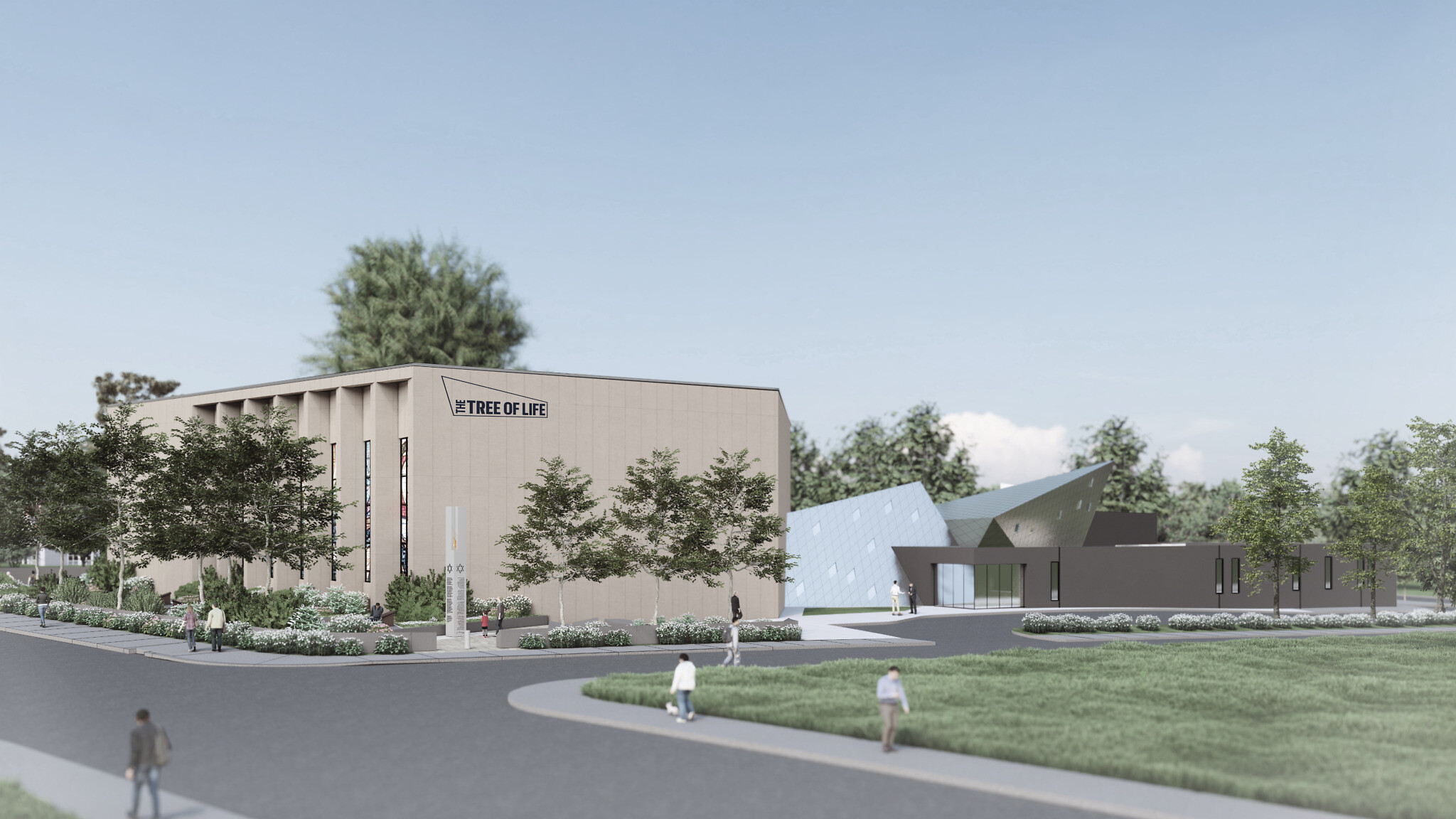
Fallow since a June 2024 groundbreaking, the land housing the Tree of Life building will soon be busy with activity.
And while the official ceremony was thick with pomp and circumstance, Michael Bernstein said that, in its aftermath, the organization’s leaders thought there was a window of opportunity to reevaluate everything “before we truly put shovels in the ground.”
Bernstein is the board chair of the Tree of Life organization. He wanted to ensure the new building would be right, he said, not only for today but for decades into the future.
To do that, the Tree of Life examined three criteria, Bernstein said: cost, sustainability and how the new building will fit within the neighborhood.
Tree of Life, he explained, went back to Studio Libeskind and its principal architect, Daniel Libeskind, and began a new relationship with local architect IKM.
“We took a solid six months and reviewed a number of different options,” Bernstein said. “The long and the short of it is, we’re very excited to have a design that meets all the requirements that we are now pushing quite aggressively into construction drawings and permits.”
Besides a reimagined facade, the building will include a 300-seat state-of-the-art sanctuary/theater that will provide space for both religious and cultural programming, and will feature the Tree of Life Congregation’s stained glass windows.
“There’s certainly going to be speaker, film and performance series,” Bernstein said. “We did not have that in the smaller sanctuary.”

Inspiration for the combined space, he said, comes from Sixth and I in Washington, D.C., a historic synagogue that now functions as both a synagogue and a space for cultural events.
While the classrooms and social hall will be about the same size as they were in the original design, Bernstein said the exhibition space is about 4,000 feet smaller than initially planned.
That diminution won’t come at the expense of the organization’s goal, he said.
“We worked with our exhibition team — we have an academic advisory committee that we really challenged. We asked, ‘Can you tell the story in a smaller space?’ and the feeling was, overwhelmingly, yes.”
A prominent feature of the previous design, the path of light, has been eliminated. Instead, there will be an entrance atrium connecting the new building with the existing building that will be functional space, something that was limited with the path of light.
“The big gain we got by having a smaller footprint was we actually opened up green space,” Bernstein said. “So, on the Wilkins Avenue side, outside of the social hall, there is now going to be a beautiful green lawn.”
The lawn will be available for additional programming, he said, something that is important to the organization as it envisions the site being used by the neighborhood.
“We’d like for people to stop and get a coffee while on a walk, sit outside, things like that,” Bernstein said.
The memorial design continues on the Shady Avenue side of the building. The entrance of the new building will be closer to where the old entrance was, and closer to the memorial.

The Tree of Life organization has already raised more than $46 million, which Bernstein said covers the capital requirements for the building. It continues to work toward a $60 million goal, down from $75 million of the original design. The additional funds, he said, will be used for the museum costs and the memorial design.
“We’re moving forward now because we can cover the cost of the building and then the balance is for operating costs and to give us some runway for the first few years,” Bernstein explained.
He hopes that construction will begin by the end of the year or the first quarter of 2026, for what he estimates will be an 18-month project.
“Our goal is to have the congregation hold High Holiday services in 2027 and then open the museum in early 2028,” Bernstein said.
Those passing the site will begin seeing physical changes by mid to late October, including a new wrap on the building and an enclosure where the memorial will be located.
The new building will house and support the work of the Tree of Life organization, which is centered on four pillars:
• Memorialization, to remember “the lives taken on Oct. 27, who they were and make sure everyone remembers what happened on that day was a tragedy for not just the Jewish community or Pittsburgh, but America,” Bernstein said.
• Education, including the Holocaust Center, which is a program of the Tree of Life with its own advisory board, and the LIGHT Education Initiative, now in 35 schools and continuing to grow.
• Jewish life and culture, consisting of the congregation and bringing Jewish life “back to the corner of Shady and Wilkins,” Bernstein said, including programming for Jews and non-Jews alike.
• A platform for national discussions, featuring programming like the traveling exhibition “Lessons from the Tree of Life: Lighting the Path Forward.”
The announcement of the new design is only part of an eventful period for the Tree of Life.
The organization’s LIGHT Education Initiative is co-sponsoring the Sept. 15 student summit at the Eradicate Hate Global Summit, featuring 36 schools and nearly 340 students.
Its traveling exhibit opens at the Museum of Jewish Heritage in New York on Oct. 5. A week later, on Oct. 12, the organization will host an event in New York with Yair Rosenberg from The Atlantic and Amy Spitalnick from the Jewish Council on Public Affairs. Spitalnick serves on the Tree of Life’s academic advisory committee. The two will discuss contemporary antisemitism and the challenges facing the Jewish community.
In Pittsburgh, on Oct. 19, another Tree of Life academic advisory committee member, Pamela Nadell, will appear at Carnegie Mellon University with The New York Times’ Bret Stephens.
Nadell’s new book, “Antisemitism, An American Tradition,” is scheduled to be published on Oct. 14.
And while Bernstein hopes the public can appreciate the programming the Tree of Life is creating, he also understands the perception that nothing has happened for almost seven years at the site of the worst antisemitic attack in American history.
He hopes the community understands the need to be purposeful and exact.
“I’d rather measure three times before we hammer than rush forward,” he said. “Ten years from now, no one will remember if we took an extra six months, but they’ll 100% know if it’s overbuilt and unsustained.” PJC
David Rullo can be reached at drullo@pittsburghjewishchronicle.org.
comments