
Hillel Academy school year starts with jokes, educational truths and ‘yes, and’
Improv affords space 'between rigidness and freedom where people really thrive'
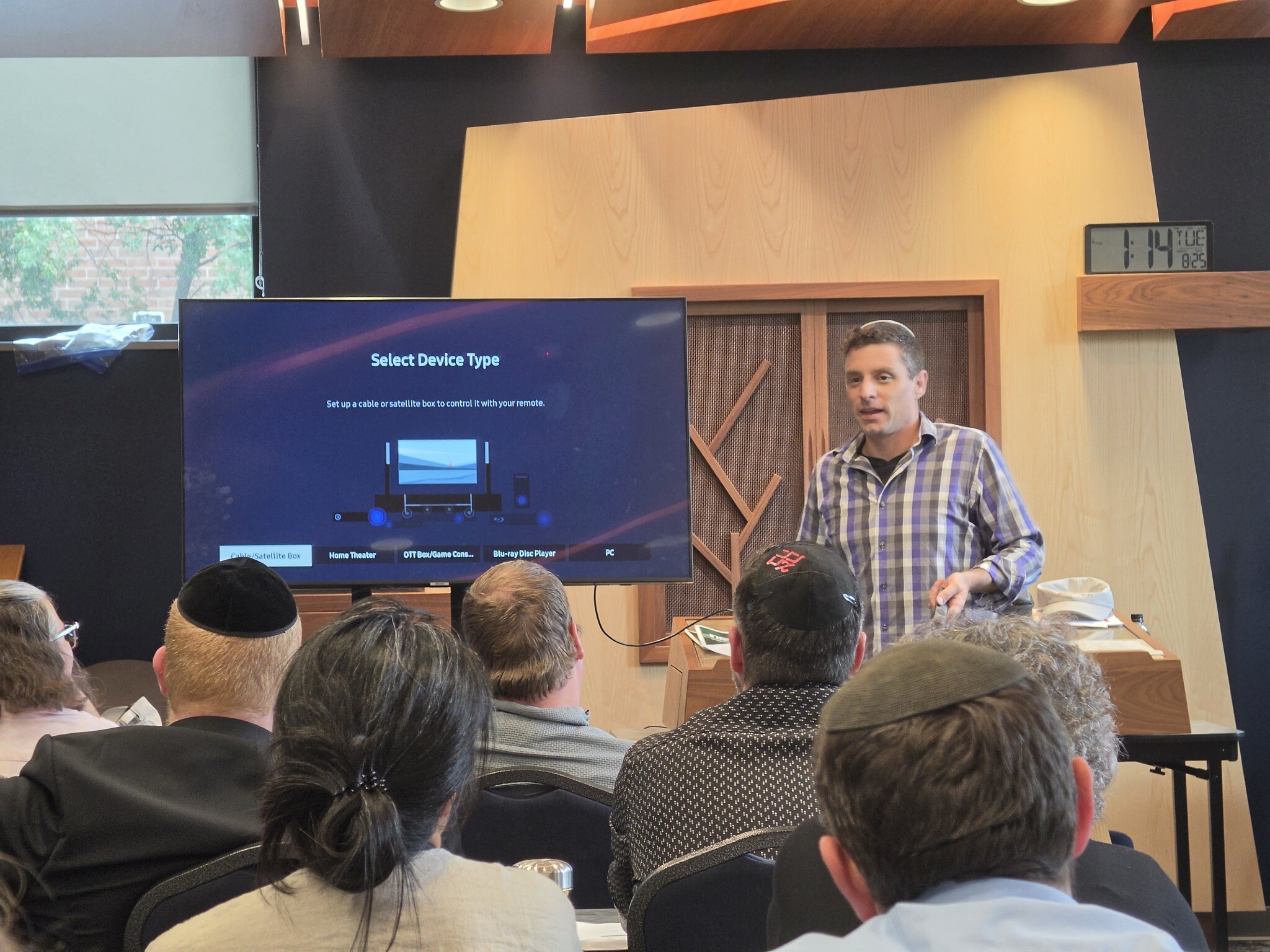
The principles of improv are propelling students and teachers at Hillel Academy of Pittsburgh toward better instruction and communication. On Aug. 25 and 26, Dr. Juda Alcabes, the self-described “improv therapist,” worked with educators and teens on a series of trainings.
After traveling from his home in Boca Raton, Florida, Alcabes, a licensed therapist and professional comedian, met with administrators and teachers on Aug. 25.
“What’s the deal with school?” he asked.
As participants mulled over the prompt, Alcabes explained that his Pittsburgh visit wasn’t about trying to “blow up the structure of a classroom”; rather, it was to remind everyone about certain norms.
Children are taught by adults, and there’s often a funny dynamic, he said. Adults — whether teachers or parents — routinely want kids to talk to them and to learn, but they too often rely on ineffective approaches.

Alcabes referenced a recent engagement with his own son, who just returned from overnight camp.
After asking how the summer was, Alcabes said his son replied, “You know.”
Alcabes said he reacted by saying, “That’s it?” and thinking, “That’s the whole thing? You were away for a month. It cost me like eight grand to get you there.”
The reality, he told the group of nearly 70 educators, is that there are better ways to connect with young people and elicit feedback — and most teachers already know this. Some students are more verbal. Some are less. But in the moment, when there’s a need to cover specific material, “you don’t really get a chance to think about this kind of stuff on the fly because you got a lot to do.”
Leaning on a classic comedic form can help, he explained.
Improv, which is predicated on the rule of “yes, and,” requires parties to accept and develop whatever reality a scene partner creates, he said. By saying “yes,” a party acquiesces to the narrative. By saying “and,” a party builds on what’s there.
Alcabes — first with teachers, then the following day with high school students — demonstrated how to use the “yes, and,” approach through various games. Each activity allowed participants to further communication and create trust.
It’s about “going back to the art of connection,” he told the Chronicle. If teachers and students, or colleagues, or peers, see “we’re connected, things are a lot breezier.”
And truthfully, he continued, “at the end of the day, a teacher could not teach without a student.”
The concept is more than a maxim. Respectful communication, Alcabes explained, means recognizing that teachers and students may have different statuses in the classroom, but both sides need one another to succeed.
Alcabes said he’s seen the communicative tactic work countless times, especially when a situation requires “modification of behavior from a student.” A student is more likely to be receptive if they “actually feel like a partner in it.” The mindset shifts to “like, hey, we’re doing this together.”

Rabbi Yisroel Smith, Hillel Academy’s fifth to 12th grade boys principal, told the Chronicle he has followed Alcabes’ material for years online.
Having the “improv therapist” finally work with Hillel Academy educators and students was incredible, Smith said. Staff was able to see that there’s a space “between rigidness and freedom where people really thrive.” And students learned that “if you operate within rules, and you’re respectful of everyone, everyone can have a lot of fun more than if you just make it about [yourself] and tell a joke at someone else’s expense.”
Hillel Academy student Elisheva Sunshine, 16, praised the Aug. 26 workshop and said Alcabes conveyed a sentiment that “you don’t have to be so stuck in your ways” and that adopting an “anything could work” mindset can be beneficial in multiple settings.
Classmate Ahuva Isenberg, 17, agreed and described Alcabes’ approach as a fun reminder that “whatever comes out of your brain in that moment” doesn’t have to be perfect. By using the tools of improv, experiences can be shared and connections can be created, even when “everything doesn’t make sense.”
Although school is a place to foster learning, improv can impart educational truths that extend beyond dates, equations and spelling, Hannah Swedarsky, 17, explained. Committing to the rules of “yes, and” is something “you could take on as a lesson, and people could actually learn from you.” PJC
Adam Reinherz can be reached at areinherz@pittsburghjewishchronicle.org.
comments