
Israel trip gives Jewish day school educators opportunities to learn so they can teach
'Teachers need to understand what’s happening in Israel. They need to provide students with real information'
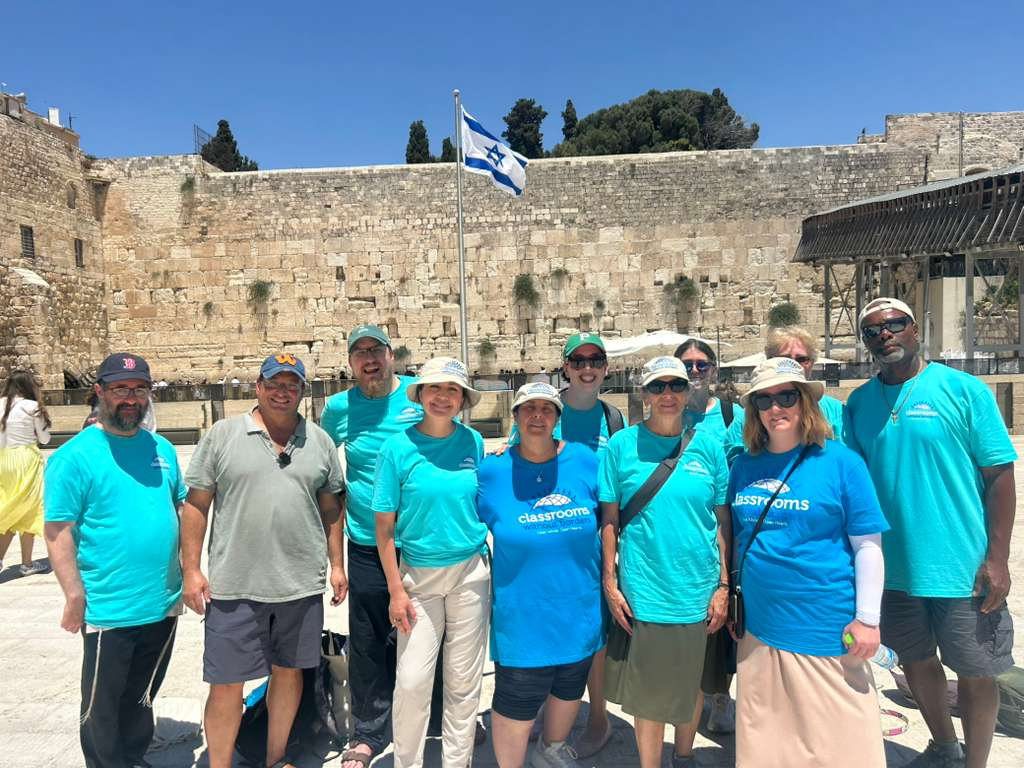
Teachers and staff from Pittsburgh’s three Jewish day schools spent 10 days in Israel this summer, exploring the country’s history, culture and educational landscape as part of a Classrooms Without Borders seminar designed to strengthen classroom instruction back home.
The June 30-July 9 seminar was preceded by nearly 18 months of preparation.
Shelly Itskowitz, a middle school Judaics teacher at Hillel Academy of Pittsburgh, described the seminar as an educational gift, and said its impact was strengthened by several unexpected additional months of study.
After registering for the seminar in 2024, Itskowitz and day school colleagues were slated to spend a year learning from Classrooms Without Borders staff before visiting Israel in summer 2025.
Regional conflict, however, caused organizers to postpone the trip until summer 2026.
As opposed to seeing the delay as a source of frustration, participants and organizers recommitted to the goal, explained CWB Founder and Executive Director Tsipy Gur.
“What we learned two years ago is that many teachers — Jewish and non-Jewish in the day schools — have not been to Israel in years,” she said. “They need education and they need to understand history.”
After the summer 2025 trip was delayed, participants spent the following months delving deeper into Jewish history and regional relations with CWB scholar-in-residence Avi Ben-Hur.
Those sessions delivered “just pure facts and knowledge about Israel and its connection to the Jewish people,” Itskowitz said. “There was no sugarcoating at all.”
Though participants enjoyed an additional period of preparation, concerns remained that the Israel visit could be canceled due to ongoing war. After a mid-June ceasefire took hold between Israel and Hezbollah, however, and CWB board members approved the trip, nine cohort members ventured to the Jewish state, Gur said.
She credited Classrooms Without Borders’ board and the Jewish Federation of Greater Pittsburgh for supporting day school teachers in their efforts to meet the demands of today’s classrooms.
“Teachers need to understand what’s happening in Israel. They need to provide students with real information,” she said. “We have a big responsibility.”
Different pasts, one path
Itskowitz praised organizers with not only delivering countless insights throughout the Israel-based seminar — and its lead-up — but fostering sincere respect for difference. “We went with teachers who are devout Catholics, who are Protestant, who are non-denominational Christian.”
Within the cohort, perspectives on Israel and religion ranged, but when it came time for discussion, “it was never combative or defensive,” she continued. “It was always, ‘I didn’t know that. Tell me more.’ Everybody had something to give.”
Brenda Hayes, a middle school Spanish and ESL teacher at Community Day School, said her desire to join the seminar was fueled by a quest to learn more about Israel.
For the past seven years the non-Jewish CDS staffer has worked with numerous Israeli students and colleagues. Having spent so much time hearing about Israel, she wanted to see the country firsthand.
“It felt like home,” she told the Chronicle after returning to Pittsburgh. “I was just so happy with everything: the weather, the food, the friendly people.”
Vaughn Peterson, director of security at CDS, said he’d previously visited other Middle Eastern countries during his time as a Marine.
When Classrooms Without Borders offered Jewish day school staff an opportunity to learn about Israel and visit the Jewish state, Peterson said he couldn’t pass up the chance.
“It was in my heart to go, and I just feel like it’s an important thing for people to actually understand,” he said.
History and now
While participants spent more than a year studying various periods of Jewish history, the trip enabled educators to see Israeli life post-Oct. 7, Gur said.
Especially memorable, Itskowitz said, was a conversation with a Kibbutz Be’eri resident who recalled Hamas’ Oct. 7, 2023, attack and its aftermath.
“He was emotional, obviously, when he was talking about his experiences,” she said. “They know that it can happen again — they tell themselves that they don’t want to pretend like it can’t, because that’s why they were in the situation they were in, thinking that everything was fine — but their lives are moving on.”
Vaughn said the Be’eri visit, as well as a stop at the Nova music festival site, made clear that it’s difficult imagining the horrors of Oct. 7, “until you get there and you speak to the people that were in the area, who had to react to the situation.”
“These people are so resilient — they’re being threatened on a daily basis, and they still are able to go on with their lives — and it’s important to them to keep the state of Israel,” he said.
“Basically, if that goes, then it’s a whole different ball game.”
Home again
Rabbi Dovid Rothman, a middle school Judaics teacher at Yeshiva Schools of Pittsburgh, called the seminar “an opportunity of a lifetime” and credited it with challenging long-held beliefs.
“I’m an American through and through, and I just cannot believe how comfortable I felt. It was home the moment I got there. It really shocked me,” he said.
Rothman, a former New Englander, told the Chronicle his family, leading back to his great-grandparents, had been in the Boston-area since the late 1800s.
“I’m a Bostonian — Sam Adams — I’m very patriotic,” he said. Still, “being in Israel — and about half the Jewish population is there right now — it just felt right to be there.”
Prior to the seminar, the Yeshiva Schools educator had never visited Israel. Touring the Jewish state, seeing historic sites and learning from fellow teachers — both cohort members and Israeli educators — will deeply impact his classroom, he said.
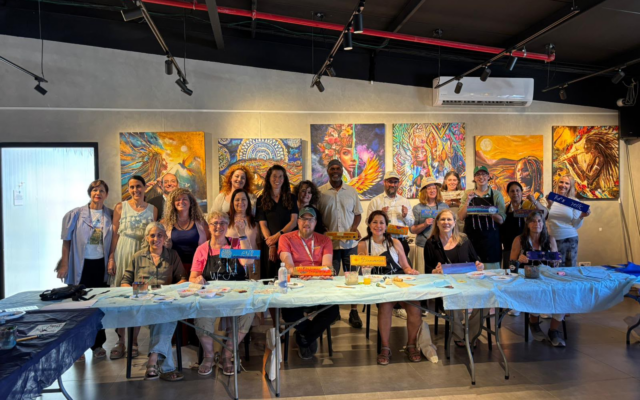
A theme often referenced by CWB staff was “when there’s upheaval and difficulty, that’s a catalyst of change,” Rothman said. Whether regarding the destruction of the Temple, exile or Oct. 7, in every period “there was some upheaval, there was some difficulty, and the periods changed because of that catalyst.”
Rothman said tour guides and experts often communicated the trope through storytelling.
Taking a narrative approach, he continued, offers a “glimpse into the life of a person.”
“It’s just a different feeling — it really connects you to the people.”
The Jewish day school teacher mentioned upcoming curricula involving the Shulchan Aruch, a 16th-century code of Jewish law, and said that by relating the experiences of its author, Rabbi Joseph Karo — or digging into the Mishnah and not only conveying halachic teachings but the personalities of the rabbis mentioned in the text — he can help Pittsburgh’s Jewish students achieve new connections to familiar material.
“I am pretty excited about this,” he said. “It’s going to change my class.”
Upon conclusion of the seminar, Gur told the Chronicle that along with providing professional development in Pittsburgh, CWB has enabled more than 1,000 educators to travel to Israel and across Europe since the organization’s 2011 inception.
The charge then, as it is now, is to empower educators and deliver opportunities and resources to meaningfully impact the future, she said. “We need our teachers to understand.” PJC
Adam Reinherz can be reached at areinherz@pittsburghjewishchronicle.org.
comments