
CMU’s Fence Working Group delivers report amid renewed tensions
A series of anti-Zionist messages painted on the Fence has reignited debate over free speech and student safety
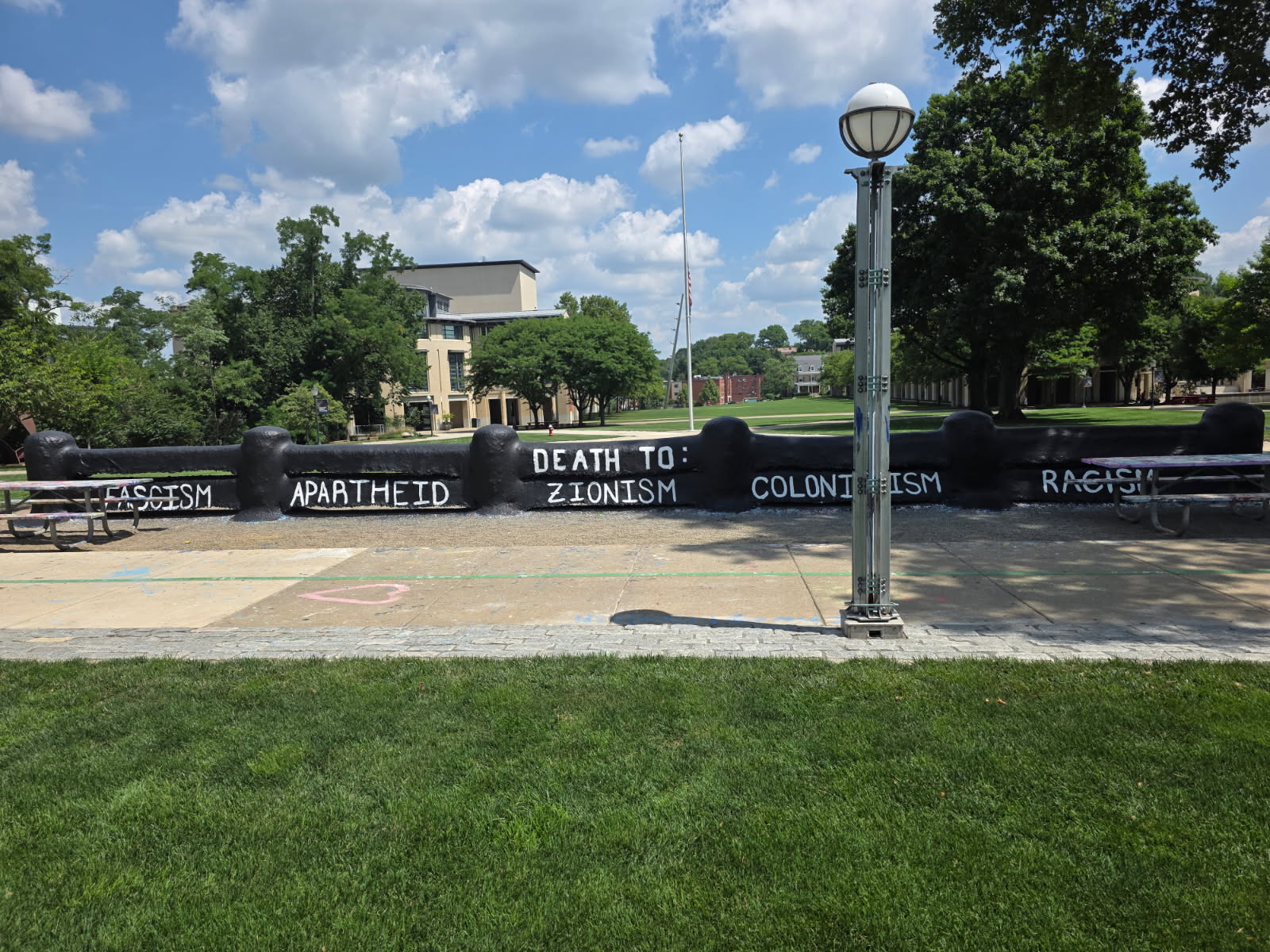
For over a century, Carnegie Mellon University’s Fence has played an ever-evolving role as a “student-centered” space for expression and community. This past month, a series of anti-Zionist messages painted on The Fence has reignited debate over free speech, student safety and the university’s role in stewarding one of Carnegie Mellon’s oldest traditions.
On June 9, The Fence was painted with the phrases “Free Palestine” and “By any means necessary,” an axiom considered by some community members to be antisemitic and a call to violence against Jewish people.
Although the university did not paint over “By any means necessary,” University President Farnam Jahanian condemned the message as “threatening” in an email to the university community, emphasizing that it is “categorically unacceptable for an anonymous message painted on [CMU] property to incite or imply support for violence.”
Over the past month, The Fence has been repainted several times with a range of statements related to Zionism. The university painted over a message on The Fence, attributed to “a few Jewish students,” that included the verbiage “Death to Zionism” in Yiddish. In an email to the CMU community, Jahanian wrote that “a call for ‘death’” violated the university’s longstanding policy against threats of violence directed at individuals or groups based on their identity.
The latest controversy comes amid the release of the Fence Working Group’s final report. Jahanian convened the FWG in September 2025, following his controversial decision to paint over the unattributed message “No Rapists on Our Campus” and temporarily take The Fence “offline” during President Donald Trump’s participation in the Pennsylvania Energy and Innovation Summit at CMU last July.
Composed of students, faculty, staff and alumni, the FWG was tasked with providing university administration with recommendations on how to steward The Fence going forward while “ensuring clarity, accountability and respect for its roles, and the boundaries of its roles” within the CMU community.
The 45-page report features six key recommendations rooted in the principle of “bilateral restraint” — the notion that the university has a responsibility to protect free speech even if it makes some community members uncomfortable. Likewise, community members should not exercise their right to freedom of expression to the “maximum permissible limits.”
Among its recommendations, the report encouraged administrators to continue to “celebrate” The Fence as a student-centered space, while avoiding language that suggests it is “student-owned.” It also suggested that university administration and student government collaborate to establish clearer processes for managing The Fence, communicate that the messages on The Fence represent the perspectives of individual painters and develop traditions during major campus events.
The FWG also suggests that the administration should only paint over The Fence in “rare, extreme cases,” especially when the message might be perceived as “invoking the institution of Carnegie Mellon.” Through this lens, the university’s main interest in painting over messages is in “removing its liability, not in punishing the speaker.”
For some Jewish students, the recent Fence paintings have raised concerns about their sense of belonging and safety on CMU’s campus. Three students who spoke to the Chronicle expressed that while the messages make them feel unwelcome, they largely view the controversies surrounding The Fence from a distance.
“I have periodically gotten emails from President Jahanian regarding events at The Fence. I would say that, you know, the majority of my experience with this was immediately proceeding Oct. 7,” said Ben Koby, a Jewish student at CMU. “From my limited interaction with how things are going, it appears that the administration is taking a much more proactive role as far as this issue is concerned, especially compared to three years ago.”
Other students emphasized that while the messages may be concerning and should be addressed by the university, as the FWG’s report suggests, they likely do not reflect the shared perspective of students at large.
“When I see something like that, the question is always: ‘Is it a small group that just did it overnight, and now everyone’s talking about it, or is it a big, concerted effort within students?” said Raphael Katz, a Jewish student at CMU. “It’s a very technical school … everyone’s in their computers and code, and you know, it’s definitely a very non-political [program].”
As it stands, the restrictions regarding The Fence largely govern “process” but not “content.” Under CMU’s Graffiti and Poster Policy, the only formal content restrictions prohibit obscenities and incitements to violence. Moreover, while Jahanian has repeatedly underscored the “anonymous” nature of these messages, there is no formal rule that requires students to take responsibility for their paintings.
The FWG’s report suggests that while anonymous speech is not “precluded,” it may increase the university’s “liability,” and as such, increase likelihood of removal.
“The anonymity that social media, and what have you, has enabled people in that [they] no longer feel responsible for their actions, or believe that they can do things and get away with things that in previous times would have been considered absolutely unacceptable and would have had serious consequences,” Koby said. “So, unfortunately, there isn’t a policy that allows everything to be hunky-dory — it requires responsibility on the part of the community.”
Going forward, Koby hopes the student body can “maintain the level of decorum” necessary to have access to “unrestricted free speech in a private setting.”
However, some student groups have expressed concern with the FWG’s recommendations and the university’s recent responses to The Fence. CMU’s chapter of Young Americans for Liberty, which has spent the last year urging the university to enshrine rules governing The Fence into official policy, criticized the administration’s actions.
“We condemn the administration for censoring students who exercised their free speech rights on The Fence within the bounds of what has traditionally been considered acceptable,” wrote the Young Americans for Liberty in a statement on June 30. “We also believe it’s important to emphasize that while we fight for a University which upholds robust freedom of speech, we must commit ourselves to dialogue which respects the dignity of others and seeks to constructively engage with ideas, especially those which are more controversial. The way that those who painted The Fence expressed their position was deeply objectionable and irresponsible, even though they were within the bounds of acceptable speech at The Fence.”
Bruce Ledewitz, an emeritus professor at the Thomas R. Kline School of Law, told the Chronicle that he believes a court would likely view the phrase “Death to Zionism” as protected political speech rather than a true threat. However, he noted that as a private institution, CMU has broader discretion to regulate speech it believes comes too close to inciting violence.
“Something written on The Fence that’s an actual threat, of course, would undoubtedly not be protected by the First Amendment, and it also would be a violation, undoubtedly, of university policy,” Ledewitz said. “But you know, there have not really been credible threats; people are mostly objecting to what is protected speech.”
Ledewitz emphasized that while he doubts the university would ultimately face legal consequences for allowing such messages to stand, administrators have legitimate reason to be concerned in today’s political climate.
“Every threat of violence creates a hostile environment by definition,” Ledewitz said, “so if the university permits expressions of violence against Jewish students — or against really any group,” they might face legal action.
“They would not be held liable, you understand, under current law — everything is protected by the First Amendment,” he said. “But if the university were to say, ‘Look, we know we would prevail, [but] we don’t want to be sued’ … I mean, it’s unfortunate, but the Trump administration, or figures in the Trump administration, have sued in legally dubious contexts just to cause expense and worry to defendants.”
Whether the university will adopt the recommendations listed in the FWG’s report remains to be seen. In a June 12 email to the CMU community, Jahanian wrote that he will review the report and “discuss its recommendations and observations with university leadership, the working group, and student government leaders,” before more fully addressing its suggestions come fall. PJC
Octavia Liku can be reached at oliku@pittsburghjewishchronicle.org.
comments