
When cars brought chaos, chaos brought ideas
Under several Jewish leaders, the Better Traffic Committee spent the late 1920s and 1930s advancing novel ideas to educate the public about the dangers of the car.
Are you trying to cultivate a spirit of gratitude this year? Why not start with a challenge? It’s easy to be grateful for family and good health and dramatic sunsets. But can you summon the strength of character to be grateful for Pittsburgh traffic?
History is here to help.
As with most world-changing technology, the automobile was given to humanity without much effort to mitigate its negative consequences. The growing use of cars in Allegheny County in the late 1910s and early 1920s brought deadly chaos to local streets.
According to research from historian Joel Tarr, Allegheny County reported 182 automobile-related deaths in 1922. The total included 82 pedestrians struck by vehicles, more than half under the age of 14. By comparison, Allegheny County reported 73 automobile-related deaths in 2024, despite having exponentially more cars on the road.
As a public health intervention, Mayor William Magee formed the Better Traffic Committee in February 1925. It had seven subcommittees, including an “education and publicity committee.” While the other committees worked on municipal policy, the education and publicity committee tried to get out the word about the dangers of the automobile. The committee accepted its charge with flair, creativity and optimism.
The Better Traffic Committee survived the mayoral election that fall, when lawyer Charles H. Kline beat Magee. Kline tapped the downtown department store magnate Walter Rosenbaum in May 1926 to lead the education and publicity committee.
Rosenbaum was the general manager of Rosenbaum’s Department Store, which had been founded by his father, Max. Safety became Walter’s leading civic undertaking.
Rosenbaum started with a report on traffic fatalities since 1923. It was a useful report, and it got good press. Then, Rosenbaum got creative. He launched a contest called “Let’s Stop Auto Accidents.” Anyone in the region who had witnessed a car crash firsthand could send a report to the committee. The most helpful reports got cash prizes.
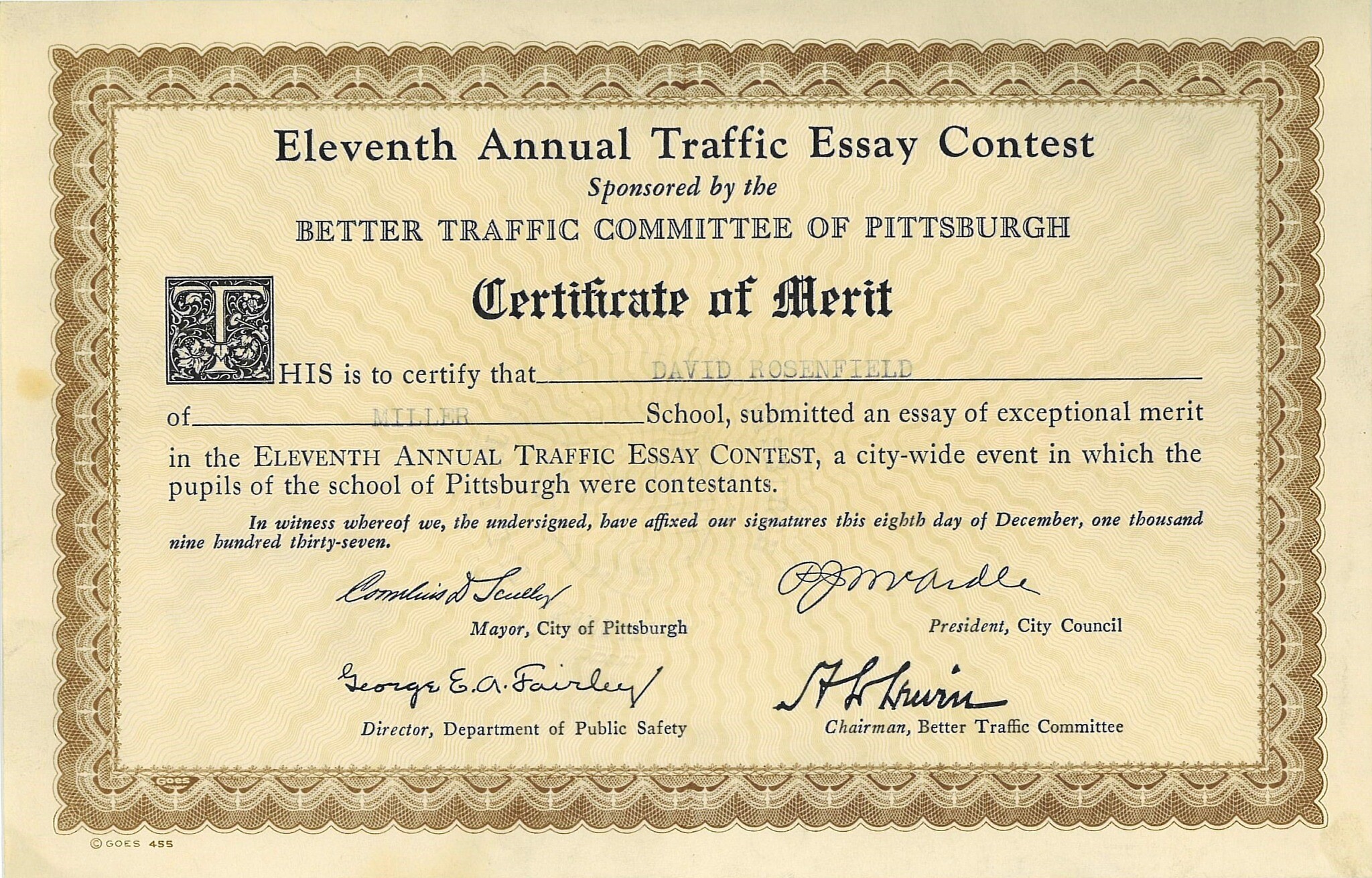
With the start of the school year that fall, Rosenbaum launched an essay contest for school children. All 78,000 students in the area would be eligible. The contest had three divisions by grade, each division getting a prompt. The contest offered prizes totaling $810, about $15,000 today. A few weeks later, the University of Pittsburgh and Duquesne University announced scholarships for some of the essay contest winners.
The contest attracted national attention. That November, national highway safety pioneer Stephen P. James described the Pittsburgh essay contest as the most ambitious competitive program ever devised by a municipality to improve public awareness of traffic safety. He encouraged every large city in the country to follow our example.
The Better Traffic Committee essay contest was a fixture of primary education in Pittsburgh throughout the 1930s. The Rauh Jewish Archives holds no less than four certificates awarded to Jewish children during these years, recognizing their work. If you have someone in your life that attended city schools in the 1930s, ask them about it.
Under Rosenbaum, the Better Traffic Committee devised all sorts of interesting projects. It made safety films to show as trailers before motion pictures. It designed posters to hang around town. It recorded public service announcements for the radio.
It held an annual “Pedestrian Week,” celebrated with communal whistle blowing at the end of the school day to warn drivers. It developed a “Court of Public Opinion.” Volunteer scolds handed out fake summons to jaywalkers, encouraging safer behavior.
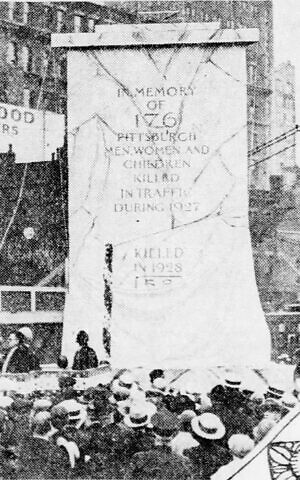
By the early 1930s, the Better Traffic Committee was seeing results. Through education and policy, Pittsburgh posted the best traffic safety numbers in the country in 1932 for American cities with more than 500,000 people, the Sun-Telegraph reported.
Even so, politics was always idling its engine. Mayor William McNair removed most of the committee in May 1936, claiming it was packed with special interests. The ousted members felt they had been fired for opposing administration traffic policy.
Under the reorganized Better Traffic Committee, Dr. Adolph L. Lewin was named chairman. Lewin was born in Germany and immigrated to the United States as a 19-year-old boy in 1880. He earned a medical degree at the University of Pittsburgh in 1892, making him among the earliest Jewish doctors trained in the city. He spent his entire medical career in Pittsburgh and became a noted civic leader throughout the city.
Lewin claimed to be one of the first doctors in Pittsburgh to make house calls by car, having graduated from a horse and buggy. Before that, he got around on a bicycle.
In the fall of 1938, Lewin expanded the popular traffic essay contest with a song contest. The committee selected 14 original compositions from students. It published a songbook, titled “Original Safety Songs,” and distributed 10,000 copies. Among the selections was a musical titled, “The Chivalrous Knights of Safety.” It was a morality play featuring “a contest between the Knights of Safety and the Knights of Carelessness.”
The following year, Pittsburgh posted its best safety numbers since data collection began in 1923. Also in 1939, the Better Traffic Committee convinced the Pittsburgh Auto Show to donate a new 1940 Plymouth coupe to the winner of the annual essay contest.
This creativity continued in July 1940, when the Better Traffic Committee started “safety towns” at area elementary schools, including Colfax and Wightman. As described in the American Jewish Outlook, each town had “street intersections, houses, apartments, a hospital, police station, fire house, school, and other buildings. Children driving toy automobiles and acting as pedestrians will be guided by miniature traffic light.”
And yet, again, politics was ready to pull the break.
The traffic essay contest appears to have quietly ended in 1939. After learning that Mayor Cornelius D. Scully had suppressed a key safety report in the summer of 1940, Lewin threated to resign. He ultimately stayed with the committee in 1940, only to be fired in early 1941. Amid these controversies, traffic fatalities increased 20%.
The Better Traffic Committee remained active through the 1960s, when it appears to have been incorporated into the Department of Public Safety. In its later postwar years, it lacked the creative energy it had demonstrated in the 1930s. In its heyday, it showed what’s possible when people stop wringing their hands and start rolling up their sleeves. PJC
Eric Lidji is the director of the Rauh Jewish Archives at the Heinz History Center and can be reached at rjarchives@heinzhistorycenter.org or 412-454-6406.
comments