
What a synagogue, a church and a train car taught me about humanity
And how to teach it

A particular moment has stayed with me since I returned from my third trip with Classrooms Without Borders — a journey through the American South to learn about the Civil Rights Movement. That moment, and the trip as a whole, deepened my understanding of history, justice and my role as both an educator and a human being.
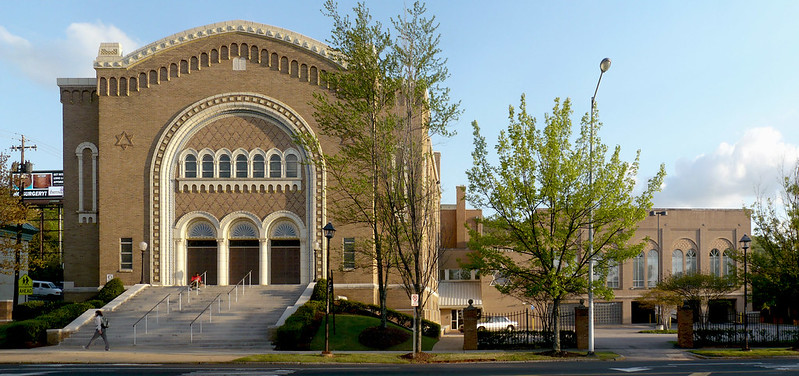
In Birmingham, we visited Temple Beth El and learned about the bombing that was attempted there in 1958. Sticks of dynamite were discovered outside a sanctuary window, placed by white supremacists who were targeting not just Black communities, but Jewish allies who dared to stand beside them in the fight for civil rights.
Our group had just come from the 16th Street Baptist Church, where four little girls were murdered in a bombing in 1963. At the church, there’s a memorial to those girls outside the window of the room where they lost their lives. To stand in that space and later walk into the synagogue — into a space filled with light, beauty and reverence — and know that the same kind of violence almost happened there, gave me a feeling I can only describe as dread, a heaviness that settled deep in my chest.
Get The Jewish Chronicle Weekly Edition by email and never miss our top stories Free Sign Up
I felt a deep sadness at the church, especially standing in front of that window, imagining those girls, their innocence and the hatred that stole their lives. But at the temple, that sadness took a different shape. It felt like anxiety, like a “what-if” that still echoes. The synagogue was a place of worship and community, and we were surrounded by stories of strength — including a Torah on display that survived the Holocaust. That moment hit me. Survival isn’t something that only happened in the past. Jewish communities have had to survive again and again — across borders, across generations. From Europe to the American South, the same resilience can be felt in these sacred spaces. The Torah that survived Nazi destruction now sits in a synagogue that withstood an attempted bombing less than two decades later.
That connection between past and present made it impossible to ignore how close we still are to hatred and how urgently we must protect what’s sacred: our communities, our neighbors and our shared humanity.
On previous Classrooms Without Borders trips, I stood inside concentration camps, extermination camps and gas chambers. I’ve seen what hatred can do at its worst. But to visit the American South and hear how Jewish people, who had endured the Holocaust, continued to face discrimination in the U.S. while still choosing to fight for the rights of others, deepened my understanding of what resiliency truly means.
On this trip, we also stepped inside a recreated train car — the kind that once transported enslaved people across the U.S. as they were sold and relocated. They were treated not as people, but as property. We stood inside a preserved cabin once inhabited by those enslaved at a forced labor camp. The air was thick, the space stifling and the conditions a heartbreaking reflection of how inhumanely people were forced to live. It was a painful, physical reminder of how deep the roots of injustice run in this country.
I’ve visited historical sites in Europe; I remember the clarity I felt there. In those places, it was easy to demand accountability, to say, “This was wrong, and someone should have answered for it.” But standing inside that train car in the U.S., I realized there’s a hesitation when the injustice is ours, when it’s woven into our soil. It’s harder to ask, “Who will be held responsible?” when we’re talking about ourselves.
There’s a lie we’ve told ourselves: that America couldn’t possibly be capable of something so cruel. But in that moment, the parallels between the horrors of Nazi Germany and the systemic dehumanization of Black people in the United States became impossible to ignore. The structures may have looked different, but the violence, the silence, the erasure — they mirrored each other in haunting ways.
As I return to my classroom, I carry with me the weight of these stories and the strength of those who chose to stand up, even when it was dangerous, even when it wasn’t their fight alone.
Jewish Americans, despite bearing their own traumas, stepped forward during the Civil Rights Movement, not out of obligation,
but out of conviction. They recognized that justice is not selective — and neither is courage.
That kind of moral clarity, rooted in lived experience and unwavering empathy, is what I hope to pass on to my students. It’s not enough to teach history; we must teach responsibility. My goal is to help them see that their voice matters, that silence is complicity and that choosing to stand up for others is how we build a more just world — together. PJC
Kristina Rhoades is a 12th grade English teacher at South Allegheny High School.
comments