
Seven Romanishe organizations
Who were the Daughters of Israel Cemetery Association?
On the high curving hillside in Reserve Township where Hoffman Road meets Irwin Lane, there are no less than seven Jewish cemeteries, and these are them: the Workmen’s Circle No. 975 cemetery, the Workmen’s Circle No. 932 cemetery, the First Podolier Independent Society cemetery, the “old” Kether Torah cemetery, the Cneseth Israel cemetery, the “new” Kether Torah cemetery and the Adath Israel cemetery.
Where Hoffman Road bends, a private road continues straight for a few hundred feet, ending in a cul-de-sac. On a clear, humid day earlier this summer, I visited that road, hoping to solve a mystery. All I found were more mysteries and more dead ends.
It started with a document, an affidavit from 1932 describing an arrangement at the First Podolier Independent Society cemetery. Under the terms of the deal, the Daughters of Israel Cemetery Association had agreed to pay $200 for rights to use that private road to access a 16-by-100-foot strip of land it held within the Podolier cemetery.
“Who are the Daughters of Israel Cemetery Association?” I thought.
There seems to be no end to the Jewish organizations created before World War II. Every effort to influence communal affairs was brought forth through some new entity with a name, a constitution, bylaws, a board of directors and a meeting calendar.
Eager to know more, I pulled the Daughters of Israel Cemetery Association’s incorporation papers from the hefty, canvas-bound charter books at the County Records Office downtown. It was dated June 1917, and it listed 25 charter members, all Jewish, mostly women from the Hill District. One name caught my eye: “Tony Ellovich.”
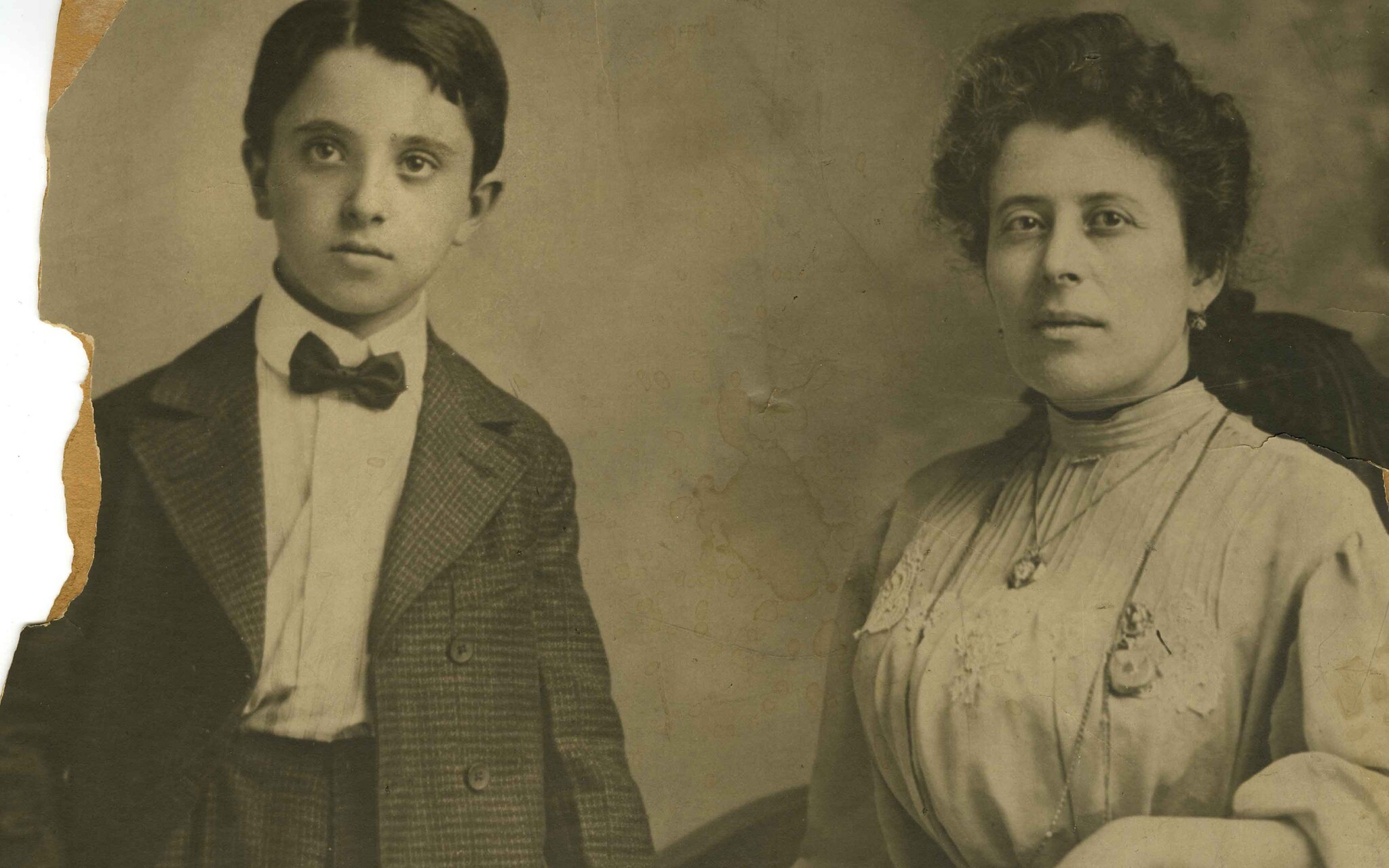
Tillie Herman was an innkeeper’s daughter in Romania. She was cultured and intelligent, fluent in several languages and recognized for her scholastic achievements.
Tillie’s parents made aliyah in the late 1880s, wanting to be buried in the Holy Land. Before they left, they hastily married their daughter to a local flour merchant. It was a poor match. Tillie’s new mother-in-law didn’t like her, and her new husband wouldn’t defend her. After eight years of abuse and beatings, she sought a divorce.
The single mother went to live with an aunt. To make ends meet, she pawned jewelry and sold embroidery. Through a matchmaker, she met a widower who was 36 years her senior, a single father named Joseph Ellovich. They fell in love and married.
Toward the end of October 1904, the couple arrived in New York with their two children. They chose to live in Pittsburgh, where they had relatives among the hundreds of newly arriving Romanian Jews who were turning the Hill District upside down.
* * *
Famine, violence, and discrimination sent thousands of Jewish migrants out of Romania in the late 1890s. Some came to Pittsburgh. They partnered with recent Galician immigrants in 1889 to form Ahave Sholem Congregation. As more people arrived in Pittsburgh, these two constituencies branched off. The Galitzianers created Machsikei Hadas around 1896, and the Romanians created Ohel Yaakov in December 1899.
The Romanians grew fast, for a time faster than any other Jewish group. Growth can foster ambition, and ambition can bring competitiveness. Over the next 20 years, the Romanians created no less than seven groups, each with similar members and missions.
The Romanian Lebanon Society began in 1901. It was a charitable group, comprising the “better element of the Romanian Jews,” as they described themselves.
The First Roumanian Sick and Beneficial Society began in August 1903, also to provide charity and mutual aid. Perhaps they were annoyed by the elitist tendencies of the Romanian Lebanon Society. The Roumanian Ladies Aid Society began in 1906. It was chartered in early 1907 “for the mutual relief of its members in case of sickness, disability or death and to aid in the case of the deserving sick and indigent and the burial of the worthy poor and unfortunate among the Jewish people of Allegheny County.”
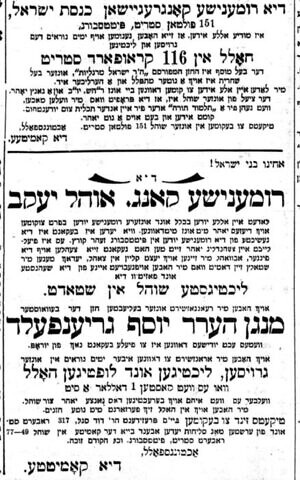
By September 1904, the growing Romanishe community in the Hill District had divided into two congregations, Ohel Yaakov and Cneses Yisroel, seen here in competing High Holidays ads in the local Yiddish newspaper Der Volksfreund. (Photo courtesy of the National Library of Israel)
Toward the end of the year, a contingent left to start a second Romanian congregation called Cneses Yisroel, meaning “Gathering of Israel.” In the Torah, Jacob is also named Israel, and so the names of these two synagogue were essentially synonyms.
I haven’t found a good reason for the split, but you can see a trend. Splits often have to do with status. People who don’t feel respected start something new.
The Romanians now had two shuls and no cemetery. Ohel Yaakov acquired land on Soose Road in Shaler Township in December 1908 for a burial ground. A short while later, a new breakaway group started a third Romanian congregation, called Shaare Shamayim Anshe Rumanian,” meaning “Gates of Heaven, People of Romania.”
According to Tillie’s son Philip, the cemetery caused the split. Ohel Yaakov planned to bury families by order of death. Philip recalled, “Mr. Marshall, who was in the wholesale tobacco business, came back at the next meeting and said, ‘I’ve talked that over with my wife and we don’t like that arrangement because a shoemaker might be buried next to us and we don’t want that. We baal habatim (householders) should have the choice graves.’ So that started arguments, and it started another Romanishe shul.”
A few months after the split, Ohel Jacob formally changed its name to Oir Chudish, meaning “New Light.” The reason for the change is unclear. Coming shortly after the split, a name change sounds to me like a rebranding. The dispute was resolved, and the Shaare Shamayim group rejoined Oir Chudish sometime around 1912.
By the time of this reunification, Cneseth Israel still did not have a cemetery. In August 1916, it acquired a half-acre plot near the Beth Abraham Cemetery complex in Baldwin Township from the First Roumanian Sick and Beneficial Society. It never developed the land. In November 1919, it bought 0.625 acres in Reserve Township.
If you’ve kept count, I said there were no less than seven Romanian groups formed before 1919, but I’ve only named six. That’s why the name Tillie Ellovich caught my attention. She was Romanian. I started researching the other 24 charter members of the Daughters of Israel Cemetery Association. Almost all of them had origins in Romania, and many were also active members of the Roumanian Ladies Aid Society.
Which brought a question: If the Roumanian Ladies Aid Society already had a mission to provide “burial of the worthy poor,” why did its members feel compelled a decade later to start a second organization specifically for purchasing cemetery property?
This is the first of a three-part series. In the second part, we visit the cemetery to search for remaining traces of the Daughters of Israel Cemetery Association. PJC
Eric Lidji is the director of the Rauh Jewish Archives at the Heinz History Center and can be reached at rjarchives@heinzhistorycenter.org or 412-454-6406.
comments