
Jewish sleepaway camp made them comedians, so they made a movie about it
"Tiny Fugitives" sees Johnny Knoxville and a crew of 12-year-olds run riot at Camp Fineman
This story was originally published in the Forward. Click here to get the Forward’s free email newsletters delivered to your inbox.
Jewish sleepaway camp is where parents send their children to forge a lasting connection with their ancient peoplehood. Perhaps regrettably, many also leave having developed something else: shtick.
“It’s a breeding ground for comedy bits,” said filmmaker Michael Lewen, 36, a proud alumnus of Camp Modin in Belgrade, Maine. “Everyone learned how to be a comedian at summer camp. This is where you first try out your stuff.”
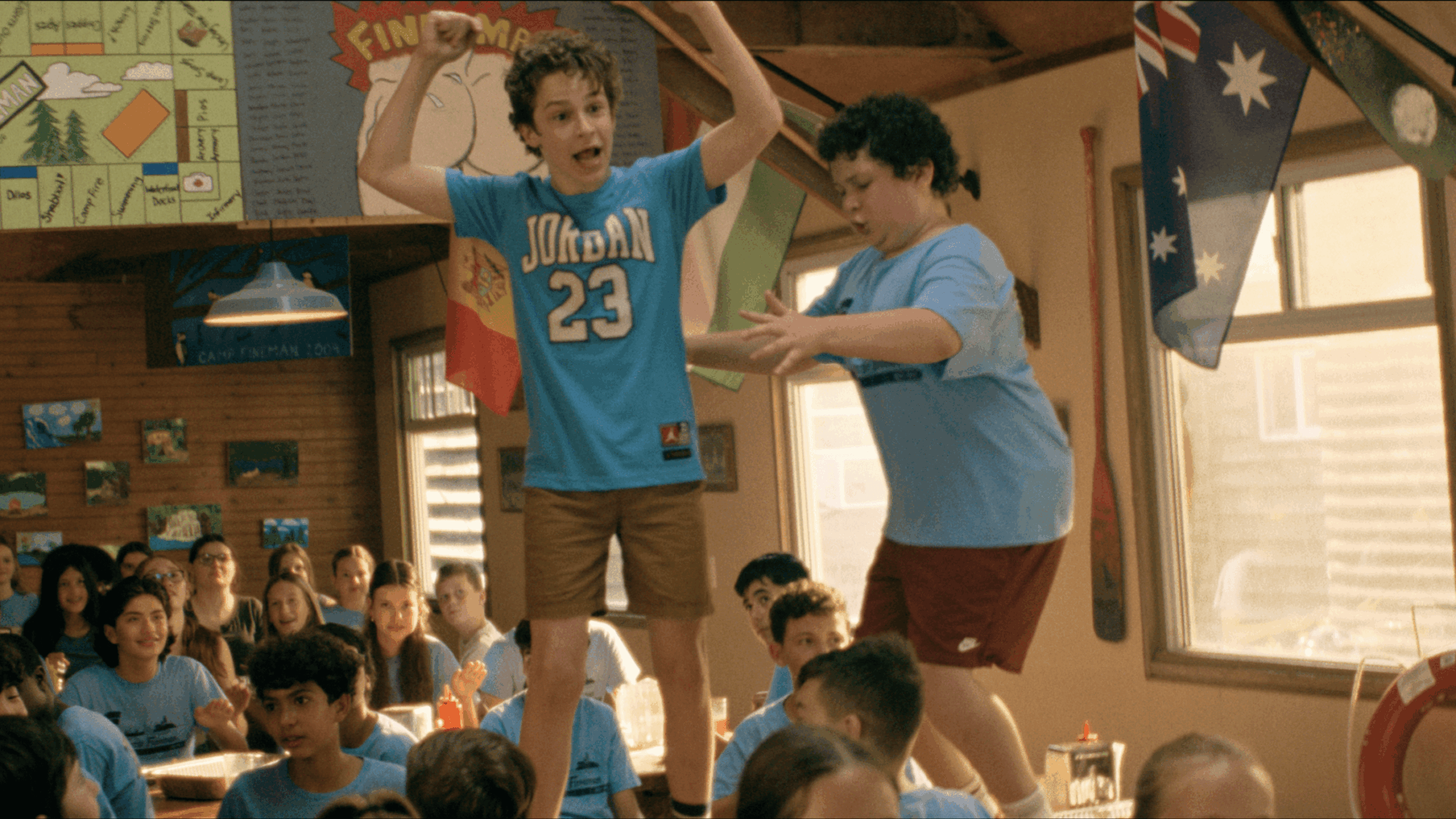
Years after retiring his color-war uniform, Lewen, a regular collaborator of Judd Apatow, is returning to the cradle of his comedy career. His sophomore feature Tiny Fugitives, hitting theaters Sept. 18, takes us to Camp Fineman, where 12-year-old Jacob Udell (Benjamin Pajek) commands a cool-kid cachet apart from his public-school tormentors.
Jacob’s goals for the summer start off simple — a bunk-wide record for “ask outs” to the social and telling his longtime crush how he feels. But when his parents show up on visiting day to announce their divorce, and that they may not have the money to send him for another season, Jacob and his best friend Charnis (Aaron Harris) hatch a plan: When the buses leave camp, they won’t be on them. They will live at camp year-round.
It’s a notion not completely foreign to Lewen’s co-writer, Jacob Kaplan, 28.
While Kaplan spent less time than Lewen at his own camp (Camp YJ in Amherst, New Hampshire), he keeps finding fresh material in the experience. He toured a standup show, Kings of Camp, about those halcyon days of canteen privileges and Capture the Flag. Lewen connected with Kaplan after reading a cartoon pilot he wrote about an alien child who sends dispatches back to his home planet from a Jewish summer camp, mistakenly believing his idiosyncratic environs to be representative of human civilization.
Kaplan remembers camp as his first brush with independence. The divorce plot is drawn from his life and he remembers it as a merciful break from parental logistics.
The jokes are an amalgam of his and Lewen’s field notes from back in the day and ideas from their capable cast of 12-year-olds, one of whom does a credible impression of Barack Obama saying kiddush. The foil to Jacob and Charnis’ great escape is a “lifer” named Bob, played by Johnny Knoxville, who gives chase and is often grievously injured in the pursuit. Thank Hashem for the infirmary.
“There was definitely some push and pull with the stunt coordinator,” Lewen said of Knoxville’s presence on set. Coming off of the later Jackass films, he wanted to drive his ATV without his glasses and urged people to hit him harder.
But for all the slapstick, Bob, based on a familiar archetype of a fanatical counselor is, along with Charnis and Jacob’s friendship, the heart of the film. His message, and one I’ve heard from many a counselor of my own: camp is special because it ends.
If it didn’t quite end for Lewen and Kaplan, who got to relive those days on the set of a couple different Toronto camps, and recreate some of the magic for their actors, they insist they’ve now had enough.
Tiny Fugitives Lewen said, is indebted to Stand By Me, includes visual nods to Francis Ford Coppola films like Apocalypse Now and The Conversation and seems to have no anxiety about the influence of another raunchy two-hander like Superbad (Seth Rogen and Evan Goldberg produced). It owes a less obvious debt to Michael Mann’s Heat, Lewen said, only “instead of De Niro and Pacino, it’s Johnny Knoxville and a 12-year-old who both want the same exact thing out of life, and only one of them is going to get it.”
Among the comedy’s most understated features is its ambient Jewishness, in no way essential to the plot, as it is in another recent camp film The Floaters, but key to its sensibility.
The kids find ancient Manischewitz in a dining hall. Jacob pads his elbow with a loose kippah to break the frame to a map of the old camp grounds. In a fanciful moment, he suggests laundering petty cash in $18 sums to skirt suspicion. A line, delivered out of context and without elaboration: “Charnis, what do you mean a three-state solution?”
Asked if the film might have been more marketable with a generic sleepaway camp, Kaplan and Lewen seemed to have heard that note a lot.
“For the comedy you want to go from what felt the most true to your life and the situations and what actually happened and painting as vivid a picture as possible,” Kaplan said, invoking Wet Hot American Summer, which presented a Jewish summer camp without ever quite announcing that it was one.
Lewen said they focused on the bigger idea when they went out to pitch: “When you’re young, there are places where you feel like you make sense. For some people, it’s the baseball team. For some people, it’s debate camp. For some people, it’s your cousin’s house. And for us, it was Jewish summer camp.”
The producers are betting big on Tiny Fugitives’ cross-quadrant appeal, making it a rare R-rated comedy to play theatrically. Among the hoped-for viewers are some actual 12-year-olds, who will need a parent or guardian owing to the film’s coarse language, which is likely not very scandalous to the tween set it’s depicting.
“I actually think it’s a totally good movie for young people to see,” Lewen said. “I just remember being that age and watching stuff that felt a little bit real, and like I actually saw myself in it, and it’s so satisfying and cathartic.”
To that end, he said, Knoxville is chartering a bus to take camper-aged kids to the theater.
“I think it’s cool for there to be a cool movie that’s also Jewish,” Lewen said. “It’s the same reason I like Jewish summer camp and want my kid to go there.”
This story was originally published on the Forward.
comments