
The origins of Yom Kippur
Some thoughts on "the holiest day of the year"
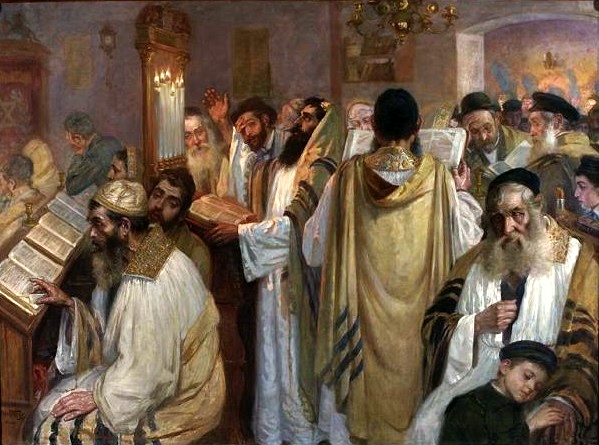
We are lucky that the earliest mentions of holidays like Pesach or Purim, as found in our foundational scriptures, still speak to us viscerally. It is hard not to be moved by the drama of the Exodus story, or the soap opera of Esther, and it is no surprise that both can be dramatized so easily.
Yom Kippur, as it first appears in the Torah in Leviticus 16, is much more forbidding. In part this is because what is outlined there is a ritual that we have not seen performed for almost 2,000 years. As Baruch Levine writes, it is “one of the most complex rituals to have reached us from any ancient society.” While it was later expanded during Temple times, Leviticus claims to give us the earliest version of the rite as it took place at the portable Tabernacle in the wilderness: It includes the bathing and dressing of the High Priest, the sacrifice of a bull and a goat to expiate the sins of the priesthood and the people, the famous scene of driving a second goat (the “scapegoat”) into the wilderness with the sins of the people now clinging to it, and the purification of the sanctuary by sprinkling the blood of the sacrificed goat and bull. So close at this moment to the presence, or kavod, of God, the High Priest also burned incense inside the Holy of Holies, its cloud serving as a kind of protection for him.
The goal of this ritual was to purify the sanctuary and make it a fit place for God’s presence; the purification of the Israelites and their priests was a secondary matter, and only necessary to keep the sanctuary itself pure, should God decide to descend to the earthly residence the Israelites had made for him. The main actor in this ritual was the High Priest and, centuries later, the Mishnah and Talmud — which, we must remember, were only written after the Temple and office of High Priest were gone — recreate the High Priest’s much more expanded preparations so slowly and carefully, as if the sages were trying to take hold again of an irretrievable world.
Get The Jewish Chronicle Weekly Edition by email and never miss our top stories Free Sign Up
Once the ritual is completed we suddenly read more familiar words in the closing verses of Leviticus 16: “And this shall be to you a law for all time: In the seventh month, on the tenth day of the month, you shall practice self-denial; and you shall do no manner of work … For on this day atonement (yom-ha-kippurim) shall be made for you to purify you of all your sins; you shall be pure before God.” And yet throughout, the one doing all the work is the High Priest, and the focus is still on the sanctuary itself, whether wilderness Tabernacle or Temple.
From the destruction of the Second Temple in 70 CE until today, however — and, incredibly, for much longer than the priesthood and either Temple was ever in existence — the act of atonement has fallen on each one of us. We can see this clearly in the Ashkenazic custom of the kittel. While the Talmud says the High Priest wore “white linen garments” for part of the Temple service and that the people “wear white and cover themselves in white,” the tradition of wearing a kittel seems to have originated only in the 12th or 13th century. Of the many reasons given, some are: its resemblance both to burial shrouds or the clothing of angels; white as the color of purity, cleanliness and joy; and to remember the High Priest in the Temple.
The well-known kapparot ceremony is first mentioned in writing in the late seventh century in Babylonia, and had likely been a popular practice for some time already. From the Middle Ages through the modern period, and depending on who you read, the act of swinging a rooster (or hen) over your head a set number of times while reciting “This is my exchange, this is my ransom, this is my atonement,” was condemned or justified, but it never lost its popularity on the ground.
Some suggest that, after the destruction of the Temple, when the scapegoat rite could no longer be enacted, the kapparot served a similar purpose in transferring one’s sins to the chicken or allowing it (since it was then ritually slaughtered) to die in your place. As always in Judaism there are etymological justifications, too: kapparah (the singular of kapparot) means atonement; and in Aramaic, the word for rooster, gever, is also Hebrew for man (geveret for woman).
While it is easy to disparage the rite as superstitious or magical or just cruel, it clearly met a need that wasn’t otherwise being filled and, since chickens were inexpensive, even the poorest Jew could participate. Bella Chagall, first wife of the artist Marc Chagall, left a vivid description of the rite from the late 19th century in Vitebsk, Russia, when, as a little girl, she saw that “the courtyard was littered with feathers. It sounded like a thousand gongs clanging for fire: the courtyard reechoed with the crowing of the cocks, with their embattled uproar … I remember how my little chicken quivered in my hands when I held it upraised for the rite. I too was quivering.”
Again during the period of the Mishnah and Talmud (third through sixth centuries), the Book of Jonah became the haftarah for the Yom Kippur Mincha service because it “mentions the repentance of the people of Nineveh.” But with the centuries of accumulated preparations and rites surrounding the High Priest on Yom Kippur no longer possible after the destruction of the Temple, and with life in Jerusalem now a memory for everyone in exile, I wonder if Jonah wasn’t also chosen because it gives us the story of a city that, at the last moment, escaped destruction. It must have been a bitter vision for the sages to focus on, and it also gives us the complex character of Jonah himself, a reluctant prophet if there ever was one, a man who remains unsatisfied even after accomplishing what God asked him to do.
In other words, the weight of what Yom Kippur asks of us is not easy, and it is to Judaism’s credit that the difficulty and strangeness of it has never been ironed out of the day, and that it is still called, these many centuries later, the holiest day of the year. We might say it along with Bella Chagall about the entire experience: “I too was quivering.” PJC
Tim Miller is a poet and writer living in Pittsburgh. He is online at wordandsilence.com.
comments