
Israeli Arab leader urges integration, interdependency and shared society
“I don’t give up hope,” he said. “I’m a father. I’m a grandfather. I don’t give up hope. I don’t have an option.”
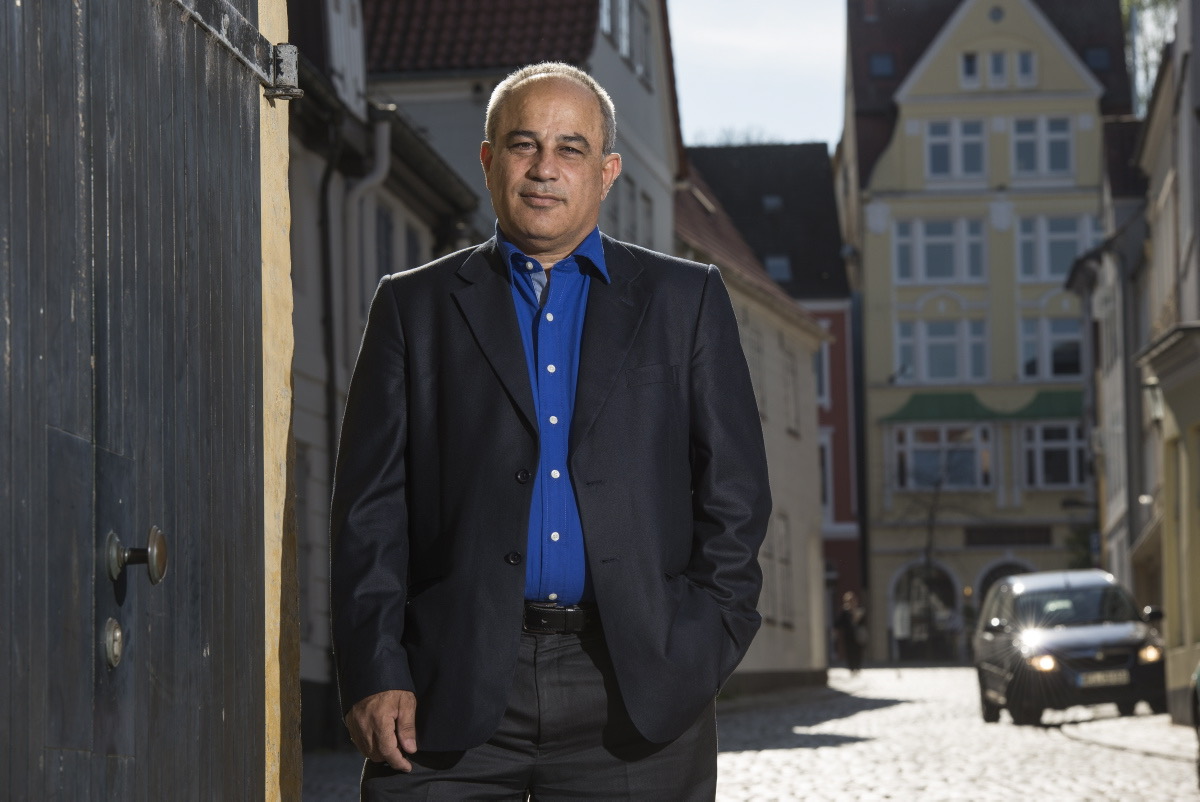
Mohammad Darawshe finds commonality with the Jewish Diaspora in communities like Pittsburgh.
“I feel that the American Jewish community lives the experience of being a minority in America, understands the mindset of the minority in Israel, and I think that they see mutual interest in trying to keep the same values that they want to keep in America to protect them as a minority,” said Darawshe, the director of strategy at the Center for Shared Society at Givat Haviva, an organization working to promote social change and a model society for Jews and Arabs. “They want to see the same values in Israel. That is the common denominator that Arab citizens have with American Jews.”
Darawshe — an Israeli Arab who previously worked as co-director of the Abraham Initiatives, served as elections campaign manager at the Democratic Arab Party and United Arab List, and was a leadership fellow at the New Israel Fund — was in Pittsburgh last week, the first stop in a 21-city tour that began Sept. 3. Currently a visiting professor at American University, he spoke at the Rivers Club before an invitation-only crowd at the request of a private organizer.
American Jews, he told the Chronicle, have a vested interest in making Israel a more democratic society that is more respectful of minority rights and Jewish-Arab partnerships inside Israel.
Darawshe stressed that neither he nor Givat Haviva tackle cross-border or cross-green line issues, choosing instead to work on promoting a “shared society” that integrates Arab citizens as full partners with Israel.
It’s a message, he said, that goes over well with American Jews, especially among younger generations, some of whom may be pulled away from engagement with Israel after Oct. 7.
“That’s a feeling I’m discovering meeting with university students where I’m teaching,” he said. “It’s also a vibe that I picked up on today with the people I met.”
Although he largely steers clear of the politics surrounding the Israel-Palestinian conflict, Darawshe said that the violence of some settlers in the West Bank presents an obstacle to realizing a shared society.
Arab citizens of Israel, he said, are saddened to see what he described as the “indifference” of many Israeli Jews to the situation.
“It damages the trust,” he said. “We can’t do much about it because if we demonstrate against that, if we revolt against that, it will damage our relationship with Israeli Jews.”
Instead, he said, Arab citizens have expectations of “non-extremist, non-radical” Israeli Jews to “step out and do something.”
One of those expectations is to vote in the upcoming elections.
The current government, he opined, is damaging the future of the Jewish people, the future of Arab citizens in Israel and the future of Palestinians.
The consequence, he said, is for Arab citizens to pull out of what he calls the “Israelization process” — the integration into Israeli society of Arab citizens, which he said is essential to the national interest of the state of Israel.
Despite the current government, Darawshe said he remains hopeful that full integration will occur.
“I don’t give up hope,” he said. “I’m a father. I’m a grandfather. I don’t give up hope. I don’t have an option.”
He points to fields like medicine, technology and academia that show what can happen when Arab citizens are allowed to participate fully.
More than a third of the medical staff in Israeli hospitals are Arab, he said, as are 23% of the engineering students, which he believes is the future of the Israeli economy.
The formula, he said, is for the Jewish community to create space and the Arab community to create capacity.
As an example, he pointed to “cross-sector teachers” — Arab teachers in Jewish schools and Jewish teachers in Arab schools. Two years ago, there were about 2,500 exchanges. Today it’s nearly 4,500.
The Israel-Palestinian conflict and developments in Gaza and the West Bank, however, continue to contribute to polarization.
“The perspectives are different,” he said. “The majority of Arab citizens still believe that Palestinians deserve freedom and should get their own Palestinian state to live in peace and security in the West Bank and Gaza with the state of Israel.”
Less than 20% of Israeli Jews feel the same way, he noted.
Rather than focus on the differences, he said, it makes more sense to create “islands of cooperation and interdependency.”
“I think it will take us a generation to speak about political solutions,” Darawshe said. “I’m not very hopeful of political solutions. One state, two states, three states, I don’t have an answer about this. What I know is feasible, is that we can bring Jewish and Arab classrooms to work together. We can bring Jewish and Arab mayors together to work on joint sewage systems and joint industrial zones. We can break segregation in education. We can create interdependency in art and high tech.”
The Jewish high tech industry, he said, needs more Arabs because of their strong math skills. The relationship, he added, is symbiotic: Arab workers can earn up to three times their current salaries, while Israel gains access to valuable skills.
Darawshe is unsure if an Arab political party will be part of the next coalition but said it’s something he would like to see.
“It requires courageous Jewish and Arab leadership,” he said.
While Darawshe hopes to see greater Arab participation in future governments, Givat Haviva is more focused on “small islands” of cooperation, where Arabs and Jews enter one another’s communities, become less intimidated and build trust.
“Unfortunately, only 7% of Arabs citizens live in mixed towns and villages and that means also that only about 7% of Israeli Jews are exposed to Arab citizens as fellow residents,” he noted.
He believes that interdependency and integration are the answer.
Darawshe hopes American Jews will give greater thought to Israel’s Arab citizens, who make up approximately 21% of the population. Some of those citizens can trace their families back more than 20 generations and deserve the promises outlined in the country’s Declaration of Independence, he said.
Givat Haviva, he continued, is proving there are ways Arab and Jewish Israeli citizens can live together. And American Jews, he said, can support those efforts.
“We have a lot of accomplishments that can bring pride if you are engaged in them,” he said, citing the cross-sector teachers program as an example. “As an American Jew you can be very proud.” PJC
David Rullo can be reached at drullo@pittsburghjewishchronicle.org.
comments