
A new book about a ‘daring escape from Afghanistan’ has surprising Pittsburgh connections
'The Last Free Women,' tells the story of four women who escaped after Afghanistan after Kabul fell to the Taliban.
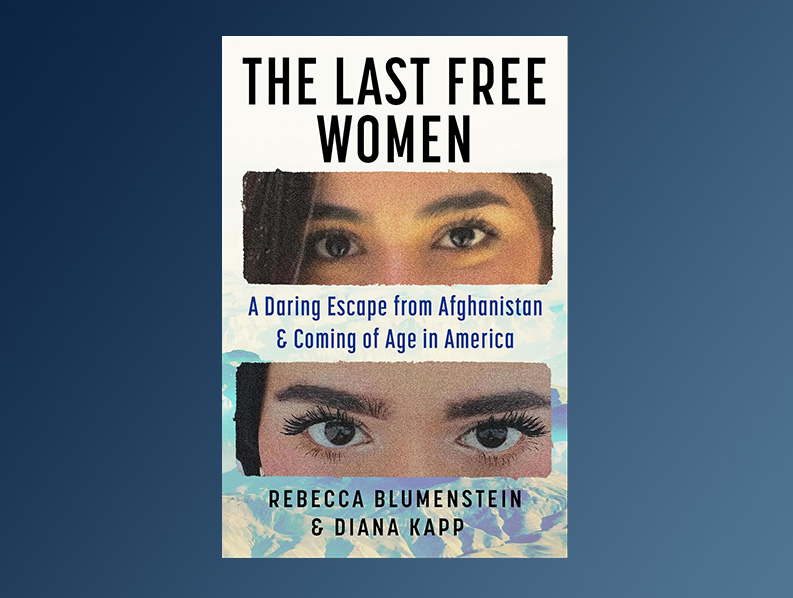
It was a dinner conversation with her friend Diana Kapp that inspired Rebecca Blumenstein to co-author the new book “The Last Free Women: A Daring Escape from Afghanistan and Coming of Age in America.”
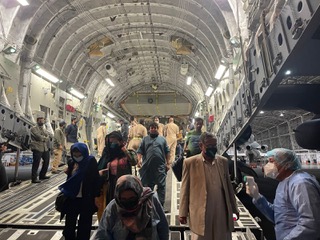
“I was in the middle of the evacuation and resettlement of this group of 124 Afghans,” Blumenstein recalled, “when Diana and I met for dinner in New York. I was ranting about these incredible young people, and how hard it was to get them back in college. They were on the cusp of becoming doctors and lawyers in Afghanistan, and their whole world fell apart because of their service to America.”
Blumenstein and Kapp, both of whom are Jewish, have the experience to recognize a story that needs to be told, and by the time they finished dinner, they decided to tell the tale of the Afghans in America together.
Blumenstein is NBC’s news president, editorial, and former managing editor of The New York Times. Kapp is a journalist and author, whose work has taken her to such fraught sites as San Quentin prison and Afghanistan.
Blumenstein helped coordinate evacuation from Afghanistan not only of Times’ reporters, but everyone who worked in the paper’s Kabul bureau after the Taliban took control of the country.
“That means chefs, drivers, translators, gardeners and their immediate families,” she said.
Kapp spent time in Afghanistan in 2012 when she traveled to the country to write a profile of a British physician who built or remodeled 130 schools near the Pakistani border.
She recalled that period as a time of optimism, when women were seeing “a real future for themselves in Afghanistan.”
“We would talk to girls in the classrooms and ask them, ‘How many of your mothers can read?’ and none of their hands would go up. And then, we would ask them how many hoped to go to university and it would be every hand,” she remembered.
That optimism faded with the reemergence of the Taliban and it’s capture of the country’s capital city, Kabul, in August 2021. It was the final act in the American government’s direct involvement in the country, which began following al-Qaeda’s terrorist attack on Sept. 11, 2001.
Four women — Maryam Alokozay, Marwa Rahim, Mursal Rahim and Samira Rustami — are highlighted in “The Last Free Women,” serving as microcosms to the plight experienced by many of the Afghans who had bright futures planned in their home country, then suddenly experienced challenges they never expected in America.
The same women who were readying to become physicians and attorneys in Afghanistan were now being told their English scores weren’t high enough to get into American colleges. Even if they were, they didn’t have the money to pay for tuition and boarding.
Marwa and Samira are sisters. Samira was pregnant when she arrived in the United States. Blumenstein said the lives of all four were suddenly “bifurcated” by their extraction from Afghanistan and the expectations of refugees escaping war-torn countries.
“One of the tensions in the book is that the refugee specialists were saying, ‘They’re not going to go to college. They’re lucky to be here. They should get a job doing Uber. It’s the most they can expect. The next generation is what it’s about, especially the women,’” Blumenstein said.
The story, which began in Afghanistan and continued through Texas — where the families initially sojourned — took an unexpected turn through Pittsburgh, where Blumenstein’s husband grew up and her sister-in-law lives.
A conversation with the Jewish Healthcare Foundation’s Daniel Rosen pointed Blumenstein toward using her Pittsburgh connections to help the women.
“He said, ‘Use your contacts. You know me. Your son goes to Carnegie Mellon. Your whole family is in Pittsburgh. Why don’t you call [Farnam] Jahanian?’” Blumenstein recalled.
Jahanian, who is CMU’s president, spoke with several Pittsburgh universities and soon a plan was born.
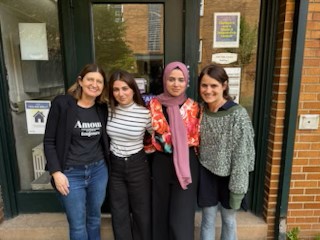
Chatham University agreed to enroll three of the women to spend a year improving their English before restarting their regular studies. The fourth enrolled at the University of Pittsburgh but has since transferred to a program outside of the city.
The next challenge was trying to figure out how to cover the costs.
To do that, a nonprofit was created: the Journalism Refugees Education Fund. Proceeds from the sale of “The Last Free Women” are going to the fund and are being used to help 11 Afghans study in America.
“We feel one of the best and most direct ways to help someone get a fresh start is to give them an education, which is a theme that runs through the book,” Kapp said.
Blumenstein’s sister-in-law, Laura Kessler, helped Samira’s family furnish their apartment at Chatham and provide necessities like kitchen supplies, a crib mattress and more. She became so close to the family that Samira’s daughter calls her “Nana.”
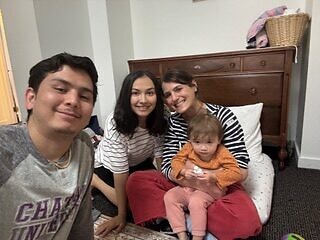
“Rebecca always jokes that she doesn’t go to a single family gathering that Samira and her daughter, Durrin, and husband aren’t at,” Kapp said.
Pittsburgh, Blumenstein said, has been “so welcoming” to the families. Samira’s daughter even attends programming at the Jewish Community Center.
While the Steel City plays a starring role in the story of some of the families that have come to the United States, Kapp said the book is focused on the women and their drive to create better lives for themselves.
“They’re so dedicated to getting back on track and going after their dreams,” she said. “They will do almost anything to make that happen.”
It’s a story of hope that shows some of the best of the United States, Blumenstein said.
“In America, even at a time of great division, we write about countless acts of people who helped along the way who didn’t have to. It’s a story that I think gives hope to those that despair about where we are as a country,” she said. “There’s a lot that unites us and I think everyone realizes that someone helped their family along the way and that we are a nation of immigrants.”
Kapp will be in conversation with Samira and Marwa, two of the women featured in “The Last Free Women: A Daring Escape from Afghanistan and Coming of Age in America,” on Sept. 13 at City of Asylum. Blumenstein will be in Pittsburgh on Sept. 16 at 5:30 p.m. at the JCC’s annual meeting, honoring Laura and Jon Kessler for the work they’ve done, and in conversation with Samira and Waissuddin Rustami. PJC
David Rullo can be reached at drullo@pittsburghjewishchronicle.org.
comments