
Shnas HaChinuch’s call to ‘teach’ still resonates 50 years later
No matter where one falls on the Jewish landscape, everyone — even children — bears a responsibility to teach others

A single-syllable imperative has delivered 50 years of instruction: Teach. In 1976, the Lubavitcher Rebbe, Rabbi Menachem Mendel Schneerson, organized a campaign encouraging a year of education. Called “Shnas HaChinuch,” the campaign identified education as a primary mechanism for Jewish survival.
As one of 10 campaigns introduced by Schneerson to bolster Jewish observance and identity, Shnas HaChinuch centered on education. The campaign urged adults to recommit to educating others while also affirming that children, too, can serve as educators.
“As the Rebbe said, ‘If you know an aleph, teach an aleph. If you know a beis, teach a beis,” recalled Chabad of Squirrel Hill co-Director Rabbi Yisroel Altein.
The concept, Altein noted, was driven by a belief that it’s essential — for individuals of all ages — to “impart and share with someone else information that you have.”
From classroom to beyond
Each day, both in Pittsburgh and across the country, children are exposed to various school-based lessons. Chabad’s pedagogical mission, according to Yeshiva Schools of Pittsburgh Elementary School Principal Rabbi Mannis Frankel, is that children leave class “comfortable talking to someone they meet — whether it’s a neighbor, whether it’s someone who goes to a different school, whether it’s a child who maybe is not as aware of Torah — and will be open and comfortable sharing things that they learn with them.”
The objective, Frankel explained, is for children not only to learn, but to understand that knowledge is meant to be shared, because the “ultimate learning is when we teach.”
That belief, pioneered by Schneerson, marked an educational innovation, according to Altein: No matter where one falls on the Jewish landscape, everyone — even children — bears a responsibility to teach others.
Planting seeds with verses
During Shnas HaChinuch, Schneerson identified 12 passages to further the campaign. Called the 12 Pesukim, the collection includes two sets of six verses: Two verses come from the Torah, two from rabbinic literature and two from the Tanya, an 18th-century Chassidic philosophical work.
Together, Schneerson explained, the 12 Pesukim provide a framework for constant study, teaching and growth.
Once taught these verses — which contain ideas regarding God’s oneness, the Exodus from Egypt and the importance of fulfilling biblical precepts — the expectation was that children would teach the verses to others.
Promoting the 12 Pesukim reflected an idea “the Rebbe called ‘chinuch al taharas hakodesh,’ education that’s based on a pure and holy foundation,” Altein said. As a tool, the verses offered a model for Jews worldwide, of all ages, to tap into Jewish wisdom and disseminate its lessons.
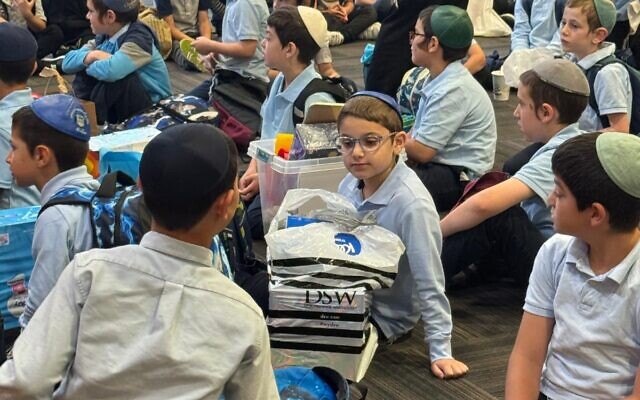
Each morning at Yeshiva, students recite the same verses identified by Schneerson 50 years ago. Since the start of this school year, Yeshiva’s Head of School Rabbi Yossi Rosenblum has also worked to further integrate those 12 verses within curricula and programming.
Rosenblum cited the 12th verse, a passage from the Tanya, which reads, “The Jews should rejoice in their Maker. Every Jew should share in God’s joy, who rejoices and is happy in His dwelling in this world.”
Along with titling this year’s fundraising campaign “Fuel the Joy,” Rosenblum has stressed the theme in weekly reels. In the 60-second clips, which focus on education and parenting, he frequently highlights the importance of joy in learning, connection and friendship.
From that day to today
Most educators recognize a duality of instruction where lessons are taught for both immediate gains and delayed returns: Teaching someone vocabulary, for instance, helps with an upcoming quiz and also fosters eloquence after the test’s completion. Shnas HaChinuch continues operating with a similar understanding, Frankel explained.
“There’s a connection between Jewish children studying and reciting words of Torah, and bringing strength and protection to the Jewish people,” he said.
Communal landscapes reflect attitudes toward education. When instruction is seen as something beyond finite school-based lessons, but a vehicle for collective improvement, the question becomes, “How can I contribute to the Jewish people? How can I contribute to my community? How can I contribute to my children?”
Even 50 years later, a lasting idea of Shnas HaChinuch is “we all have families. We all have kids in our communities,” Rosenblum said. That campaign challenges “everybody to participate in educating ourselves and educating people.”
For the people
Schneerson’s efforts advanced societal regard for education. In 1978, Congress touted the Jewish leader’s undertakings and noted a “need for the Nation to set aside on the calendar a day devoted to the importance of education to the lives of its citizens and to the general well-being of the Nation.”
Marking April 18 of that year “Education Day, U.S.A.,” Congress acknowledged Schneerson’s campaign and said the date coincided with the “seventy-sixth birthday of this celebrated spiritual leader.”
Since then, the day has been celebrated annually by Congress and the last eight U.S. presidents on a Gregorian date coinciding with Schneerson’s Hebrew birthday. In 1992, while promoting education as well as moral and ethical behavior, the name was adapted to “Education and Sharing Day, U.S.A.”
Fifty years since Shnas HaChinuch was launched, Altein isn’t surprised the campaign has continued fetching interest while spurring others to learn and teach.
Education is the means of ensuring “Jewish continuity,” he said. “The foundation of Judaism is the education that we have.” PJC
Adam Reinherz can be reached at areinherz@pittsburghjewishchronicle.org.
comments