
Dan Gilman named Corey O’Connor’s chief of staff
Squirrel Hill resident ready to help implement incoming mayor's vision for Pittsburgh
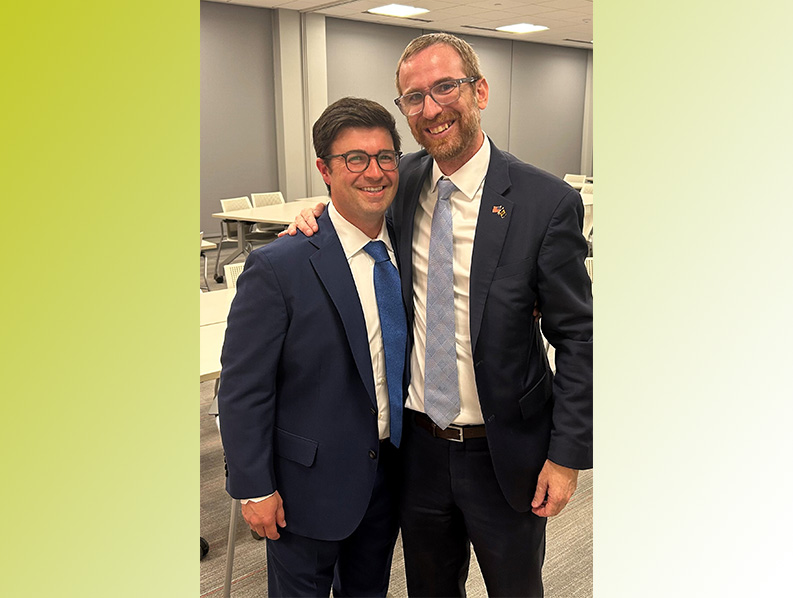
Dan Gilman’s parents taught their son the importance of public service, community and politics from a young age.
Gilman’s father was the president of the synagogue the family attended when they lived in Northern California. His mother was involved with the National Council of Jewish Women.
“My parents were involved with [the Jewish] Federation and Hillel, on boards and university capital fundraising campaigns,” he remembered.
The pair were what Gilman called “super voters,” who never posted a yard sign or knocked on doors, but voted in every election. At home, the family discussed civics, politics and government.
They also impressed on their son what he called a “very traditional Jewish value.”
“You don’t have to do everything, but you can’t sit on the sidelines,” Gilman said. “Raise your hand, volunteer, get involved and do whatever you can to make whatever world you’re in a better place in that moment.”
It’s a lesson he has taken to heart.
Earlier this month, Gilman, 43, was named incoming Pittsburgh Mayor Corey O’Connor’s chief of staff. It’s a position Gilman previously held for former Pittsburgh Mayor Bill Peduto. In the interim, and until January when O’Connor is sworn in, Gilman serves as chief of staff and senior adviser to Duquesne University President Ken Gormley.
Gilman caught the political bug while still in high school volunteering for Al Gore’s presidential campaign. He next worked for several years as a legal intern with the American Civil Liberties Union before earning a fellowship that sent the Carnegie Mellon University undergraduate to Washington, D.C., where he worked for Democratic U.S. Rep. Mike Doyle, Squirrel Hill’s former congressional representative. The House had a Republican majority at the time.
“What I discovered being in the minority was that no matter what we came up with, what argument we made or how much it cost, it was going to be voted down on party lines because that’s how Washington operated,” Gilman said. “It’s not a partisan statement. It’s just the reality of Washington, D.C.”
The slightly more worldly Gilman returned to Pittsburgh serving tenures as a vice president and president in CMU’s student government. A meeting with Bill Peduto, then a Pittsburgh City Council member, led to an internship while Gilman was still in college.
The difference between national politics and local government was palpable to Gilman.
“We were getting things done, from getting a stop sign up or repainting a crosswalk, getting the Little League field ready for the weekend — whatever the problem was. It was an unknown world to me where you could see, feel and touch things getting done,” he said.
The lesson he learned was that local government might play the most crucial role in addressing many societal challenges, he said.
After graduating, Gilman had two job offers: one from Peduto and one from another, slightly more well-known politician — Bill Clinton.
Gilman said he “chose right” and accepted the job with Peduto. He kept that position for nearly a decade before running for his boss’s council seat when Peduto was elected mayor. Gilman served the city’s 8th district until being named Peduto’s chief of staff for his second mayoral term.
Gilman and his wife, Amanda, reside in Squirrel Hill and have two children, Sam and Tessa. He’s a member of Temple Sinai but growing up, his family was affiliated with Congregation Beth Shalom.
O’Connor’s new chief of staff said he wasn’t expecting a role in the new administration.
“I was just thrilled that Corey was going to have the opportunity to be mayor,” Gilman said. “I believe so deeply in him and his vision at this particular moment. I think it’s the right person, right city, right moment for the mayor-elect. I would do anything to help him succeed. This is 100% about a city that I love and believe in, and a mayor I love and believe in.”
Gilman is grateful to help build a new administration, he said, noting that it’s a sprint to try to set it up in seven weeks. The goal, he said, is to put together a team “that can implement the mayor’s vision effectively and efficiently — everything from the mayor’s office staff to cabinet-level positions.”
That means a lot of interviews with both lifelong Pittsburghers and those from out of town, including people in both the public and private sectors, excited about the mayor’s vision for the city.
O’Connor has been transparent about his goals for the city, Gilman said, which include financial stability; both capital and human investments downtown to ensure it’s an inclusive, safe and welcoming place; and, helping the city become more supportive of business development and neighborhood investment.
“We’re committed to Corey’s vision of being every family’s first choice,” he said. “That starts with looking at our rec centers and parks, and making sure our neighborhoods are places we all want to live.”
And, Gilman said, it’s important to use the bully pulpit of the mayor’s office as a convener, bringing together universities, hospitals, the corporate community, foundations and nonprofits.
“If we can all get in the boat and row in the same direction we can do amazing things in the city. That hasn’t been the case for too long in Pittsburgh,” he said.
Aware that the mayoral Democratic primary was fairly divisive, Gilman still believes both he and O’Connor share an idea of what will unite the city.
“The short answer is you deliver,” he said. “A government that works and delivers on its promises, puts the interests of the people first, will ultimately win over politics and any sort of small dissent. Let your actions speak for themselves and deliver for the people.”
When that happens, Gilman is certain his Pittsburgh passion will be felt by residents and visitors to the city.
“We’re either America’s smallest big city or biggest small town,” he said. “We’re on the global map because of our hospitals, universities, sports teams, and arts and culture. Yet the actual size is 55 square miles and 304,000 people. We are not a big place and anyone who lives here knows we feel even smaller most of the time. But this is a place where you can do great things.” PJC
David Rullo can be reached at drullo@pittsburgjewishchronicle.org.
comments