
A Land For All coming to Dor Hadash
Presents a new vision of the two-state solution
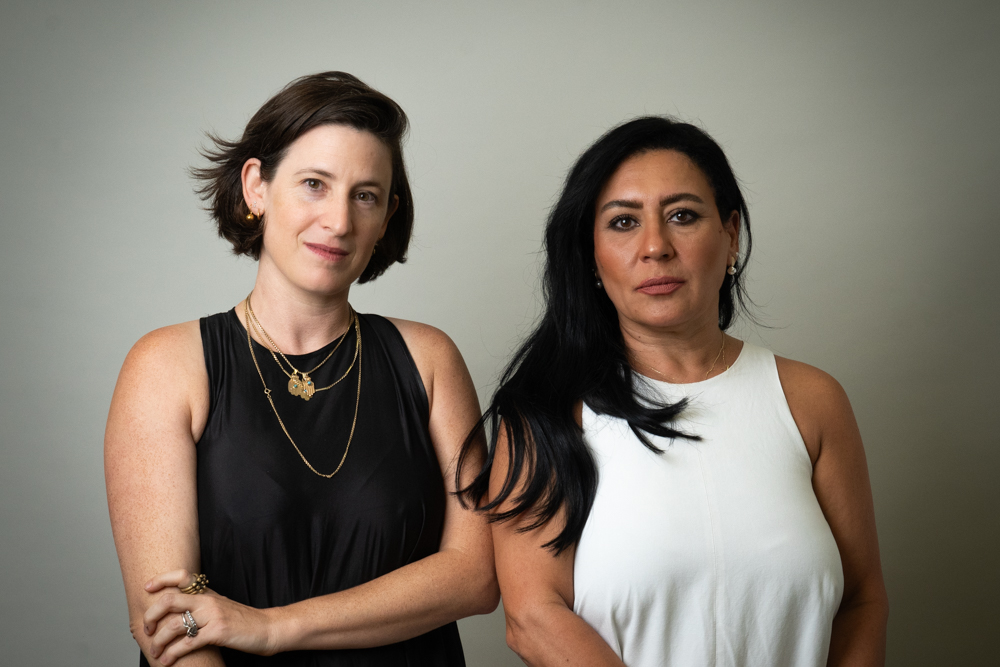
May Pundak and Rula Hardal have a vision of a two-state solution for the Israel-Palestinian conflict. It simply isn’t the one you may have in mind.
Historically, when there’s talk of an independent Israeli state and an independent Palestinian state, it is centered around two countries existing separately without much integration and coordination. That’s not the way Pundak and Hardal see it.
The two are co-directors of A Land for All, an organization whose members believe it’s possible for Israel and a Palestinian state to exist as “two sovereign states,” but “one shared homeland.”
Congregation Dor Hadash is bringing A Land for All to Pittsburgh on May 13 at 7 p.m. at Rodef Shalom Congregation.
A Land for All’s website envisions a “confederal model, grounded in international law, local needs and hard-earned lessons from failed negotiations.” It proposes a future “built with both peoples — not at the expense of either of them.”
Pundak, an Israeli human rights attorney who lives in Israel and is the daughter of historian and journalist Ron Pundak, one of the architects of the Oslo Accords, said the best example of the model is the European Union.
“Think about France and Germany,” she said. “There is no question that they are two separate, independent sovereign states. There are two different governments, two different legal systems, two different economies, two different internal issues to different states, but they work under a shared framework that takes into account that the issues that they share deserve attention to such a degree that it needs another layer of system of shared institutions.”
A Land for All, she explained, believes that Israelis and Palestinians have shared needs, including a strong economy and security.
“If Israel and Palestine have completely separate states and Palestine has a failed economy, there’s going to be no safety or security for Israelis,” she said. “You need to find mechanisms that ensure the shared interest of the stability and sustainability of a peace agreement.”
It starts with the 1967 borders and a shared Jerusalem, she said, but would gradually grow to include a porous border with freedom of movement and residency.
“There will be a border, but it will hopefully move towards a porous border where people can move freely,” she said. “So, folks from Ramallah could visit Haifa.”
Hardal, a political scientist who lives in Ramallah, said the fate of Israel and the Palestinians is even more intertwined than France and Germany, on a much smaller piece of land. Both groups, she said, have an emotional connection to the land.
“Our starting point is, yes, two separate sovereign states with shared institutions to take care of things that we jointly have to take care of, like the European Union. Then, also there’s a paradigm shift between separation and segregation and walls to partnership, shared interests and a sense of belonging to the whole land,” she said.
Hardal said A Land for All wanted to respect the history of the two peoples and the ongoing support of the international community when crafting their plan and didn’t want to invent something new.
“We considered the framework of having a confederation and shared institutions between the two states and offering this creative freedom of movement and citizenship and residency,” she said. “All Jews and Palestinians will have the feeling — despite their legal status in Israel and Palestine — of freedom and owning the whole land.”
Neither Israelis or Palestinians, she said, are naive regarding the challenging nature of the task and the reality on the ground. They’re also aware that any two-state solution requires governing partners. Israel has a system in place, begging the question: Who would the Israelis work with in a Palestinian state?
Hardal said that both Hamas and the Palestinian Authority — groups she called “weak, “corrupt,” and “not professional” — are recognized by the international community as governing the Palestinians. The Palestinian Liberation Organization still has some sway, as well, she added.
“The Palestinian people will decide who are their leaders — if we like them or not. It’s the same conversation about the regime in Iran,” she said.
Pundak said the response to their plan from many in Israel has been “shock” and “disbelief” that there is a viable option available, one in which they can help take ownership and agency over the situation.
“For many people, there is this feeling of like, ‘Wow.’ For others we’re perceived as moving from politically naïve to politically relevant. The transformation has been going on for the last few years. We’re backing it with research and policy and experts, with international support and Palestinian partners,” she said.
Hardal said the reaction has been similar among Palestinians — but she labeled Israel’s reaction to Hamas’ Oct. 7 terror attack a “genocide,” a claim widely disputed by genocide scholars and most mainstream Jewish organizations. According to the American Jewish Committee, “few claims are more offensive and blatantly wrong.”
“The situation here in Israel, in Palestine, since Oct. 7, and the ‘genocide’ in Gaza and what’s going on with the ongoing violence and disposition of Palestinians in the West Bank. We don’t have any illusions. We live in our communities, and we know the different perspectives,” she said.
Still, she said, many Palestinians believe A Land for All’s plan is better than the alternative, classic two-state solution.
Pundak said the organization is building partners in the U.S. and international community.
Beyond borders and governments, individual opinions and beliefs will also need to be aligned, something Pundak said Hardal helped her with when she joined A Land for All.
Hardal said she doesn’t shy away from using words like “genocide” or “occupation” in conversation but, as a pragmatist, it’s more important to deal with the specific national interests of the people and the political vision that is needed.
“We can choose other words, nicer words, but the reality on the ground — and we live it every day, all of us Jews and Palestinians — is very hard,” she said.
In the end, Pundak said, it comes down to individuals willing to work for peace.
“We are an organization that offers something positive, but I am not a human rights organization. I do this for my family. I think that’s the strength and the authenticity of our work. We’re excited to build new partnerships and friends in Pittsburgh who are choosing to not give up and think outside of the box. We need to listen to the people on the ground who are doing the work and we need to find something that we can identify with on a pragmatic level,” she said. PJC
David Rullo can be reached at drullo@pittsburghjewishchronicle.org.
comments