
‘Time and the River’ is a historical poetry collection for the ages
Tim Miller's new poetry collection stretches epochs
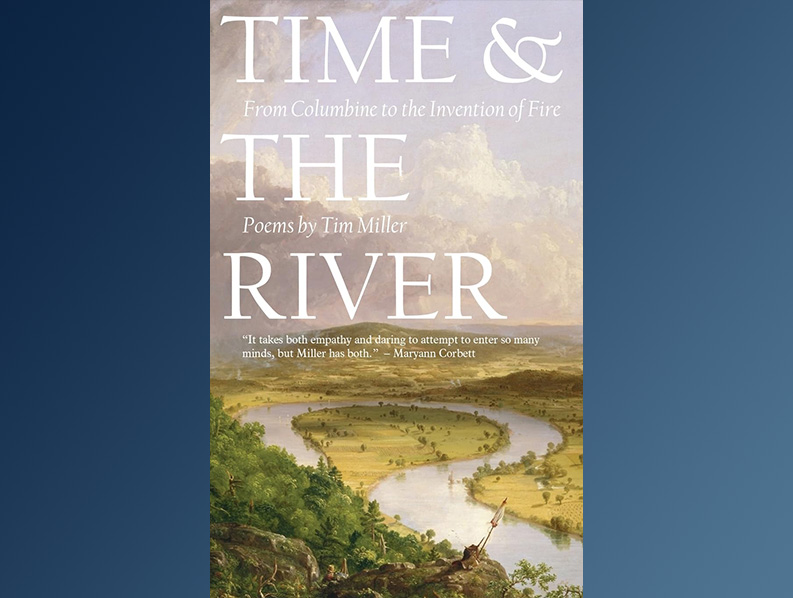
As a genre, historical poetry has an uphill battle.
It’s not often placed in bookstore endcaps or featured in magazines and podcasts unless it’s tied to a specific event, like Black History Month or the Fourth of July, for instance.
By most readers, it’s considered the red-headed stepchild of modern and romantic poetry. The former is a favorite of academics who enjoy spending time contemplating their navels, the latter bought by husbands and boyfriends to be gifted accompanying a box of chocolates. Historical poetry often gets a bum rap, seen as too subjective and impersonal to be of much use in the current world.
That, however, didn’t stop poet Tim Miller from crafting an entire collection of historical poetry.
“Time and the River: From Columbine to the Invention of Fire” is comprised of 52 poems, covering various historical guideposts, including Iron Age burials, Israelite prophets, the Cold War, Columbine, Michelangelo and Shakespeare, to name a few.
Taken as a whole, the collection accomplishes what Thomas Wolfe’s main character attempts in a novel sharing a title with Miller’s work: It finds meaning, belonging and direction in the world. The search crosses millennia and epochs, identifying new ways to connect with topics one might more often expect to find in Ph.D. dissertations than poetry collections.
Miller opens the book with “Dylan Klebold’s Crush,” and while many might have trouble identifying with a mass shooter, most readers will have no problem making a connection with a high school girl who was the crush of a boy whose two paths have taken vastly different turns in life.
Similarly, in “Merlin,” Miller twists the camera’s focus from Camelot or Guinevere, recycled so often in myth and fantasy, to a man contemplating the passage of time and his body.
“Time and the River” ends with “Fire,” the oldest subject contemplated by the poet. The work touches on several familiar themes, like the use of the subject to cook or stay warm, but also some less discussed notions:
“When did a flood of first engulf
A place where we lived, met, or just loved”
Or, later:
“When was the first hearth, like some landed star
That lit up the night and kept us all warm,
Extending our time together and giving
Us the excuse to fill it with stories?”
Scattered throughout the collection are several poems with Jewish themes.
In “Europe, 1941-1945”, Miller writes about the Holocaust, and the writing is as plaintive and filled with emotion as much of the work written in literature that has contemplated the tragedy and human expense of the 6 million murdered.
“Ezekiel” takes a personal look at the prophet, who is “broken-hearted at forty-three.”
“I am white-chested at forty-three.
I am forty-three and tired of memory.”
Thoughts more expected to be spoken by a father who has weathered the storms of everyday life than one of the most significant biblical prophets.
Moses, Jacob and Abraham are all portrayed in similar ways — as men and people rather than religious patriarchs who may be difficult for some to identify.
And that, perhaps, is the hidden trick of Miller’s book and poetry: He makes us identify and care about subjects and people far outside our current lens.
In “Time and the River”, Miller hasn’t written a collection of poetry that will be pulled out for specific holidays and then tucked away for the remaining 364 days each year. Instead, he’s done what good poets do: crafted interesting poems that make one ponder the state of man and his or her place in the world. It’s a worthy read that deserves to be added to anyone’s poetry shelf. PJC
David Rullo can be reached at drullo@pittsburghjewishchronicle.org.
comments