
‘Sons and Daughters’ takes us back to an obliterated world
“Sons and Daughters” presents the full catalogue of movements and identities that roiled the Jewish world in the 1920s and ’30s.
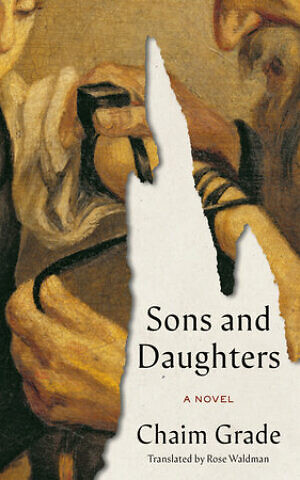
“Sons and Daughters”
By Chaim Grade
Translated by Rose Waldman
Penguin Random House, 704 pages
One of the saddest aspects of being Jewish is feeling disconnected from history.
Even if you know the names of your great-grandparents, there is no returning to their ancestral homes, generally speaking. Few remnants of the shtetl remain. Go back three or four generations, and, more often than not, there’s a gaping black void.
Fortunately, Penguin Random House and translator Rose Waldman have come to our aid with the publication this year of “Sons and Daughters,” the magnum opus of Yiddish novelist Chaim Grade.
At the center is Sholem Shachne Katzenellenbogen, the elderly head rabbi of a Polish shtetl. His children vex him, as, one-by-one (with one exception), they abandon his halachic lifestyle to pursue modern ambitions.
The specter of the looming Holocaust lurks throughout the novel, but the characters don’t have the benefit of our hindsight as they experience the rising tide of antisemitism in real time. Amid the pogroms and boycotts, they still find ample bandwidth to confront family dysfunction and to passionately debate issues of Jewish continuity, identity and theology.
Grade was studying in a yeshiva in Lithuania during part of the interwar period. Although he ultimately left the yeshiva to become a writer and immigrated to the United States, he retained a strong emotional connection to his former community.
Two decades after the war, he took on the burden of recreating the world that he left behind — and that the Holocaust obliterated — in full-color detail.
With this novel, Grade posthumously joins I.B. Singer and Sholem Aleichem in the pantheon of the 20th century’s greatest Yiddish authors, in my estimation.
But the novel owes debts to the Russian literary masters. The title of the book is a nod to Ivan Turgenev’s “Fathers and Sons,” a classic about intergenerational conflict. It is Fyodor Dostoevsky, though, who Grade truly emulates.
The influence of Dostoevsky’s opus “The Brothers Karamazov” is obvious. The rabbi’s eldest son, Naftali, bears a strong resemblance to Ivan Karamazov. Both of them are tortured souls, torn between secular reasoning and spiritual longing. Similarly, the rabbi’s youngest son, Rafaelke, reminds me of Alyosha, the youngest Karamazov. Both of them are beloved by their entire contentious families.
Grade also follows Dostoevsky stylistically. Most of the characters operate in a constant state of agitation and anguish. And they are not shy about launching into extended monologues.
“Sons and Daughters” presents the full catalogue of movements and identities that roiled the Jewish world in the 1920s and ’30s. In addition to our ultra-Orthodox rabbi and his daveners, we find Zionists, Communists, secularists, merchants and emigrants to America, along with Modern Orthodox and Reform Jews. There is even a character who flirts with Nietzscheism.
Young Jews had options, like never before in history, and much to the chagrin of the rabbi, his children responded to the pull of this newfound freedom.
The novel doesn’t have a plot, or even an ending. Grade died before he finished it. Nonetheless, it rises to an apex of sorts over the final three chapters.
In one sequence, Naftali and his sister’s fiancé, Klavneh, spar at the Shabbos table over the root causes of Jewish survival and continuity. Naftali attributes our continued existence to the tangle and rigidity of Jewish law, which has set us apart from other nations. Klavneh points toward our Prophetic tradition, our ethics, morality and love.
Grade wrote himself into the novel as Klavneh, an aspiring Yiddish writer, so you know where the author lands in the debate. But many readers will side with Naftali. In the spirit of Dostoevsky, Grade presents both arguments in good faith and with full force.
In these days of ideological polarization, within both the Jewish community and our nation, the even-handedness of “Sons and Daughters” is a breath of fresh air.
In the final chapter, Klavneh meets Zalia Ziskind, an aging, hunchbacked rabbi and friend of the family. Ziskind embodies the sense of tragedy that hangs over the entire novel. He tells Klavneh that he saves old Warsaw newspapers to revisit the accounts of people killed in mishaps and accidents.
“I’ve been asking God terrible Job-like questions about His management of the world, and I never got an answer,” Ziskind says.
Those unanswered questions multiplied after the Holocaust.
The characters we meet in “Sons and Daughters” could not foresee the Shoah. They squabble and scheme. They have arguments and ambitions. Moments of doubt and despair. Some success, mostly failure.
In the end, it was all for naught. Most of them would have been murdered just a few years after the final chapter. Shabbos-keepers and secularists would have all met the same fate. But at least we got to know them.
They weren’t our actual ancestors. But, chances are, people quite similar to our great-grandparents live somewhere in “Sons and Daughters.” And for that, we owe Grade, Waldman and Penguin our gratitude. PJC
Jeffrey Spitz Cohan is a writer who lives in Forest Hills. His work can be found on Substack at inalignment.substack.com.
“Sons and Daughters” is the Chronicle Book Club’s pick for its Oct. 19 meeting on Zoom. Register at drullo@pittsburghjewishchronicle.org and write “Chronicle Book Club” in the subject line.
comments