
Richard Swartz has spent more than four decades with Bloomfield Garfield Corporation
Organization has worked to fill ‘the hole in the doughnut’ in East End neighborhood
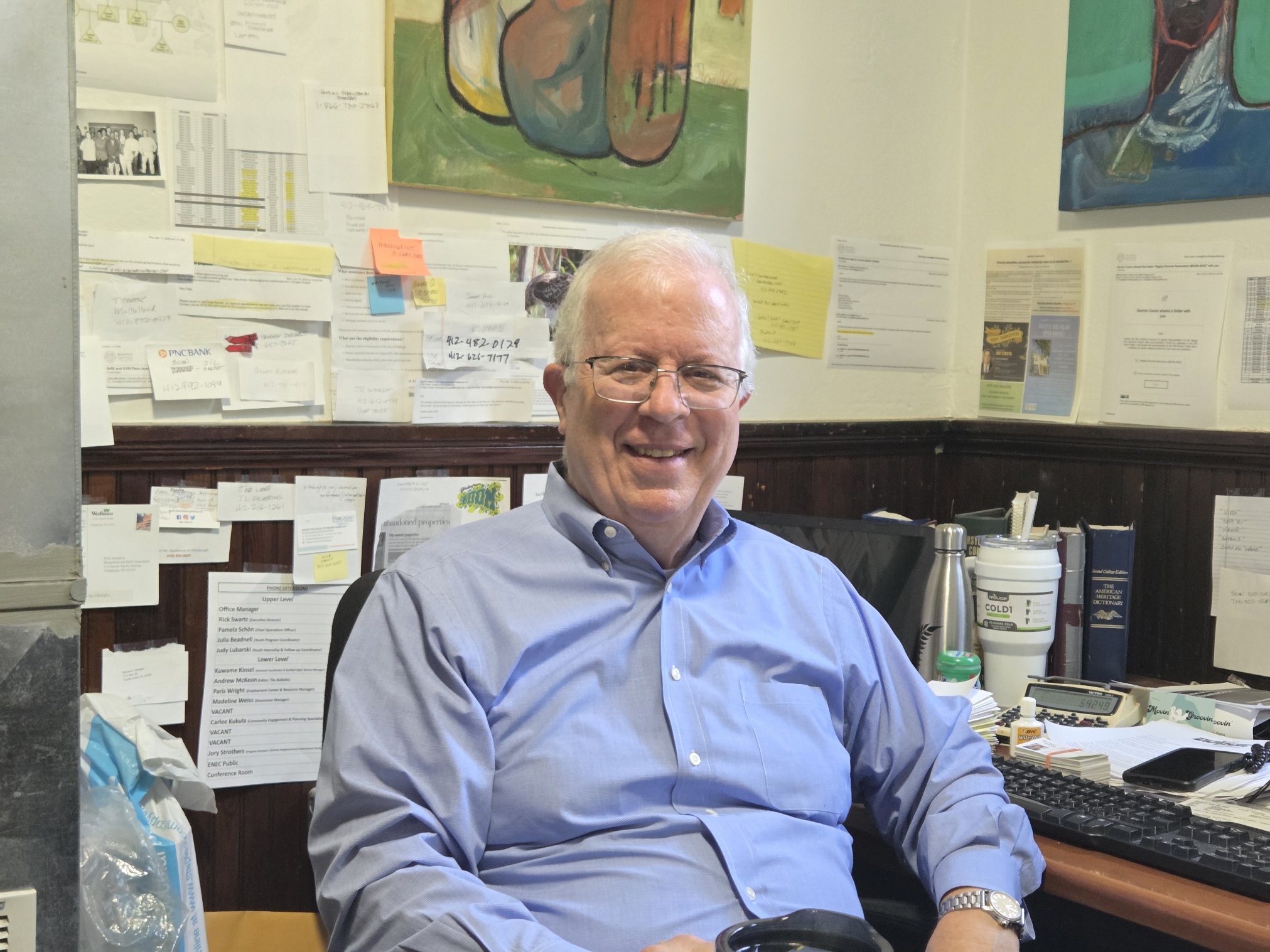
When Richard Swartz was hired as the commercial district revitalization specialist for the Bloomfield Garfield Corporation in 1981, the East End neighborhood was often referred to as “the hole in the doughnut,” he recalled.
“Morningside, Stanton Heights, Lawrenceville, Bloomfield were all surviving fairly well,” Swartz said, “but Garfield was taking a major hit from abandonment in both the residential and commercial areas, and then the surging crime rate was accompanied by economic decline.”
In fact, he said, when he began his work with the nonprofit, it wasn’t clear that it would be successful in helping the East End neighborhood recover from the collapse of the area’s steel mills and related industries.
Pittsburgh, Swartz noted, had a history of demolition in distressed neighborhoods, citing the Lower Hill District, which was razed to make way for the Civic Arena.
“I think they were prepared to do that in other neighborhoods,” he said. “You can go to Larimer and see the effects of widespread demolition.”
Swartz knew that for Garfield to appear as a viable neighborhood it had to reinvent its business district along Penn Avenue. First, though, the city had to be convinced to take a chance on the Bloomfield Garfield Corporation as a partner with a vision for eliminating blight and addressing public safety.
“We convinced the city to give us funding so we could start new housing development,” said Swartz, who in 1986 became the executive director of the organization, a position he still holds. “The attempt was to take vacant lots that had been created from years of demolition and build single-family standalone houses, to replicate the success of the suburbs.”
The plan worked. The Bloomfield Garfield Corporation secured enough funding from the city to rehab four lots, found a home builder who had built single-family homes in Manchester and built Ryan Homes-style houses, which sold for a little more than $59,000.
Homebuyers, Swartz said, got additional financing from the Urban Redevelopment Authority, meaning a mortgage might be as little as $30,000 in 1983.
“They had a house that was modern and energy efficient,” he said.
Eventually, the BGC began rehabbing homes in the neighborhood, which had more than its share of vacant properties.
Dubbed “Rehab for Resale,” the program was aggressive, Swartz said, and included secondary mortgage funding to make the homes affordable for families.
By the early 1990s, BGC began setting its sights on the Penn Avenue business district.
“We knew that with any neighborhood, your commercial district is your front door to the community, so we started acquiring commercial buildings from private owners who were leaving the neighborhood thinking that it might not have any future,” he explained.
There were times BGC paid as little as $10,000 to acquire a building.
The organization started a rehabilitation program, creating commercial storefronts on the first floor and residential units on the buildings’ second and third floors.
By the early 2000s, Swartz said BGC was collaborating with another organization, the Friendship Development Corporation, to buy buildings from Negley Avenue to Matilda Street. The idea was to rehabilitate the buildings and attract artists and related businesses to the storefronts.
As Swartz explained it, the idea of attracting traditional businesses to the neighborhood probably wouldn’t work.
“That ship had sailed,” he said. “If we could get a coffee shop or small restaurant, fine. We decided to turn to the artist community and the community of architects and see if we can bring them to Penn Ave.”
The plan, he said, was a “stroke of genius” from BGC’s partners in Friendship, who had more ties with the artist community.
“They came out of their garages, they came out of their basements, and they relocated to Penn Avenue,” he said.
“Unblurred: First Fridays on Penn Avenue” was created to highlight the new community; it’s the city’s oldest art crawl.
Swartz said the community began attracting people outpriced in neighborhoods like Lawrenceville and Shadyside.
Mr. Roboto — a volunteer-run show space and art gallery — is an example of the type of business that moved into the neighborhood.
“We bought the building where Roboto is now located,” he said. “It was a bar. We sold the liquor license because we weren’t interested in running a bar. We renovated the building and eventually Mr. Roboto approached us. That’s the market we want to attract to the street — the Gen Xer. Let the millennials go to Shadyside; we want the Gen Xers.”
Other examples include the Pittsburgh Glass Center and Commonplace Coffee.
The plan worked. Some homes can now sell for as much as $400,000 — a far cry from the prices they were going for when Swartz first started with the BGC, but still under the $600,000-plus price tag of many homes in Lawrenceville and East Liberty.
BGC, he said, is working to ensure the community stays “mixed income.”
BGC, Swartz said, is invested in the community. The organization helps individuals who may be having a hard time paying bills or have unexpected expenses. It also holds those in the neighborhood accountable.
“If you’re a landlord in Garfield and your house is rotting from the inside, and we find out about it, we’re going to call you on it. If you’re a business owner selling alcohol to minors, we’re going to call you on it. If you’re dumping debris down the hillside, we’ll call you on it.”
In short, he said, the whole of the neighborhood is the sum of its parts.
It’s something Swartz has believed in since he first came to BGC in 1981 from the McKeesport nonprofit housing agency, Housing Opportunities, which he joined after graduating from the University of Pittsburgh.
The Youngstown native has lived in the Pittsburgh region all but one year of his professional life, when he spent time in Washington, D.C. He’s lived with his wife, Laura Swiss, and two, now-adult, children in various Pittsburgh neighborhoods, including Squirrel Hill, East Liberty and Garfield. The couple now live in Friendship and are members of Beit Kulanu, where Laura serves on the congregation’s board.
Swartz called himself a “firm believer” in the idea that faith must translate into action.
“Where I get a little frustrated sometimes is when I see people espouse a set of beliefs when they’re in that building on Fifth Avenue, but when they leave, they quietly forget what it was that was imparted at a service. Faith without action is just kind of empty,” he said.
It’s a belief that carries over into his professional life, as well.
“If we’re to have a community here in the Garfield-Friendship-Bloomfield neighborhood, it has to be one of acceptance, tolerance and that allows for different political expressions,” he said. “Not everybody has to be liberal or progressive or conservative. We can entertain everyone under the same tent. We can all have different beliefs as long as we agree on one thing: that we have to be responsible as adults and be accountable to one another.” PJC
David Rullo can be reached at drullo@pittsburghjewishchronicle.org.
comments